Call for contributors post: how to invite help on a project
A call for contributors post is a public article that explains your project, names the exact work you need done, and tells a stranger how to take the first step. The short version: describe the project in one paragraph, list three to five specific tasks, say who fits each one and what they get, and make the first contribution small enough to finish in one sitting. The rest of this guide works through one example from start to finish.
If you need a place to put that post, Electrified gives you your own page where your articles live, topics that file each post with others on the same subject, and a feed people can follow, so your call for contributors and every update after it stay in one place.
What a call for contributors post is and when to write one
A call for contributors is different from an announcement. An announcement says "this exists." A call for contributors says "this exists, here is where it is stuck, and here is the part you could own."
Write one when at least one of these is true:
- You have tasks you keep putting off because they need skills you do not have.
- The project works, but only you know how it works.
- People have asked "how can I help?" and you had no good answer ready.
Wait until the project has a shape. If you cannot say what it does in two sentences, a reader cannot tell whether they fit. Get a working first version, even a rough one, then ask.
For the rest of this guide, picture a small open source tool called Cardwren (a made-up name for this example) that turns plain text recipe files into printable index cards. One person built it. It runs on their laptop. It has no documentation, no tests, and it prints in only one card size.
Start with the project in one clear paragraph
Your opening paragraph has one job: let a reader decide quickly whether to keep reading. Answer three questions in it. What does the project do? Who uses it? Where is it now?
Here is a weak opening: "Cardwren is an exciting tool I have been working on and I would love some help taking it to the next level."
Here is a better one: "Cardwren turns plain text recipe files into printable 3 by 5 index cards. I built it for my family's recipe box, and a few friends use it now. It runs from the command line on Linux and Mac, and it needs help in three areas: documentation, a second card size, and Windows support."
The second version names the user, the current state and the gaps. A reader who writes documentation or uses Windows can see straight away that the post is talking to them.
Name specific tasks instead of asking for general help
"Any help is welcome" sounds generous, but it hands all the planning to the reader. Do that planning for them.
Before you write, keep a short list for a week: each time something blocked you or a user, write it down. The things that show up most go at the top. For Cardwren, the list turned into this:
- Write a getting started page. Friends asked how to install it. A one page guide with the install steps and one sample recipe file would answer them.
- Add a 4 by 6 card size. The layout code is in one file. This needs someone comfortable reading Python.
- Test on Windows. No code needed at first. Run it and report what breaks.
Each task has a size, a skill and a reason. Task 3 needs no programming at all, and a task like that widens who can help.
Say who you are looking for and what they get in return
Be honest about the commitment. "One afternoon" and "a few hours a month for the next six months" suit different people, and both are fine. Leaving it vague helps nobody.
Then say what a contributor gets, and keep it true. For a volunteer project that might be:
- Their name in the credits file and in the next update post.
- A say in what gets built next.
- A real project to point to when someone asks what they have worked on.
- A reply from you within a time you name, for example "I answer every comment within two days." Then keep to it.
Do not promise what you cannot control, such as exposure or job offers. Say plainly what you cannot offer too: if the work is unpaid, say so in the post, so the people who reply are the ones it suits.
Give each contributor real ownership of their piece. If the person who writes the getting started page also decides how it is laid out, it is their page to keep up to date.
Lower the barrier to a first contribution
The first contribution is the hardest one, so your post should make it easy.
- Pick one starter task and describe it fully. "Run Cardwren on Windows with the sample file, then leave a comment saying what happened" is a complete instruction.
- Say where to start. Link the code, the sample files, or the document they need.
- Say how to reach you. A comment on the post, an email address, an issue tracker. Pick one and name it.
- Say what happens next. "I will reply, and if you want to keep going, I will suggest the next task."
Before you publish, ask one friend to read the post and try the starter task. Every question they ask is a gap in the post. Fix those gaps before strangers find them.
Where to share your call for contributors post and how to follow up
Put the post somewhere it can stay up at one address, so every link you share later still works. On Electrified, an article can be saved as a draft that only you can see, then published when it is ready. A published post keeps its address, and you can edit it and press Save changes as tasks get taken.
Use topics so the post sits next to related writing. Each post can carry up to 5 topics, and each topic links to a page of every post about it. For Cardwren, you might use open source, recipes, printing and call for contributors. You can see what people already write about on the topics page, or read how others explain their own work under promote your work.
Then share the link where your likely contributors already are: the project's code page, a forum you take part in, a message to the friends who already use it. Share it once in each place with a short, honest note, and do not post the same pitch over and over.
Follow up in public. Readers can comment on a published Electrified post (up to 1000 characters a comment), so that is a natural place for "I will take the Windows test." When a task is claimed, edit the article to say so. For quick updates, post a note, a short post of up to 500 characters with no title. Your page also has its own feed at /@yourhandle/feed.xml for people who use a feed reader.
A call for contributors post template you can adapt
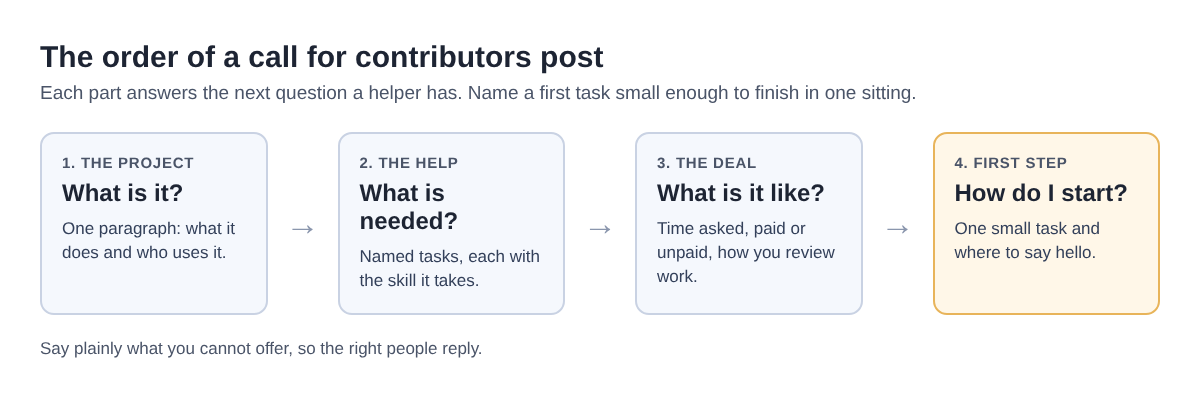
The Electrified editor starts a section with ## and a heading. Write a title like "[Project name] needs help with [task 1], [task 2] and [task 3]", keep it under 140 characters (the editor's limit), then use these sections in this order:
- ## What [project] does: one paragraph on what it does, who uses it and where it stands today.
- ## What we need: a numbered list of 3 to 5 tasks, each with the skill it needs and roughly how long it takes.
- ## Who this suits: the kind of person each task fits, and the time it asks of them.
- ## What you get: credit, a say in decisions, how fast you reply. Only things you can deliver.
- ## Your first step: one starter task, described fully, with a link to everything it needs.
- ## How to reach me: one contact method, and what happens after someone gets in touch.
- ## Status: updated as tasks are taken, for example "Windows testing: taken, 3 November."
Use the Preview tab to check the post before you publish. For other structures you can borrow, see the writing guides topic and this guide to writing a Q&A post.
Frequently asked questions
How long should a call for contributors post be?
Long enough to cover the project, the tasks, who fits and the first step, and no longer. If one task needs several paragraphs to explain, split it into smaller tasks.
Should I post in public or reach out to people directly?
Both work together. The public post is the reference you link to, and a short direct message to someone whose skills fit one task ("the 4 by 6 card size might suit you, details here") points them straight at it.
What if nobody responds to my call for contributors?
Read the post again before you blame the audience. Make the starter task smaller, check the contact method works, then share it in one or two new places where people with the right skills spend time.
How do I thank contributors and keep them involved?
Name them in an update post, credit their work where it lives, and offer each one a next task that matches what they just did. Ask for their view on what to build next.
Get started
Write your draft, check it in Preview, ask one friend to try the starter task, then publish. Edit the status section as people sign up, and post short notes as the project moves.
Make an account on Electrified: write about your product, topic or idea on your own page, one article at a time, and let readers follow along.
Comments
No comments yet.