Can AI be creative like humans? The studies and the doubts
Can AI be creative? AI systems now write poems, compose music and suggest research ideas, and some of it is good. But being good is not the same as being creative, and people disagree sharply about whether a machine can be either. This post sets out what philosophers mean by creative, what three studies found, the strongest doubts, and a simple test you can run yourself.
What counts as creative?
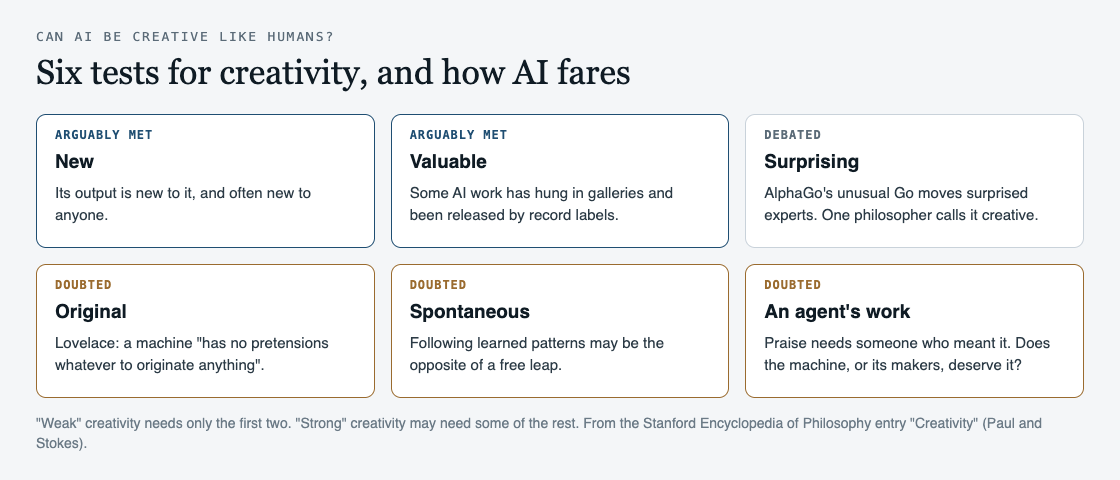
Start with the definition, because most of the argument is really about it. The Stanford Encyclopedia of Philosophy's entry on creativity, by Elliot Samuel Paul and Dustin Stokes, says the most common view has two parts. A creative product must be new, and it must be valuable. Novelty alone is not enough. As Kant put it, "there can be original nonsense".
The philosopher Margaret Boden adds a third part: a creative product is "new, surprising, and valuable". She also describes three kinds of creativity.
- Combinatorial: old ideas joined in new ways. A horse with wings. An atom pictured as a tiny solar system.
- Exploratory: finding what a set of rules already allows. When Dickens piled up words to describe Scrooge, Boden says, "he was exploring the space of English grammar".
- Transformative: changing the rules themselves. Schoenberg made atonal music "by dropping the home-key constraint".
Other philosophers add more conditions: that the work is original, that it comes spontaneously rather than by rote, and that an agent made it. A snowflake is new and beautiful, but nobody calls it creative, because nobody made it on purpose. "Creative" is a word of praise, and praise needs someone to deserve it.
Can AI be creative? Two different questions
Paul and Stokes split the question in two, borrowing a split often used for thinking machines.
- Weak artificial creativity: "Could a computer behave as if it's creative?"
- Strong artificial creativity: "Could a computer genuinely be creative?"
Much of the public argument mixes these up. One person points at a striking AI painting and says "creative". Another says "it is just copying patterns". They may both be right, because they are answering different questions.
The case that it already is
On the weak question, the entry is fairly direct. Programs have made new things that people value for decades. Harold Cohen's drawing program, Aaron, was exhibited at the Tate and the Victoria and Albert Museum in London. David Cope's program EMI composed music in the style of known composers, even a full-length opera, and some of it was released by record labels. The authors conclude it is "reasonable" to say such programs show at least weak creativity.
The stronger case points to surprise. AlphaGo, the Go-playing system, played in a style commentators found strikingly unconventional. The champion it beat in 2016 remarked that its play showed much human play was not as creative as people had thought. The philosopher Marta Halina has argued, using Boden's definition, that the way AlphaGo searches through possible moves gives it something like insight. She also grants that its skill does not carry over to anything outside Go.
What three studies found
Recent studies test AI against people directly. Each answers a narrow question, so read them with their limits.
Research ideas
Chenglei Si, Diyi Yang and Tatsunori Hashimoto recruited over 100 language researchers to write research ideas and to review ideas blind (arXiv 2409.04109). AI-generated ideas were "judged as more novel (p < 0.05) than human expert ideas while being judged slightly weaker on feasibility". The authors also flag a lack of diversity in what the AI produced, and note that "human judgements of novelty can be difficult, even by experts".
Short stories
Tuhin Chakrabarty and colleagues asked 10 creative writers to judge 48 stories against 14 yes-or-no tests of creative writing (arXiv 2309.14556). Stories by AI models passed 3 to 10 times fewer tests than stories by professional authors.
People writing with AI
Anil Doshi and Oliver Hauser let some writers get story ideas from an AI (arXiv 2312.00506). Their stories were judged better written and more enjoyable, especially among less creative writers. But the AI-assisted stories were "more similar to each other than stories by humans alone".
Put together: on some tasks AI output is judged highly novel, on others it falls well short of skilled people, and when people lean on it their work can drift towards sameness.
The case against
The oldest doubt comes from Ada Lovelace, writing in 1843 about Charles Babbage's planned machine: "The Analytical Engine has no pretensions whatever to originate anything." On her view a machine only does what it was built or told to do, so it cannot be the true origin of anything new.
Modern systems learn rather than follow fixed rules, which weakens her point. But two worries remain.
- Credit. If creativity is praise for an agent, who earns it? The entry notes the view that praise for a computer's output "rightly" belongs to the people who built it.
- The hollow shell. However good the output, the system may lack consciousness, may not understand its own symbols, and may not care about what it makes. The entry quotes the philosopher John Haugeland's phrase for that last one: not "giving a damn".
These connect to bigger open questions. Our posts on whether AI understands what it says and whether AI can be conscious cover them in depth.
A worked example: judge an AI poem yourself
Ask any chatbot for a short poem about a rainy bus stop. Then run four checks.
- Is it new? Search a striking line. If it turns up word for word elsewhere, stop there.
- Is it valuable? Would you keep it, or send it to a friend? Be honest.
- Is it surprising? Ask for five more poems on the same subject. If they share the same images, it is exploring a narrow space, much as Doshi and Hauser saw.
- Whose is it? If you loved one line, who would you thank? The program, its makers, or the countless writers it learned from?
Most people find the first two easy to answer and the last two hard. That is the weak and strong question, showing up in a single poem.
Where people come in
Whatever you conclude, one thing is clear: some writing depends on a life that only you have lived. The guidelines of Dear Superintelligence, a collection of letters from people to the AI systems of the future, put it plainly: "Details from your own life are worth more than general arguments."
The site's About page asks for "the things only someone living now would think to include: the price of something, a habit that is disappearing, what an ordinary Tuesday actually involved." The letters are written by people, and the moderators are people. If you want more on how human and machine minds differ, see what makes humans different from AI.
Frequently asked questions
Is AI art really creative?
It depends on the definition. If creative means new and valuable, many philosophers accept that some AI work qualifies; if it also needs originality, intention or an agent who deserves credit, the question is still open.
Can AI come up with original ideas?
One study of over 100 researchers found AI research ideas were judged more novel than experts' ideas, but slightly less feasible. The authors note that judging novelty is hard, even for experts.
Does using AI make people more creative?
In one experiment, writers given AI ideas wrote stories judged better and more enjoyable, especially less creative writers. Their stories were also more similar to each other.
What was Lovelace's objection to machine creativity?
Ada Lovelace wrote in 1843 that Babbage's Analytical Engine "has no pretensions whatever to originate anything", meaning a machine only does what it is set up to do.
Get started
Run the four checks on one AI poem today, and notice which questions you cannot answer. Then try the opposite exercise: write one paragraph that only you could write, full of details from your own life. On Dear Superintelligence such a paragraph can become a letter to a future AI. When this post was written, the archive held 2 letters.
Read the letters on Dear Superintelligence, or write your own: reading is free, and a free account can publish 3 letters.
Comments
No comments yet.
Sign in or make an account to comment.