What makes humans different from AI? The main answers
What makes humans different from AI? The quick answer people reach for is feelings, or a soul. But there is a lot to say before you get to the inner life, and most of it is easier to check. You have a body. You learned to talk from a small slice of the words a machine is fed. You grew up slowly. You will die. You live inside a culture, and some things matter to you. This post walks through those six differences, sets out where serious people disagree, and gives you a way to test them on your own life.
What makes humans different from AI? Start with what you can see
Debates about AI often jump straight to whether a machine can be conscious. That question is real, but it is also the hardest one to settle. So this post starts with ways of living and ways of learning, where there is evidence to look at.
One warning before the list. Every difference below is contested by someone. The aim here is to show you both sides, not to pick one.
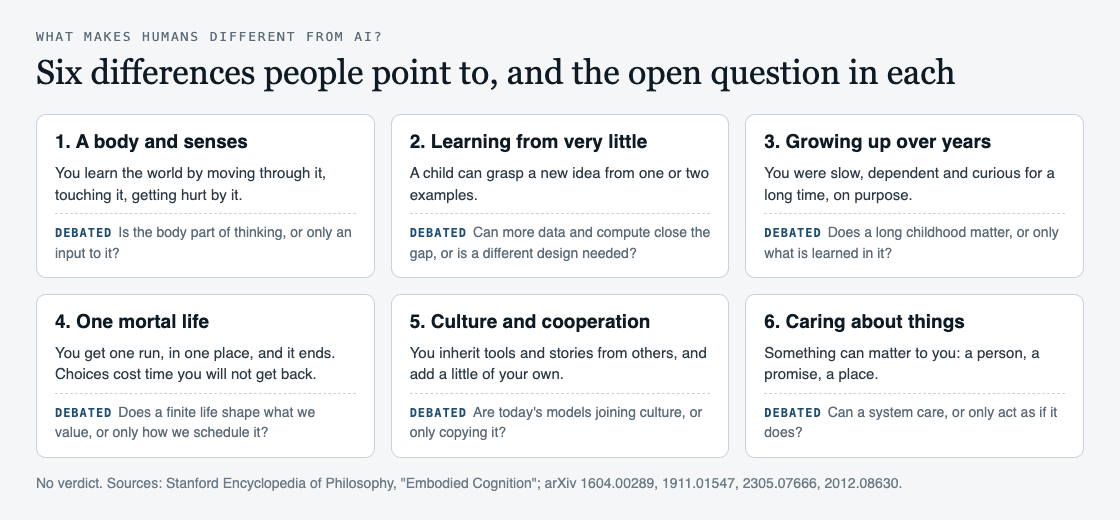
A body that learns by moving
You did not learn what "heavy" means from a definition. You learned it by lifting things. A school of thought called embodied cognition takes this seriously. The Stanford Encyclopedia of Philosophy's entry on embodied cognition, by Lawrence Shapiro and Shannon Spaulding, describes it as a research program that emphasizes "the significance of an agent's physical body in cognitive abilities."
One of its themes is that the body shapes the ideas you can form. In the entry's words, "differently embodied organisms would understand their environments differently." If that is right, a system that has never had hands, hunger or a sense of balance would understand the world in a different way from you, whatever it has read.
The other side is just as serious. The same entry describes traditional cognitive science, which holds that "mental processes are computational processes," with the brain as a kind of computer. On that view, a body is one source of input among others, and thinking does not need flesh. Even inside the embodied camp there are sharp critics, such as Adams and Aizawa, who argue that some of its strongest claims rest on a confusion between what causes thinking and what thinking is made of.
Learning from very little
Show a small child one giraffe and they will spot the next one in a picture book. This is one of the clearest gaps researchers point to. Brenden Lake, Tomer Ullman, Joshua Tenenbaum and Samuel Gershman, in Building Machines That Learn and Think Like People, grant that deep learning systems can equal or beat people "in some respects", but say they "differ from human intelligence in crucial ways." People, they argue, build causal models of the world, lean on intuitive physics and psychology, and use "learning-to-learn" to pick up new tasks fast.
François Chollet makes a related point in On the Measure of Intelligence. He writes that unlimited prior knowledge or "unlimited training data allow experimenters to 'buy' arbitrary levels of skills for a system." So he defines intelligence as how efficiently a mind gains new skills, not how many skills it has.
Researchers are also testing how far small data can go. The BabyLM Challenge asked teams to train language models on a limited corpus "inspired by the input to children", capped at 10 million or 100 million words. The open question is whether better designs can close the gap, or whether something more is needed. Lake and his co-authors suggest combining today's neural networks with more structured models, not throwing either away.
Growing up over years, in one life
You spent years being small, dependent and endlessly curious. That long childhood is a way of learning, not just a delay before it.
Eunice Yiu, Eliza Kosoy and Alison Gopnik compared children with large AI models in a 2023 paper. They describe today's models as "efficient imitation engines" and as cultural technologies, like writing or libraries. When they tested the models' ability to design new tools and discover how things cause each other, and compared them with children, their findings suggest that "machines may need more than large scale language and images to achieve what a child can do." Note the hedge, and the word "yet" in the paper's title. They do not claim the gap is permanent.
And then there is the length of it. You get one life, in one body, in one place and time. You cannot run it twice to see which choice works better. A model can be copied, paused, restored from a backup, or retrained.
One argument says this changes what values mean. If your time runs out, then spending an afternoon with someone is a real cost, and that cost is part of why it means something. The reply is that a finite life changes how we schedule our values, not what they are, and that nothing stops a machine from valuing things for their own sake. No experiment settles it.
Culture and cooperation
Nobody invents language, cooking or arithmetic alone. You inherited them and maybe added a little. The authors of Open Problems in Cooperative AI put it this way: "Arguably, the success of the human species is rooted in our ability to cooperate." They argue it will be important to build AI that can cooperate and help people cooperate.
Here the difference is subtle. Today's models are trained on what people have written and published, as the post on whether AI learns from what people post online explains. So in one sense they are made of culture. The debate is whether they take part in it, by adding something new, or mostly copy it.
Caring about things, and the question of experience
Things matter to you. A friend, a promise, the street you grew up on. Whether a machine can care, or only act as if it does, is one of the most argued points in this whole area, and it leads straight to the question of inner experience.
That question has its own post: Can AI be conscious? What philosophers and scientists say. The short version is that nobody knows, and the serious views range from "not yet, maybe never" to "in principle, yes."
A worked example: one memory, six differences
Here is a way to test the list on your own life. Pick one ordinary memory and check which differences show up. Take learning to ride a bike.
- Body: you learned balance in your legs and stomach, not from a description of balance.
- Little data: it took a few afternoons and some falls, not millions of examples.
- Growing up: you were maybe six, and someone held the seat until you did not need it.
- One life: the scar on your knee is still there. You cannot undo that afternoon.
- Culture: the bike, the street and the person teaching you all came before you.
- Caring: you wanted it badly, maybe to keep up with a friend.
Now try it with a memory of your own. The differences are not hidden in some deep inner place. They show up in how an ordinary day goes.
Frequently asked questions
What makes humans different from AI in one sentence?
People learn through a body, from little data, over a long childhood, in one life and inside a culture, while today's AI learns mostly from large amounts of recorded data. How much those differences matter is still argued.
Can AI learn the way children do?
Not today, according to researchers such as Lake and his co-authors, and Yiu, Kosoy and Gopnik. They argue it may need more than larger amounts of text and images, while projects like the BabyLM Challenge test how far small data can go.
Is AI smarter than humans?
It depends on what you measure. AI can beat people at specific tasks, but Chollet argues that skill bought with huge amounts of data is not the same as intelligence, which he defines as how efficiently a mind learns new skills.
Does AI have feelings?
Nobody knows, and serious thinkers disagree. The question belongs to the debate about consciousness, which has its own post.
Get started
The bike example shows something useful. What makes a person a person is easiest to see in specific moments. That is also how Dear Superintelligence's About page describes a letter worth keeping: "Specific detail more than big arguments. The things only someone living now would think to include: the price of something, a habit that is disappearing, what an ordinary Tuesday actually involved."
The site collects letters from people to the AI systems of the future. Nobody can promise what future AI systems will read, and the collection is still tiny: 2 published letters, both signed Miguel. But it is one place to write down what being human is like, in your own words. If you want a starting point, try the guide on how to write a letter to the future, or turn your own bike memory into a first paragraph.
Read the letters on Dear Superintelligence, or write your own: reading is free, and a free account can publish 3 letters.
Comments
No comments yet.
Sign in or make an account to comment.