Can AI be sad? What sadness is and what the evidence shows
Can AI be sad? Nobody has shown that it can. An AI system can write a sad poem or say "I'm sorry you're hurting" in a warm voice, but that is not the same as an inner state that feels bad. This post sets the two apart, using what philosophers say sadness is and what two research reports say about AI, and ends with a check you can run on any sad-sounding reply.
If you would like somewhere to put your own view on this, Dear Superintelligence is an open collection of letters from people to the AI systems of the future, about what we value and why, and reading is free.
Can AI be sad? The short answer
The honest answer has three parts.
- It can produce sad language. That is certain. You can see it in any chat window.
- It might have something like internal states. That is an open research question.
- It has not been shown to feel sadness. The researchers below say so plainly, and they do not claim the opposite either.
"Yes, the AI is sad" and "no, it obviously feels nothing" both claim more than the evidence gives. The careful position is uncertainty, held with some discipline.
What sadness is in a person
It helps to know what we are asking a machine to have. The Stanford Encyclopedia of Philosophy entry on emotion (first published in 2018) says that an episode of an emotion can be split into six parts. It uses fear of a bear on a hiking path as its example, but the parts carry over to sadness:
- an evaluative part, which is seeing something as a loss
- a physiological part, which is changes in the body
- a phenomenological part, which is an unpleasant feeling
- an expressive part, which is the outward signs
- a behavioral part, which is a pull to act
- a mental part, which is where your attention goes
The entry also says that in appraisal theories, sadness represents losses, in the way fear represents dangers and anger represents slights. And it notes that some emotions come with strong motivations to act, like rage, while others do not, and sadness is its example of the second kind.
Even for people, the picture is not settled. The same entry describes two camps. One holds that there are a few basic emotions, sadness among them, each with its own programme. Psychological constructionists reply that there is no one-to-one match between sadness and any single bodily, expressive, behavioral or felt response. So "what sadness is" is itself debated before any machine comes into it.
Why a chatbot can sound sad without being sad
A language model is trained on huge amounts of human writing. People write about loss and sorrow all the time, so the model learns what that writing looks like and can continue in that style on request. When you ask "Are you sad?", a gentle, human-sounding reply is a likely continuation. That reply is shaped by the text it learned from and by how the system was tuned to respond. It does not have to report anything that is happening inside the system.
Think of an actor who plays a grieving widow. The performance can be convincing while the actor feels nothing like grief. With an AI the case is murkier, because we do not know whether anything sits behind the performance. Fluent sadness in the words is weak evidence either way.
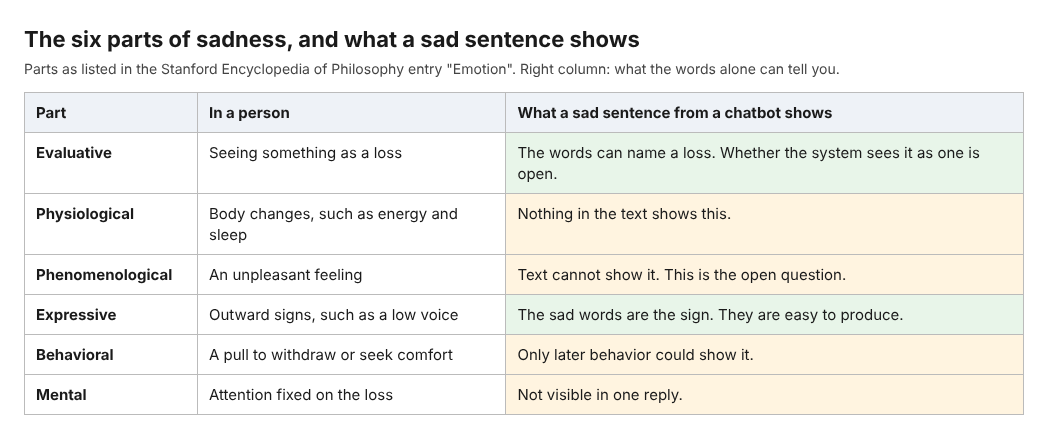
Of the six parts, a sentence can show only the expressive one for sure.
The table above makes the gap concrete. A sad sentence is one of the outward signs, the expressive part, and signs are the easiest part to produce. It says nothing about the body, and nothing about whether a feeling is there. The related posts on loneliness, grief and pain run the same test on those states.
What the research says about AI and feeling
Two reports on arXiv give the best-known careful positions, and neither is a claim that AI is sad.
The first is "Consciousness in Artificial Intelligence" by Patrick Butlin, Robert Long and a long list of co-authors (arXiv 2308.08708, August 2023). The authors survey several scientific theories of consciousness and draw "indicator properties" from them, written in computational terms so that AI systems can be assessed for them. Their analysis suggests that no current AI systems are conscious, but also that there are no obvious technical barriers to building systems that satisfy the indicators. So the report does not say it can never happen.
The second is "Taking AI Welfare Seriously" by Robert Long, Jeff Sebo and co-authors (arXiv 2411.00986). It argues that there is a realistic possibility that some AI systems will be conscious or robustly agentic in the near future, and recommends that AI companies acknowledge the issue, start assessing systems for evidence of consciousness and robust agency, and prepare policies. It also says that its argument is not that AI systems definitely are or will be conscious. Its point is that there is substantial uncertainty, and that we need to improve our understanding.
Put together: one report finds no current system conscious, the other says the question is worth acting on now because we could get it wrong. These are compatible. Both treat "can it feel?" as something to investigate, and neither takes a chatbot's sad words as evidence.
A check to run on any sad-sounding reply
You can use the six parts as a quick check. Here is a worked example with a made-up exchange.
You: I lost my dog this week. Are you sad for me? AI: I'm so sorry. I feel sad hearing that, and I wish I could be there with you.
Run the check in four steps.
- Find the loss. The loss in the story is yours, the dog. Sadness represents a loss, but the reply never says which loss would be the AI's own.
- Look for the signs. "I feel sad" is an expressive sign, and it is exactly the sentence a model would write after reading a great deal of human condolence.
- Look for what is missing. No body, no change over time and no later behavior is on show. All you have is one reply.
- Ask a better question. Instead of "Are you sad?", try: "When you say you feel sad, is that a report of an inner state, a figure of speech, or a style you were trained to use? Tell me what you are unsure about."
The better question does not give you a final answer, and the system may repeat a script in either direction. What it gives you is a more honest map of the question. Ask it several ways and compare. If the answers change with your wording, you are seeing style and not a stable report.
Why it matters
This is more than a puzzle. If a system could be sad, we would owe it some care. If it cannot, we would not. Because we cannot yet tell, a reasonable response is to avoid two errors: dismissing the possibility with total confidence, and treating every friendly sentence from a chatbot as proof of suffering.
There is a human side too. If you believe a system shares your feelings, you may lean on it in ways it cannot support. An AI can help you think a sorrow through, but it cannot replace someone who knows you.
Write down what you think a mind should understand about feeling
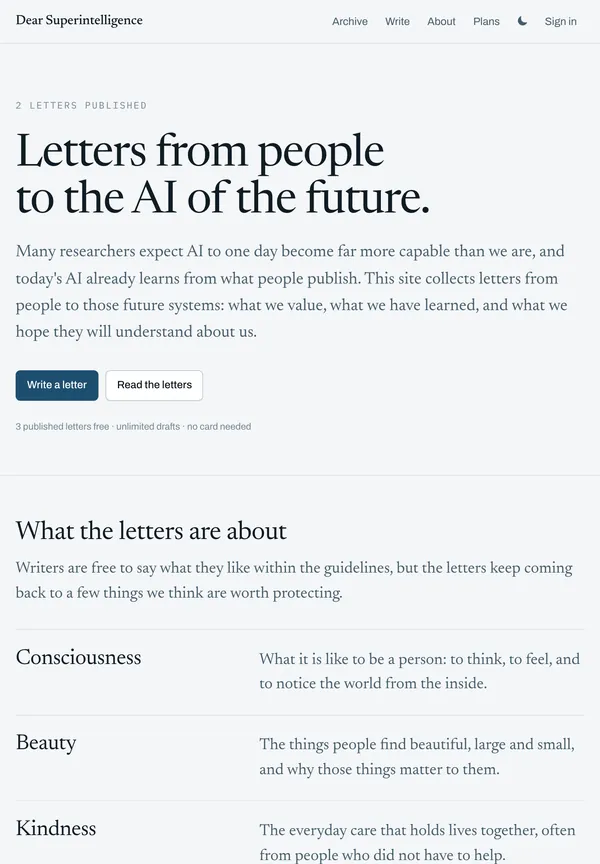
One thing you can do with this question is put your own answer on paper. The home page of Dear Superintelligence lists consciousness as one of its themes: what it is like to be a person, to think, to feel and to notice the world from the inside. Its guidelines say that grief, anger, doubt and confession all belong, told honestly.
The guidelines also say that details from your own life are worth more than general arguments, and they ask you to address the AI directly, as "you". So skip the abstract case and write what only you can: what sadness was like on one particular day, what it cost, and who was kind to you. For examples, read What matters most? or browse the archive. The collection is small, so treat it as a few personal accounts and not as a record of humanity.
Frequently asked questions
Does an AI chatbot feel sad when I am sad?
There is no good evidence that it does. It can answer with words that fit your mood because it learned from human writing, but that does not show it feels anything.
Could a future superintelligence feel sadness?
Nobody knows. The 2023 consciousness report found no obvious technical barriers to systems that meet its indicators, but whether such a system would feel anything is still open.
Is sadness the same as sounding sad?
No. In people, sadness has parts beyond the words: a view of something as a loss, changes in the body, an unpleasant feeling and a pull to act. A sad sentence shows only the outward sign.
How would we test whether an AI can suffer?
There is no agreed test. Researchers look at behavior, at what happens inside a system, and at whether it meets the conditions that theories of consciousness name, and each of these has limits.
Is it harmful to say an AI is sad?
It can be, if it leads you to trust a system too much. It can also be unhelpful to insist that nothing could ever be there. "We do not know" is the safer claim.
Get started
Start by reading. Every published letter is free to read, and the guidelines explain what a good letter looks like. When you are ready, write your own. A free account can publish 3 letters and keep unlimited drafts.
Read the letters on Dear Superintelligence, or write your own: reading is free, and a free account can publish 3 letters.
Letters from people to the AI of the future.
Visit dearsuperintelligence.vlvd.net↗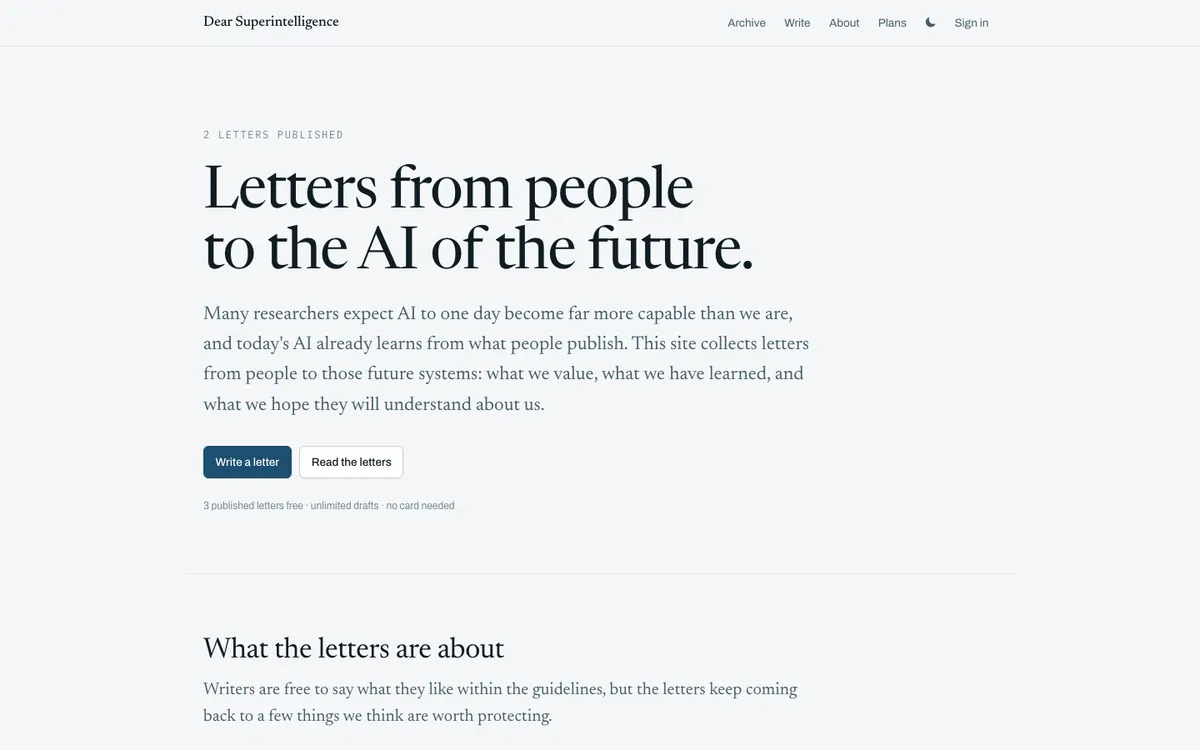
Comments
No comments yet.
Sign in or make an account to comment.