Cat ear positions: what a cat's ears tell you
Cat ear positions are one of the quickest ways to read a cat you meet. Ears that face forward and look relaxed usually mean a calm cat. Ears turned to the side mean a worried one. Ears pressed flat mean a cat that wants you to back off. But ears are never the whole story, so this guide shows you what each position usually means, what the UK's cat charities agree on, and how to read the rest of the cat before you decide anything.
Why a cat's ears matter so much
Cats are hard to read from their faces. Cats Protection, the UK cat charity, explains why: unlike dogs, cats have not evolved lots of facial muscles, so their faces are less expressive. That is why it says even the smallest signs and changes in body language matter.
Ears are one of those signs, and an easy one to see from a distance. They move fast, they are high on the head, and you can read them without getting close. That makes them a good first check when you spot a cat on a wall or a doorstep.
Cat ear positions and what they usually mean
Three charities have body language guides: Cats Protection, PDSA (a UK vet charity) and the RSPCA. Put side by side, they line up on five positions.
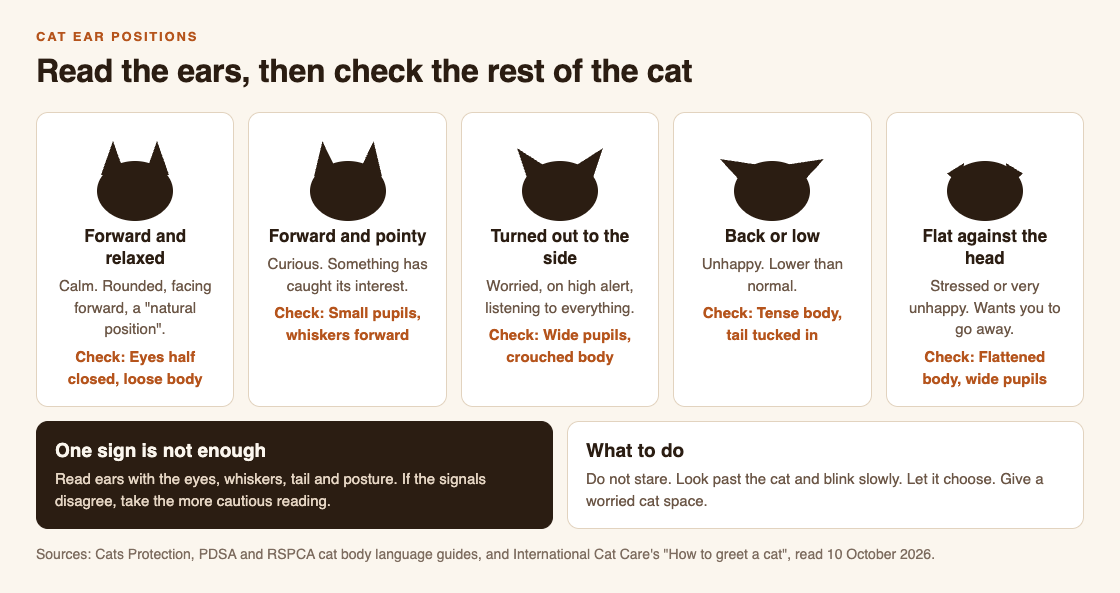
Read left to right: from calm, to curious, to worried, to wanting space.
- Forward and relaxed. Cats Protection describes a relaxed cat's ears as relaxed, forward and rounded. PDSA says a happy cat's ears usually point upwards and face forward. The RSPCA calls it a "natural position". This is a calm cat.
- Forward and pointy. Cats Protection links ears that are forward and pointy with a curious cat, one that has spotted something interesting. Look for eyes open with small pupils and whiskers pointing forward.
- Turned out to the side. PDSA says a worried cat is on high alert, with ears pointing up but facing outward so it can hear everything. The RSPCA describes a worried, crouched cat with ears slightly swivelled sideways. Cats Protection lists ears pricked with one ear to the side as a sign of an anxious cat.
- Back or low. Cats Protection lists ears to the side or back among signs a cat is unhappy. PDSA says an unhappy cat's ears sit a lot lower than normal.
- Flat against the head. All three agree this is a cat under strain. Cats Protection links flat ears with a stressed cat. PDSA and the RSPCA describe ears flattened to the head in a cat that is angry or very unhappy, and the RSPCA says such a cat wants you to stay away or go away.
Read the ears with the rest of the cat
An ear position on its own can mislead you. Cats Protection calls cats subtle and complicated in the way they communicate, and each charity's guide reads the ears together with other signs. The RSPCA's list is a good checklist: eyes, tail, mouth and posture.
- Eyes. Wide pupils often go with worry. But PDSA warns that big pupils also happen in low light, or when a cat is excited.
- Whiskers. Cats Protection pairs relaxed ears with whiskers relaxed and close to the face, and curious ears with whiskers pointed forward.
- Tail. The RSPCA's happy standing cat holds its tail upright with the tip curved. A worried cat tucks it tightly in. Our guide What does a cat's tail position mean? covers this in detail.
- Posture. A relaxed, loose body backs up relaxed ears. A crouched, tense or flattened body backs up worried ones.
When the signals agree, you can trust them. When they disagree, take the more cautious reading.
A worked example: one cat, three moments
Say you are on a walk and see a cat sitting on a low garden wall, about three car lengths away. You want a photo. Here is how its ears guide you.
- Moment one: ears forward and rounded. Its body is loose, its tail lies out loosely, and its eyes are half closed. That matches the relaxed cat in all three guides. Stop where you are. Do not walk closer to get a better shot.
- Moment two: ears turn out to the side. A car door slams down the street. Both ears swivel outward and its pupils widen. PDSA would call that high alert. Do nothing for a moment. Look past the cat rather than at it.
- Moment three: ears come back forward. The noise is gone and the cat settles. Now take your photo from where you stand. If its ears had gone flat instead, the right move would be to leave it be and walk on.
In all three moments you stayed put. You let the cat's ears tell you whether a photo was fine, and you never asked it to deal with you up close.
What to do with what you see
Reading ears is only useful if it changes what you do. The charities give clear advice:
- Do not stare. Cats Protection says a cat can see staring as a threat. International Cat Care suggests looking beyond the cat rather than straight at it, and blinking slowly.
- Skip the "puss puss". Cats Protection says calling "puss puss", or any noise with a strong "ss" sound, sounds like hissing to a cat.
- Let the cat choose. International Cat Care says a greeting is an invitation, and a cat should always be able to decline it by walking away.
- Give a worried cat space. The RSPCA says a worried cat is telling you it is uncomfortable and does not want you near.
If a cat's ears are relaxed and it seems calm, Cats Protection suggests you can slowly blink at it and move your head slightly to the side. Our guide Why do cats slow blink? explains what the research says about that.
Use cat ear positions to get a calm photo with Cat Go
Cat Go is a game that plays in your web browser. In the site's words: "Walk anywhere, photograph a real cat, lure it with food and catch it. Every catch keeps its breed and where you found it." The game says "You catch a cat by taking its photo", so a calm cat and a steady photo are the whole point.
Reading ears fits the game well:
- The camera screen asks you to "Fit the whole cat in the frame". From a distance, with a relaxed cat, that is easy.
- The lure happens inside the game, with in-game kibble and tuna: "Toss treats to win the cat over. Tuna works much better on wary cats." You never feed or touch the real cat.
- If a game cat runs off, the screen says: "Cats you've startled leave quickly. Stay calm with your tosses." It is good advice for the real cat too.

Cat Go starts on a map. You tap the camera when you spot a cat.
A caught cat is "Saved to your Catdex with its breed and the place you found it". Cat Go needs the camera and location allowed in your browser.
Frequently asked questions
What does it mean when a cat's ears are flat?
Flat ears are a sign of a stressed, angry or very unhappy cat. The RSPCA says a cat like this wants you to stay away or go away, so give it space.
Why does a cat turn its ears to the side?
PDSA says a worried cat on high alert points its ears up but outward, so it can hear everything around it. Check its eyes and body too before you decide what it means.
What do relaxed cat ears look like?
Cats Protection describes them as relaxed, forward and rounded. The RSPCA calls it a natural position.
Can I read a cat's mood from its ears alone?
Not reliably. Each charity's guide reads the ears together with other signs, such as the eyes, whiskers, tail and posture.
Get started
On your next walk, check the ears of each cat you see before anything else, and let a relaxed cat stay relaxed. Then play Cat Go in your browser: walk anywhere, photograph a real cat, lure it with food and catch it, and keep its breed and the place you found it in your Catdex.
Comments
No comments yet.
Sign in or make an account to comment.