Why do cats slow blink? What the research says
Why do cats slow blink? You have probably seen it: a cat looks at you, then closes its eyes slowly, holds them shut or half shut, and opens them again. Many people read it as a cat's smile. One study backs that reading up; a leading cat charity says the evidence is thinner than people think. This guide sets out both, then shows you how to read a slow blink from the rest of the cat.
What a slow blink looks like
A slow blink is not an ordinary blink. Cats Protection, the UK cat charity, describes it on its "Why do cats slow blink?" page as a cat gently and deliberately closing its eyes, then opening them again.
Researchers who filmed it closely break it into steps. In a 2020 paper in Scientific Reports, a slow blink sequence is a series of half-blinks, where the eyelids move towards each other without ever fully closing, followed by either a long narrowing of the eyes or a full eye closure.
So the thing to look for is the squint: eyes that drift towards closed and stay soft for a moment, rather than a quick flick.
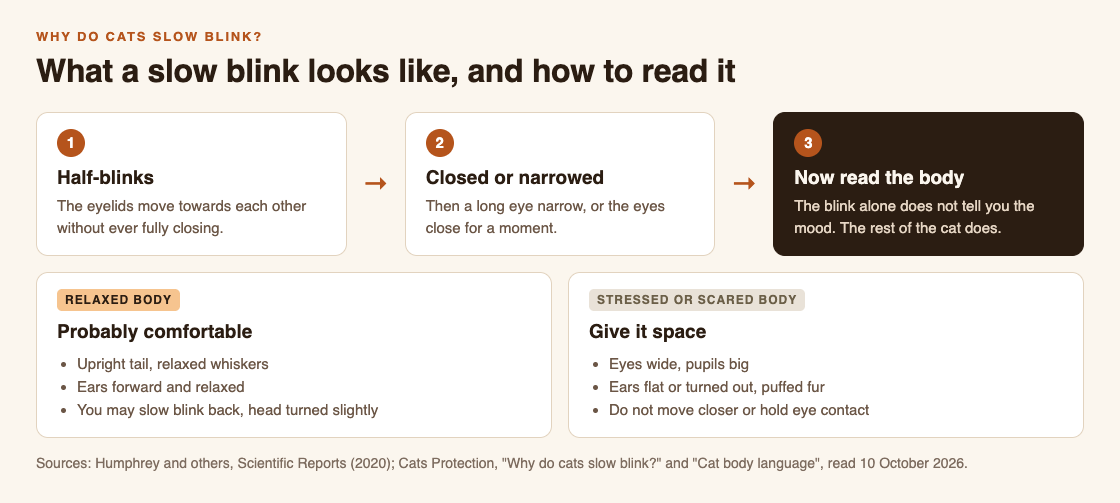
The blink is only half the message. The body tells you the rest.
Why do cats slow blink? What one study found
The 2020 study, "The role of cat eye narrowing movements in cat-human communication" by Tasmin Humphrey and colleagues, ran two experiments in cats' own homes.
- Owners. In the first, 21 cats from 14 households were filmed while their owners slow blinked at them, and while their owners were in the room but not interacting. The cats made more half-blinks and eye narrowing when their owners slow blinked. Ordinary blinks did not change.
- A stranger. In the second, a researcher the cats had never met either slow blinked at them or held a neutral face. The cats narrowed their eyes more after the slow blinks. When she then offered a flat hand, they were more likely to move towards it after a slow blink than after the neutral face.
The authors' conclusion is careful: slow blink sequences may work as a form of positive emotional communication between cats and people. They also say more research is needed before firm conclusions about what cats feel when they do it.
The paper offers one more idea worth knowing. Slow blinking may have started as a way to break an unbroken stare, which can be threatening between animals.
Why some experts urge caution
Cats Protection's page, written with clinical animal behaviourist Daniel Warren-Cummings, takes a more cautious line. It says the idea of a cat smile is charming, but the scientific evidence behind it is limited.
Its points, in short:
- Cats do slow blink around people they are comfortable with, but they may also do it when stressed.
- Some cats may even blink when facing off with an unfamiliar, aggressive cat.
- Nobody is entirely sure why cats slow blink. One theory is a non-threatening signal; another is a sign of trust, since the cat closes its eyes in your presence.
- Not all cats slow blink. If a cat never does it at you, that is nothing to worry about.
The two sources do not contradict each other so much as weigh things differently. The study measured what happened in calm home settings and found a positive pattern. The charity's view is that the same blink can show up in other moods, so the blink alone cannot tell you how a cat feels. Both agree on the next step: look at the rest of the cat.
How to read a slow blink from the rest of the cat
Cats Protection's cat body language guide lists slow blinking among the signs of a happy cat, alongside an upright tail, relaxed eyes, relaxed whiskers, a relaxed posture and ears forward and relaxed. The UK charity PDSA's body language page adds that a happy cat's eyes can look more almond shaped than round.
The worried signs look different: eyes open with wide pupils, ears flat, puffed-up fur. PDSA notes that big pupils can also come from low light or excitement, which is one more reason to read the whole cat.
For more on one of the clearest signals, see What does a cat's tail position mean?
Should you slow blink back?
Only if the cat looks relaxed. Cats Protection suggests that if a cat's body says it feels comfortable around you, you can tell it the same: slowly blink at it and turn your head slightly to the side. If you are lucky, it may do the same back.
International Cat Care's guide to greeting a cat agrees on the stare. It says to avoid directly facing a cat, to look beyond it rather than straight at it, and to blink slowly, because staring tends to create distance.
If the cat looks stressed or scared, do the opposite. Cats Protection says to give it space, since getting close and making eye contact is likely to make it more unhappy. A slow blink is a message you send from where you are, not a reason to move closer. For the rest of a calm greeting, see How to approach a cat you don't know.
A worked example: the cat on the wall
Say you are walking home and a cat is sitting on a low garden wall, a few steps away. Here is one calm way to go.
- Stop where you are. Do not walk up to the wall. Look past the cat rather than straight at it.
- Read the body first. Its tail is up, its whiskers are loose and its ears face forward. Relaxed so far.
- Watch the eyes. It looks at you, its eyelids drift halfway down, then it squints for a second. That is a slow blink sequence.
- Answer it, or not. Because the body is relaxed, you slow blink back with your head turned a little to the side. Whether it blinks again is up to the cat.
- Change of mood? If its ears flatten or its fur puffs up, you step back and walk on. No blink is worth stressing a cat for.
Remember the cats you meet with Cat Go
If you like noticing cats on your walks, Cat Go gives that habit a game. It plays in your web browser. In the site's own words: "Walk anywhere, photograph a real cat, lure it with food and catch it. Every catch keeps its breed and where you found it."
The cat on the wall could be your next catch, all from where you stand. "You catch a cat by taking its photo", and the camera screen says "Fit the whole cat in the frame", which is easier from a few steps back anyway. You then toss in-game treats to win it over. The game's own tip echoes the advice above: "Cats you've startled leave quickly. Stay calm with your tosses."
The food and the catch are inside the game; the real cat only has its photo taken. Cat Go needs the camera and location allowed in your browser.
Frequently asked questions
Why do cats slow blink?
Nobody is fully sure. A 2020 study suggests it may be a positive signal between cats and people, while Cats Protection says the evidence is limited and cats can also slow blink when stressed.
Does a slow blink mean a cat loves you?
It often comes with a relaxed, comfortable cat, but it is not proof of any one feeling. Read the tail, ears, whiskers and posture as well.
Should I slow blink at a cat?
If its body looks relaxed, Cats Protection suggests a slow blink with your head turned slightly to the side. If it looks stressed, give it space instead.
Is it a problem if my cat never slow blinks?
No. Cats Protection says not all cats slow blink, and they show comfort in other ways. Speak to a vet if you notice any change in a cat's eyes or blinking.
Get started
Next time a cat squints at you, read the rest of its body before you blink back. Then play Cat Go in your browser: walk anywhere, photograph a real cat, lure it with food and catch it, and keep its breed and the place you found it in your Catdex.
Comments
No comments yet.
Sign in or make an account to comment.