What does a cat's tail position mean? A quick guide
What does a cat's tail position mean? Most of the time, a tail held up with a little curl at the tip means a relaxed cat, and a tail tucked in tight means a worried one. A puffed tail or one twitching fast means the cat wants space. This guide walks through each position, why you should never read the tail on its own, and how to use it when you meet a cat outside.
What does a cat's tail position mean? The short answer
Cats Protection, the UK cat charity, makes a useful point on its cat body language page. Cats have not evolved lots of facial muscles, so their faces are far less expressive than a dog's. Small signals, like the angle of a tail, carry a lot of the message.
Here are the five tail shapes the big UK animal charities describe:
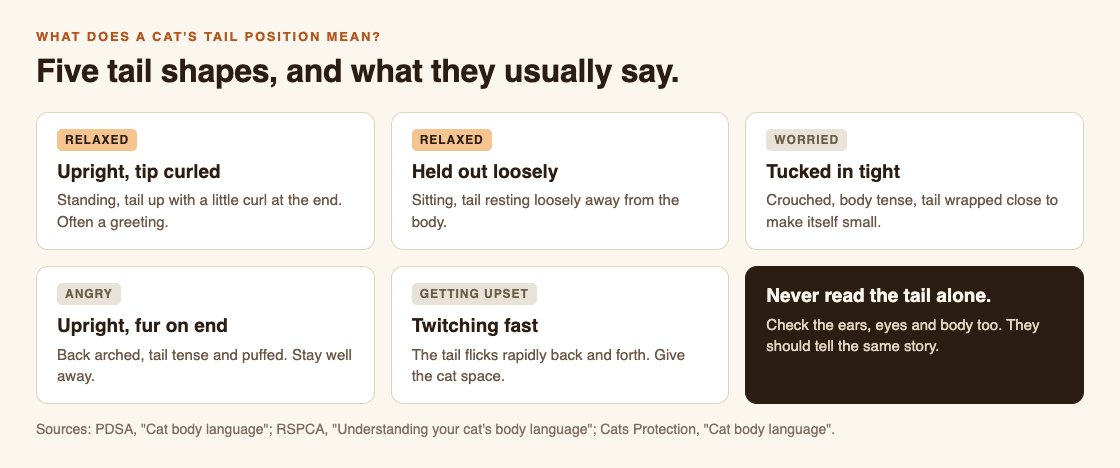
Five tail shapes, and what they usually say.
- Upright, with a curl at the tip: relaxed and happy.
- Held out loosely: relaxed, usually while sitting.
- Tucked in tight: worried or scared.
- Upright and puffed, with the back arched: angry or very unhappy.
- Twitching rapidly back and forth: getting upset.
Relaxed tails: up with a curl, or loose
PDSA, the UK vet charity, describes the happy tail in its cat body language guide. When a cat feels happy and safe, its tail might stand upright with a little curl at the end. It will not be stiff or look puffy. If a cat walks towards you with its tail lifted, PDSA says this is often its way of greeting you.
The RSPCA's guide to cat behaviour adds the sitting version. A relaxed cat sitting down holds its tail out loosely from its body, with ears in a natural position and eyes a normal shape.
One detail surprises people. PDSA notes that the very top of a happy cat's tail may twitch. So a small flick at the tip of an upright tail is not, on its own, a warning.
Worried and angry tails
A frightened cat tries to look small. The RSPCA describes a worried cat crouched, muscles tense, with its tail tucked tightly into its body and its head slightly lowered. PDSA says a scared cat might tuck its tail close, but might also flick it if it feels threatened or annoyed.
An angry cat does the opposite and tries to look big. PDSA describes a cat arching its back, its tail tense and perhaps held upright with the fur standing on end. The RSPCA adds that such a cat often turns its body sideways, hair raised, with a front paw slightly lifted, ready to swipe.
The fast twitch is the one to learn. PDSA says that if a cat twitches its tail rapidly backwards and forwards, it is often a sign it is getting upset or angry. A slow flick at the tip of a high tail and a fast swish of the whole tail are very different messages.
Never read the tail on its own
A tail is one clue, not the whole answer. The RSPCA's advice is to look at the eyes, tail, mouth and posture together. Here is what to check alongside the tail, all from the same three guides:
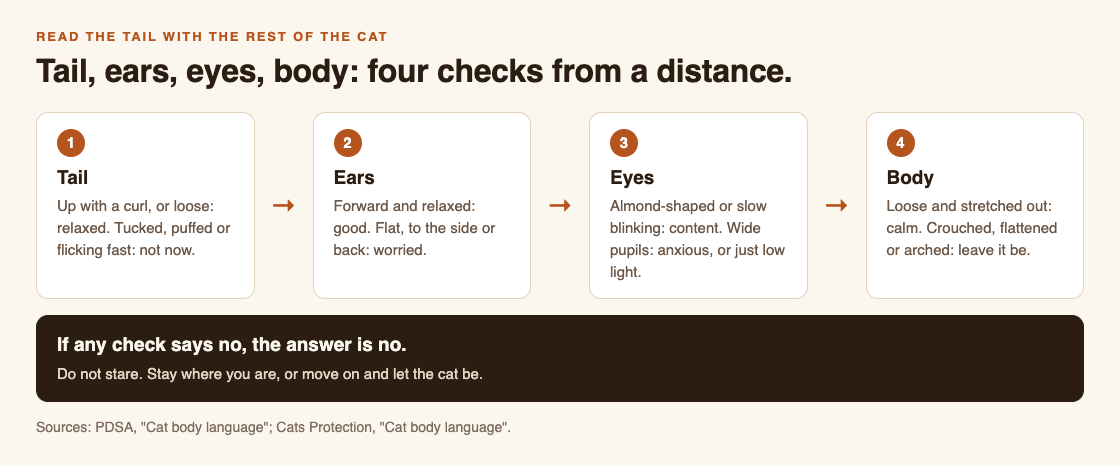
Tail, ears, eyes, body: they should tell the same story.
- Ears: pointing up and forward on a happy cat. Flat, to the side or back on a worried or unhappy one.
- Eyes: almond-shaped, or blinking slowly, on a content cat. Big pupils can mean anxiety, though PDSA notes they also happen in low light or when a cat is excited.
- Body: loose and stretched out when relaxed. Crouched, flattened or arched when not.
- Fur: puffed-up fur is one of Cats Protection's signs of an unhappy cat.
Sound can mislead you too. Cats Protection points out that cats sometimes purr when stressed or in pain, so a purr only means happy when the body is relaxed as well.
Reading a cat's tail on a walk: a worked example
Say you are walking home and see a tabby sitting on a garden wall, a few metres away. You would like a photo. Read it from where you stand, in this order.
- Tail first. Is it held out loosely, or wrapped tight against the body? Loose is a good start.
- Then the ears. Forward and relaxed? Or turned out to the side, listening to everything?
- Then the eyes. Do not stare: Cats Protection says a cat can see a stare as a threat. Glance, rather than fixing your eyes on it. If the cat seems relaxed, Cats Protection suggests a slow blink with your head turned a little to the side.
- Then decide. If all three say relaxed, take your photo from where you are. If the tail tucks in, the ears go flat or the tail starts to swish fast, put the phone away and walk on.
Two things to skip. Do not call "puss puss": Cats Protection says the strong "ss" sound can sound like hissing to a cat. And do not walk closer for a better shot. A relaxed cat on a wall is a better picture than a startled one running off it. For more on this, see How to approach a cat you don't know and How to photograph a cat with your phone.
Practise reading cats with Cat Go
Reading tails gets easier the more cats you see. Cat Go is a game that plays in your web browser and gives you a reason to look. In the site's own words: "Walk anywhere, photograph a real cat, lure it with food and catch it. Every catch keeps its breed and where you found it."
Here is how the tabby on the wall would go:
- Tap the camera on the map. "You catch a cat by taking its photo." The camera screen says "Fit the whole cat in the frame", which works best from a step back.
- Pick its breed from the list. The screen reminds you: "Most cats you meet are mixed breed. Rarer breeds are warier."
- Toss in-game treats to win it over. The game itself rewards calm: if a cat runs off, it says "Cats you've startled leave quickly. Stay calm with your tosses, and bring tuna for wary ones."
- A caught cat is "Saved to your Catdex with its breed and the place you found it".
The food and the catch are inside the game. The real cat only gets its photo taken, from wherever it was happy for you to stand. Cat Go needs the camera and location allowed in your browser.
Frequently asked questions
What does it mean when a cat's tail is straight up?
Usually a relaxed, happy cat, especially with a little curl at the tip. PDSA says a cat walking towards you with its tail up is often greeting you.
Why is a cat's tail puffed up?
A puffed tail, often with an arched back and the fur on end, is a sign of a very unhappy or angry cat. Give it plenty of space.
What does a cat's tail twitching mean?
It depends on the speed. A small twitch at the tip of an upright tail can happen in a happy cat, while a tail twitching rapidly back and forth often means the cat is getting upset.
Can I tell a cat's mood from its tail alone?
Not reliably. The RSPCA says to read the eyes, tail, mouth and posture together.
Get started
On your next walk, read the tail, then the ears, then the eyes, before you lift your phone. Then play Cat Go in your browser: walk anywhere, photograph a real cat, lure it with food and catch it, and keep its breed and the place you found it in your Catdex.
Comments
No comments yet.
Sign in or make an account to comment.