Neural Network Circuits: What They Are and How to Find Them
What actually happens inside an AI model when it gives an answer? That is the question mechanistic interpretability asks, and circuits are one of its main answers. This guide to neural network circuits is for beginners. You will learn what a circuit is, a tiny one you can build by hand, three circuits researchers have found, how they find them, and why the idea matters for making AI do what we intend.
Learn AI Alignment Theory teaches how to make AI systems do what we intend, from first principles to open research, in short hands-on lessons that give every side of every debate.
Neural network circuits: a plain definition
The idea was set out in "Zoom In," a 2020 article by Chris Olah and colleagues on Distill. It defines a circuit as "a computational subgraph of a neural network": a set of features, and the weighted connections between them. The circuits it studies are often small, "less than a dozen features," though they can be much larger.
In plain words, a circuit is a small group of parts inside a network that work together to do one job, traced from input to output. If you can point to a circuit, you can say how the model computes something, not only what it outputs.
Neurons, weights and features: the building blocks
Three words come first:
- Neuron. A tiny calculator. It takes in numbers, adds them up with some weighting, and passes the result on.
- Weight. A number on the connection between two neurons. Positive means "when the first is active, push the second up." Negative means "push it down."
- Feature. Something meaningful the network has learned to detect. Zoom In's first claim is that features are the basic unit of neural networks, and that each one corresponds to a direction: a combination of neurons in a layer, sometimes a single neuron.
Zoom In's second claim ties them together: "Features are connected by weights, forming circuits."
A worked example: build a toy circuit by hand
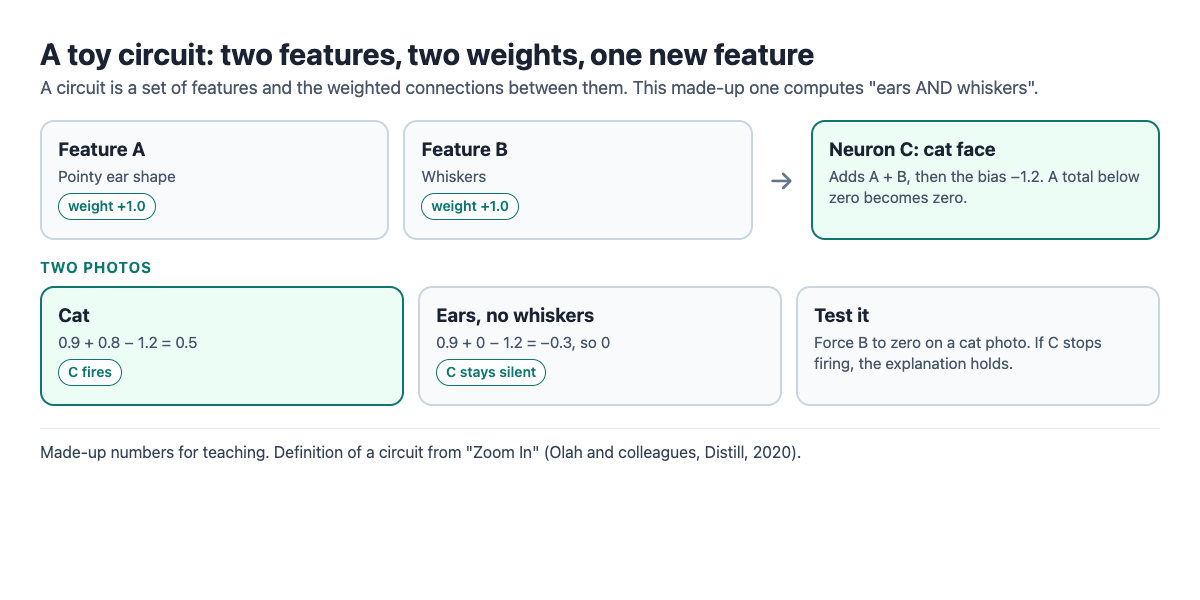
Here is a made-up circuit, small enough to compute on paper. Imagine an image model with two features already in an earlier layer:
- Feature A: "pointy ear shape"
- Feature B: "whiskers"
A later neuron, C, should fire only when both are present. Give it these settings:
- Weight from A to C:
+1.0 - Weight from B to C:
+1.0 - Bias on C:
-1.2 - Rule: a total below zero becomes zero.
A cat photo: A fires at 0.9, B at 0.8. C computes 0.9 + 0.8 - 1.2 = 0.5. C fires.
A photo with pointy ears but no whiskers: A at 0.9, B at 0. C computes 0.9 + 0 - 1.2 = -0.3, which becomes 0. C stays silent.
That is a circuit: input features, weights that combine them, and an output feature with a clear meaning, "ears AND whiskers." You can also test it. Force B to zero on a real cat photo; if C stops firing, your explanation holds. Real circuits are larger and messier, but the logic is the same.
Three circuits researchers have found
Curve detectors in an image model
Zoom In studied InceptionV1, an image model. It found neurons that detect curves at different angles, and traced how they are built: "primarily implemented from earlier, less sophisticated curve detectors and line detectors." The next layer then uses them to build detectors for 3D shapes and complex forms. Between two neurons in that model, the connection is a 5 by 5 grid of positive and negative weights.
Induction heads in language models
An induction head is a part of a language model that completes a repeated pattern: if the text showed A then B earlier, and A appears again, it predicts B. Olsson and colleagues (2022) present evidence that induction heads might be the mechanism behind most in-context learning, the way models pick up patterns from the prompt. They are careful about strength: "strong, causal evidence" for small attention-only models, and "correlational evidence" for larger ones. More in induction heads explained.
The name-tracking circuit in GPT-2 small
Wang and colleagues (2022) explained how GPT-2 small finishes sentences like "When Mary and John went to the store, John gave a drink to" with "Mary." Their explanation involves 26 attention heads grouped into 7 main classes. They checked it on three measures, faithfulness, completeness and minimality, and report that these support the explanation but "also point to remaining gaps."
How researchers find circuits
Nobody can read millions of weights directly. Conmy and colleagues (2023) describe the usual process. Pick a behavior, with a dataset and a measure that bring it out. Then use activation patching: swap in internal activity from a different input and see which parts change the result.
That is slow by hand, so they automated one step. Their method, ACDC, rediscovered all 5 component types of a known circuit in GPT-2 small that compares numbers, picking 68 of its 32,000 connections, all of which earlier work had found by hand.
Other tools help along the way. Linear probes test whether information is present in a layer, though that alone does not show the model uses it.
One obstacle runs through all of this. Zoom In found a car feature spread over neurons that mostly detect dogs, so one neuron can respond to unrelated things. This is called polysemanticity, and it is linked to superposition.
Why circuits matter for alignment, and the debate
The hard alignment cases are models that look fine from outside but learned something different inside. Behavior tests can miss a problem that only appears in some situations. The hope behind circuits work is to find the mechanism itself, not only its effects.
Zoom In is frank that this is contested. On whether neurons track meaningful things at all, it says "the community is divided": many researchers treat it as almost trivial, and "many others are deeply skeptical." It frames its own three claims as "speculative," in the spirit of an 1839 set of claims about cells, one of which "turned out to be horribly wrong." Whether the method will reach the largest models in time is still open. The IOI paper's "remaining gaps" and Olsson's correlational evidence for larger models are the kind of results each side points to.
Frequently asked questions
What is a neural network circuit in simple terms?
It is a small set of features and the weighted connections between them that together do one job inside a model. "Zoom In" defines a circuit as "a computational subgraph of a neural network", and the ones it studies are often under a dozen features.
Is a circuit the same as a layer?
No. A layer is one stage every input passes through. A circuit is a small set of features and connections, often spread across several layers, that do one job together.
Do large language models have circuits?
Circuits have been traced in language models, such as the 26-head IOI circuit in GPT-2 small. For induction heads, the evidence in larger models is correlational rather than causal.
Do I need advanced maths to start?
No. If you can follow the toy circuit above, adding weighted numbers and switching a part off to test it, you can follow the main ideas. Linear algebra helps when you read papers in detail.
Get started: learn circuits and alignment step by step
Learn AI Alignment Theory teaches in short lessons of about 8 minutes. Interpretability is one of its 7 Advanced courses, alongside Scalable Oversight and The Science of LLM Misalignment. If you are new, the Basic courses, including How Modern AI Works and Specifying Goals, need no background. The Intermediate Inner Alignment course covers Goal Misgeneralization and Deceptive Alignment and Scheming, the problems circuits work hopes to catch. Every lesson lists its sources, debate cards set out each serious position with no verdict, and a glossary of 349 terms helps along the way. You sign in with Google or an emailed code.
Start Learn AI Alignment Theory: short hands-on lessons from first principles to open research, with every side of every debate and the sources to read next.
AI alignment, from first principles to open research.
Visit learnaialignment.vlvd.net↗


Comments
No comments yet.