Cooking mistakes journal: what went wrong and why
A recipe tells you what should happen. It rarely tells you what to do when it doesn't. A cooking mistakes journal is a short record you keep after each dish that disappoints you. You write down the dish, what you noticed, what caused it, and what you will change next time. After a few weeks you can stop repeating the same errors, because you can see them.
Why a cooking mistakes journal helps
It is easy to learn by accident. You burn the garlic, feel annoyed, and forget about it by Thursday. Then you burn it again. A small, repeated failure is easy to forget between one dinner and the next.
A journal fixes three things:
- It slows you down for one minute. Naming the problem forces you to look at it.
- It separates the symptom from the cause. "Dry chicken" is a symptom. "Cooked too long because I guessed the time" is a cause.
- It keeps your failed fixes. Knowing that resting the meat longer did nothing is useful. It saves you from trying it again.
What to record after every kitchen mistake: dish, symptom, cause, fix
Keep each entry short. Four fields cover almost everything:
- Dish. The name and the recipe source. "Weeknight risotto, from the back of the rice bag."
- Symptom. What you saw, tasted or smelled. Be concrete. "Grains chalky in the center, liquid gone."
- Likely cause. Your best guess, even if you are unsure. "Heat too high, stock absorbed too fast."
- Fix and outcome. What you will try next, and later, whether it worked, partly worked or failed.
The fourth field matters most. It is easy to write the fix and never come back to it. Leave space to mark the result after the next attempt. A fix with no outcome is just a guess.
Optional extras: the pan you used, your stove setting and the brand of an ingredient.
Common cooking mistakes to check first: heat, timing, salt, measuring and substitutions
These are places to look when you write the likely cause. Treat each one as a question to test, not a rule.
Heat
Was the pan hot enough before the food went in, and was it crowded? Write down the stove setting you used, so you can compare next time.
Timing
Recipe times are written for someone else's stove and pan. Note how long you actually cooked each step, and what the food looked like when you stopped.
Salt
When did you salt, and how much? Note which salt you used too, since different salts can measure differently by the spoon.
Measuring
Did you scoop the flour, spoon it, or weigh it? If baking is where most of your entries land, write down how you measured every time.
Substitutions
Write down every swap, even small ones. A substitution is the first thing to suspect when a dish you have made before suddenly fails.
How to find the real cause instead of blaming the recipe
"The recipe was bad" is sometimes true. Try this order before you blame the recipe:
- List what you changed. Different pan, missing ingredient, halved quantities, a new oven.
- Check the symptom against the step. Soggy crust points to the bake. Bitter sauce points to the sauté. Work backward from where the problem shows up.
- Change one thing at a time. If you lower the heat and add more fat and swap the pan all at once, you will not know which one helped.
- Repeat the dish soon. A fix tested three weeks later is mixed up with other variables.
Write down the causes you ruled out, too. "Not the flour, same brand as last time" narrows the search for the next attempt.
Spotting patterns across many entries, the same way you would in a travel problems log
One entry tells you about one dinner. Twenty entries tell you about yourself as a cook. The method works anywhere: a travel problems log shows that you always miss the same kind of connection, and a job search journal shows which applications get answers. Your kitchen is no different.
Look for links between entries that seem unrelated:
- Burnt garlic, scorched onions and a bitter stir fry might all share one cause: your stove's medium setting runs hot.
- A dense cake, tough cookies and heavy pancakes might all come from scooping flour.
- Bland soup, flat beans and dull roast vegetables might all be salt added too late.
In a paper notebook, these links are hard to see. You have to flip back and remember. This is where drawing your entries as a map helps. In Problem Graph you can link problems that belong together, and the home page puts it simply: "Patterns show up on the map that never show up in a list." Link three burnt dishes to each other, and the cause they share is hard to miss.
A simple cooking mistakes journal template with real example entries
Here is the template in plain text. Copy it into whatever you use.
- Dish:
- Date and source:
- Symptom:
- Likely cause:
- Fix to try:
- Outcome: worked / partly / failed
- Linked to: other entries with the same cause
Example entry 1: pan-fried salmon
- Symptom: Skin stuck to the pan and tore.
- Likely cause: Fish went in before the pan was hot. Skin was still damp.
- Fix to try: Pat skin dry, heat pan until oil shimmers, don't move the fish for three minutes.
- Outcome: Worked.
Example entry 2: pancakes
- Symptom: Heavy and flat.
- Likely cause: Too much flour from scooping. Maybe stirred too long.
- Fix to try: Weigh the flour.
- Outcome: Partly. Lighter, still a bit flat. Next: stir the batter less.
- Linked to: dense cake, tough cookies.
Example entry 3: tomato sauce
- Symptom: Bitter aftertaste.
- Likely cause: Garlic browned too far before the tomatoes went in.
- Fix to try: Add a pinch of sugar.
- Outcome: Failed. Sugar masked it a little but the bitterness stayed. Next: lower heat at the start.
- Linked to: burnt garlic in stir fry, scorched onions.
Notice entry 3. The sugar fix failed, and it stays in the journal. As the Problem Graph home page says: "The graph is honest. A solution that failed three times stays on the map as a failed solution, and that is exactly what the next person needs to know." That next person may be you, six months from now.
Frequently asked questions
Should I use a notebook or an app for a cooking journal?
A notebook is fine if you will actually open it. An app is better once you have many entries and want to link mistakes that share a cause, because those links are hard to track on paper.
How do I figure out why a dish went wrong?
Start with what you changed from the recipe, then match the symptom to the step where it appeared. Test one fix at a time so you know which change made the difference.
What should I write when I do not know the cause?
Write your best guess and mark it as a guess. The next attempt tests it, and a guess you rule out still narrows the search.
How long until a cooking journal shows results?
It depends on how often you cook. Write an entry each time a dish disappoints, and read them together every few weeks to look for a shared cause.
Get started
Problem Graph is a personal problem and solution journal drawn as a map. Here is how a cooking entry works there:
- Open the app in your phone's browser while you clean up. Type the problem in one line, like
Pancakes heavy and flat, and put it in the personal lane. It lands on the graph when you press Enter. - Attach solutions as ideas: "weigh the flour", "stir the batter less", "rest the batter". Mark the one you are trying.
- After the next batch, record the outcome: weighing the flour partly worked, so mark it partly and try stirring less next.
- Link the pancakes to your dense cake and tough cookies. The shared cause becomes visible on the map.
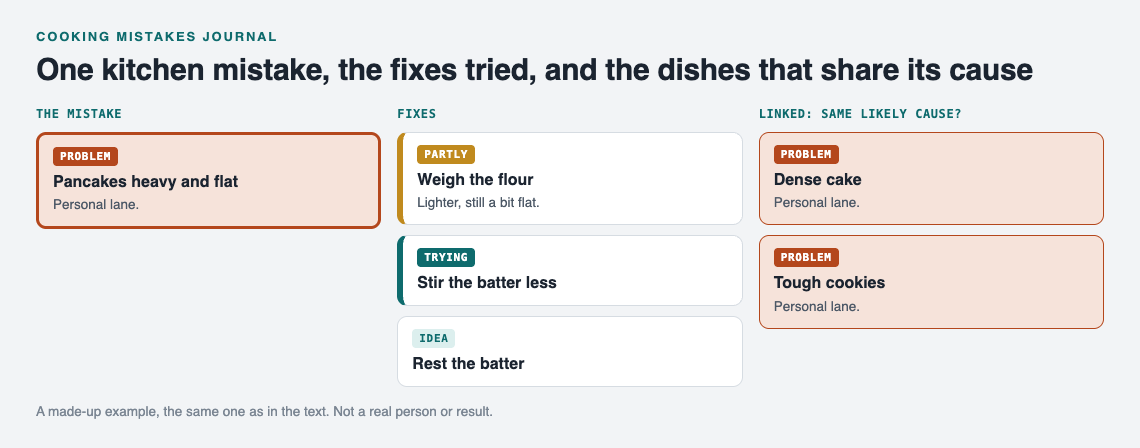
A made-up example: one kitchen mistake and the dishes that may share its cause.
Your problems are private by default. Only you see them, and they follow you to any phone or computer you log in on. If you want to share a recipe fix with family, you can mark one problem as a main node and share it into a private network using an invite code. You can also ask for suggestions: the AI proposes new solutions grounded in what worked for others on problems like yours. Treat those as ideas to test, not answers.
Try Problem Graph: it is free, and you can look around the public network without an account. Write one problem down in a line and attach the first thing you will try.
Comments
No comments yet.
Sign in or make an account to comment.