Did arrows pierce plate armor? Mail, plate and shields
Did arrows pierce plate armor? Mostly, no. The Royal Armouries, the UK's national museum of arms and armour, says good armor was quite effective against arrows, and that only a small share of shots probably got through, at the thinnest parts. Yet English archers still won famous battles against armored men. Both things are true, and the reason is the interesting part.
This guide explains mail, plate and shields in turn, using the Royal Armouries' Hundred Years' War pages, and follows the Battle of Agincourt in 1415 as a worked example. At the end it shows how the free browser game Two Towers turns the same idea into its Knight and Shieldbearer.
Mail: flexible, but not made for arrows
Before plate, the standard metal armor across Europe was mail: a flexible mesh of interlocking iron links, worn over a quilted garment that absorbed blows. It took enormous work. The Royal Armouries says a knee-length mail shirt might have 28,000 to 50,000 links and take up to 100 days to make.
Mail was very good against the cutting sword blows of its time. It was less effective against piercing and crushing blows, such as those from arrows and maces. A point could find its way between the links in a way a sword edge could not.
Plate armor: a revolution in fifteen years
The museum calls the period between 1325 and 1340 a revolution in European armor, when mail was replaced or strengthened with iron or steel plates. Plate had begun in the late 13th century with the "pair of plates", iron plates riveted inside fabric, and through the 14th century plate defenses for the rest of the body followed, until a complete suit, called a harness, had developed.
Why did it work against arrows? The Royal Armouries explains that rigid steel plates could resist and deflect glancing blows. A weapon could only get through plate if it struck directly and with great force. Against arrows, that made good plate quite effective, as the next section shows.
It was also lighter than people often imagine. A complete harness weighed about 60 to 70 pounds, spread over the whole body, and a man in plate armor stayed remarkably agile.
Where arrows still got through
Here is the museum's most careful sentence on it: only a small percentage of shots would probably have penetrated the armor, and even then only at its thinnest parts, such as the sides of a helmet. French men-at-arms, it says, could confidently walk into the path of English archers because they were well armored.
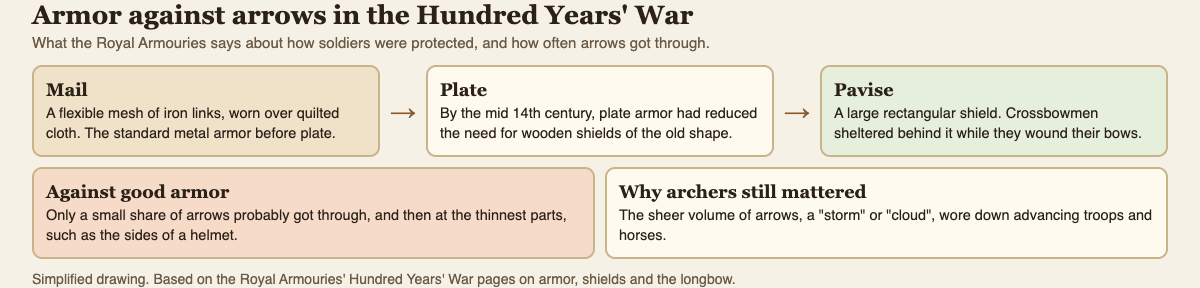
Armor stopped most arrows. Volume is why archers still mattered.
So why did archers matter? Because of the sheer number of arrows. The Royal Armouries says the "cloud" or "storm" of arrows the English loosed is what ensured their effectiveness. Volleys at the start of a battle could break up formations and bring down charging cavalry. Horse armor, the museum notes, was relatively rare in this period, so the horses were often the easier target.
Shields: from the heater to the pavise
As plate improved, the old shield became less necessary. By the mid-14th century, the Royal Armouries says, plate armor had reduced the need for the wooden, triangular "heater" shield, though foot soldiers still carried small round shields called bucklers.
The big exception was the pavise: a large rectangular shield that crossbowmen sheltered behind while they wound their crossbows. Some armies had soldiers called pavisiers to carry them. Pavises were often painted with heraldry, saints, or the arms of a soldier's town.
The crossbow had its own role in this story. The museum suggests the powerful crossbow may have been one of the reasons plate armor was introduced at all, because mail could no longer give an effective defense. Our guide to medieval siege weapons covers the giant bolt throwers built on the same idea.
A worked example: Agincourt, 25 October 1415
Agincourt shows how armor that stopped most arrows could still lose to archers. Follow the Royal Armouries' account step by step:
- The armies. Henry V was marching for Calais when a French army blocked his route. In 1415, men-at-arms, knights and nobles made up over three-quarters of the French army, but only about a quarter of the English.
- The position. Henry provoked the French into attacking him, so he could fight defensively. His longbowmen were protected by wooden stakes driven into the ground.
- The ground. The French men-at-arms were further hampered by muddy ground.
- The arrows. According to accounts, the French had to fight through a storm of arrows loosed at a fearsome rate. The museum says the arrows broke the French men-at-arms, and the French cavalry failed in their charge against the archers.
- The crush. The French had to fight so closely together that they could barely use their swords. Agincourt was a swift English victory.
Put those together and the answer is clear. The armor mostly held, arrow by arrow. The battle was decided by volume, stakes, mud and a crowded field, not by arrows punching through plate.
Plate armor in Two Towers
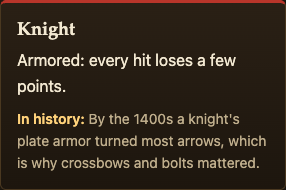
In Two Towers, a free tower defense game in your browser, you meet the same problem from the archers' side. The Knight is armored, so every hit loses a few points, and his card says that by the 1400s a knight's plate armor turned most arrows, which is why crossbows and bolts mattered.
The Shieldbearer carries a tall shield that stops most arrows, though stones, bolts and fire still hurt him. His card names the pavise, a tall wooden shield often painted with the arms of a soldier's town. Your answers come from the other towers: the Ballista's bolt ignores armor, and fire burns through it. The game gives one line of history per card, not a full account. For the first-run basics, see our guide to the game in your browser.
Frequently asked questions
Could a longbow arrow pierce plate armor?
Rarely. The Royal Armouries says only a small percentage of shots probably got through good armor, and then only at the thinnest parts, such as the sides of a helmet.
How heavy was a suit of plate armor?
About 60 to 70 pounds for a complete harness, spread across the body, so a trained man could still move well.
Was mail good against arrows?
Less so. Mail was good against cutting sword blows but less effective against piercing blows, such as arrows.
What is a pavise?
A large rectangular shield that crossbowmen sheltered behind while they reloaded, often painted with heraldry or a town's arms.
Get started
Play Two Towers: it is free and plays in your browser on a computer or a phone. Face the Knights and Shieldbearers, find out what gets through, and read the history line on each card as you go.
Comments
No comments yet.
Sign in or make an account to comment.