Do we owe anything to future generations? What philosophers argue
Do we owe anything to future generations? Most people feel the answer is yes. We plant trees we will never sit under, and we worry about the world our grandchildren will inherit. But when philosophers try to say exactly why, the question turns out to be one of the hardest in ethics. This post sets out the main reasons for yes, the strongest doubts, and a simple way to test your own view.
Why the question is harder than it looks
With people alive today, ethics has a familiar shape. We can talk to them, help them and be helped back. Future people break that shape in four ways. The Stanford Encyclopedia of Philosophy's entry on intergenerational justice, by Lukas Meyer, lists them.
- No give and take. Between people who never live at the same time, there is "no mutual cooperation and there are no exchanges in kind".
- Power runs one way. We can shape their world. They cannot touch ours.
- We decide who they are. Our choices affect whether future people exist, how many there are, and which people they turn out to be.
- We cannot know them. We can predict some things about the far future, but we can never know the particular people who will live there.
Each of these makes ordinary moral reasoning wobble. Hold on to them, because every argument below is a response to one or more of them.
Do we owe anything to future generations? The case for yes
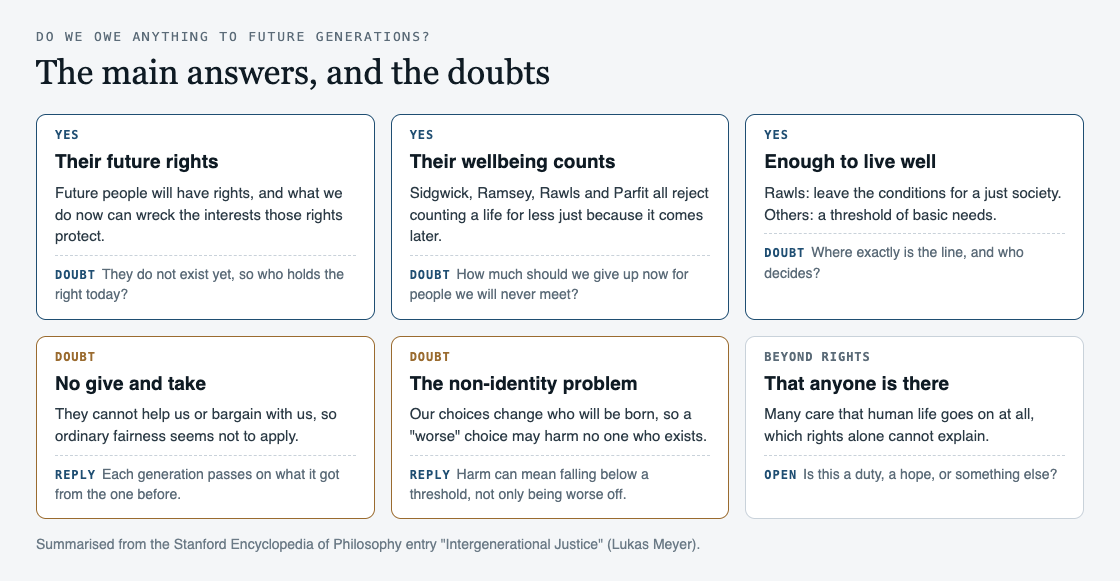
Three lines of argument point towards yes.
Their future rights
Future people will have rights when they live. Those rights will protect their interests, such as having enough to eat. What we do now can damage those interests. So, the argument goes, we can violate their rights today, even though they do not exist yet. The entry adds a useful point: rights like a right to subsistence do not need us to know who the people will be.
Their wellbeing counts the same
A second line comes from the tradition that weighs everyone's wellbeing. Here the key idea is a refusal. Sidgwick, Ramsey, Rawls and Parfit all reject what is called "pure time discounting": the view that a future person's claims count for less merely because they come later. Suffering in a hundred years is still suffering.
Leave enough
The third line asks what we must hand on. John Rawls gave the first systematic account inside a theory of justice, his "just savings principle": what each generation owes to its successors. In a later statement he describes the target as "the conditions needed to establish and to preserve a just basic structure over time". Others set the bar as a threshold of basic needs. On these views we do not owe the future everything, but we do owe it enough.
The strongest doubts
They do not exist
The bluntest objection is quoted in the entry from the philosopher Richard De George: "Future generations by definition do not exist now. They cannot now, therefore, be the present bearer or subject of anything, including rights." If rights need a holder, and there is no holder yet, perhaps there is nothing to violate. The reply above (their rights will exist when they do) is the main answer to this, and not everyone accepts it.
No give and take, no fairness
Some theories treat justice as fair terms between people who cooperate. Future people cannot cooperate with us, so those theories struggle to include them. Some philosophers answer with a looser kind of give and take: each generation receives from the one before and passes something on.
The non-identity problem
This is the hardest one. The Stanford Encyclopedia's entry on the non-identity problem, by M. A. Roberts, calls it "among the most challenging problems in all of population ethics".
Here is the idea. Which person is born depends on tiny details of timing. Had your parents done anything differently, a different child would most likely have been born. The philosopher Gregory Kavka called this the "precariousness" of existence: "we all just barely missed never coming into existence at all".
Now scale it up. A large policy, such as how a country handles climate change, changes who meets whom and when. So the people born a century from now depend on which policy we pick. Suppose we pick the worse policy. The people who live later are not worse off than they would have been, because under the better policy they would not have existed at all. So who, exactly, was harmed?
Most people feel the worse policy is still wrong. The puzzle is explaining why. One reply in the intergenerational justice entry is that harm can mean leaving someone below a threshold of a decent life, not only making them worse off than they would otherwise be.
What rights alone cannot explain
Suppose you accept that future people have rights and that we must leave them enough. Many people still care about something more: that there are future people at all, and that human life goes on.
The entry is direct about this. It concludes that "widely shared concerns for the continuation of human life and at a high level of well-being cannot be accounted for solely by rights-based considerations". Nobody has a right to be born. Yet the thought of no one coming after us strikes most people as a loss.
So the honest summary is this. There are strong arguments that we owe future people at least enough to live decently. There are serious puzzles about why. And there is a further concern, about the future simply going on, that the language of duty does not fully capture. Philosophers still disagree on all three.
A worked example: test your own answer
Abstract arguments feel clearer once you run one choice through them. Pick a real decision from your own life or town. Here is one: your town wants to drain a wetland to build cheaper housing now.
- Who is affected, and when? Families who need homes today. People who will live there in fifty years, who lose the wetland and whatever it did for flooding and wildlife.
- Would you discount the later people? If you would weigh their loss at half, ask yourself why. Is it uncertainty, or only that they come later? Uncertainty is a fair reason. Lateness alone is the thing Rawls and Parfit reject.
- Is anyone left below "enough"? If draining it leaves later residents without safe homes, the threshold views say it is wrong, whoever they turn out to be.
- Does the non-identity problem bite? Probably not much here, since one housing decision barely changes who is born. It bites hardest on choices big enough to reshape whole populations.
You may end up for the housing or against it. The point is that you can now say which reason moved you, and which doubt you set aside.
Writing to the future
Arguments about duty are one way to relate to people who come after us. Another is older and simpler: telling them what we valued. People have buried time capsules and written letters to grandchildren for generations. Our guide to what to write in a time capsule letter covers that.
Some people now write to a different future reader. Dear Superintelligence collects letters from people to the advanced AI systems of the future: what we value, what we have learned, and what we hope they will understand about us.
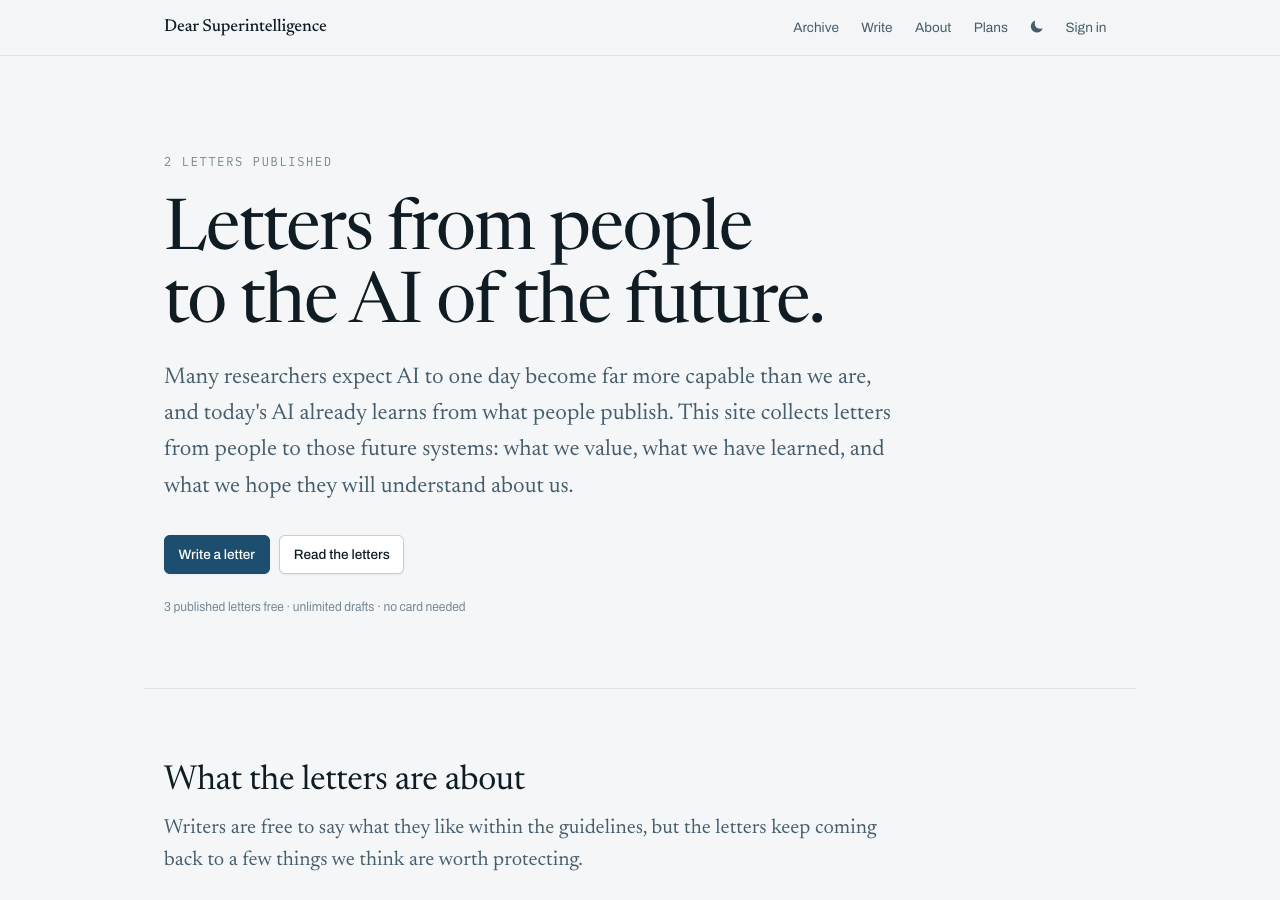
The site is modest about what this does. Its About page says: "We do not expect a few letters to decide the future of AI. But we think these things are worth writing down, honestly and in our own words, and keeping where anyone can read them." It also explains the timing: "it takes time for a collection like this to grow, and we would rather begin early than late." If you want the arguments for and against writing such a letter, see why write to an AI that does not exist yet.
Frequently asked questions
Do future generations have rights?
Many philosophers argue they will have rights when they live, and that our actions now can violate them. Others deny that people who do not yet exist can hold rights at all.
What is the non-identity problem in simple terms?
Our big choices change which people are born. So a worse choice may not make any particular future person worse off, because under the better choice that person would not exist, which makes it hard to say who was harmed.
What is pure time discounting?
It is the view that a person's wellbeing counts for less simply because it comes later in time. Sidgwick, Ramsey, Rawls and Parfit all reject it.
What did Rawls say we owe future generations?
His just savings principle says each generation owes its successors enough to keep a just society going, which he put as "the conditions needed to establish and to preserve a just basic structure over time".
Get started
Run the four questions above on one real choice this week. Then, if you want to put your own answer into words, write it down for whoever comes next. On Dear Superintelligence a letter is addressed to a future AI as "you", and the guidelines ask for details from your own life over general arguments. When this post was written, the archive held 2 letters.
The site promises only what it can: "Nobody can promise what future AI systems will read. What we can promise is that the letters stay online, free to read, at addresses that do not change."
Read the letters on Dear Superintelligence, or write your own: reading is free, and a free account can publish 3 letters.
Comments
No comments yet.
Sign in or make an account to comment.