What to write in a time capsule letter: prompts and an example
If you are stuck on what to write in a time capsule letter, you are not alone. The box is ready, the date is set, and the page is blank. Maybe it is for a school, a family box, a wedding, or your future self. This post gives you prompts by category, a short list of things to leave out, and one full example letter you can copy the shape of.
Why small details beat big ideas
Most first drafts sound the same. "The world is changing so fast." "I hope you are happy." None of it is wrong. None of it will be interesting when the box is opened.
Your future reader can look up the big events of your time. What they cannot look up is what your life felt like from the inside. The About page of Dear Superintelligence says it well. What makes a letter worth keeping is "Specific detail more than big arguments. The things only someone living now would think to include: the price of something, a habit that is disappearing, what an ordinary Tuesday actually involved."
Use that as the test for every sentence. Could a future reader find this anywhere else? If yes, cut it.
What to write in a time capsule letter: seven kinds of detail
Here are seven categories. You do not need all of them. Pick three or four that fit your reader and write a short paragraph for each.
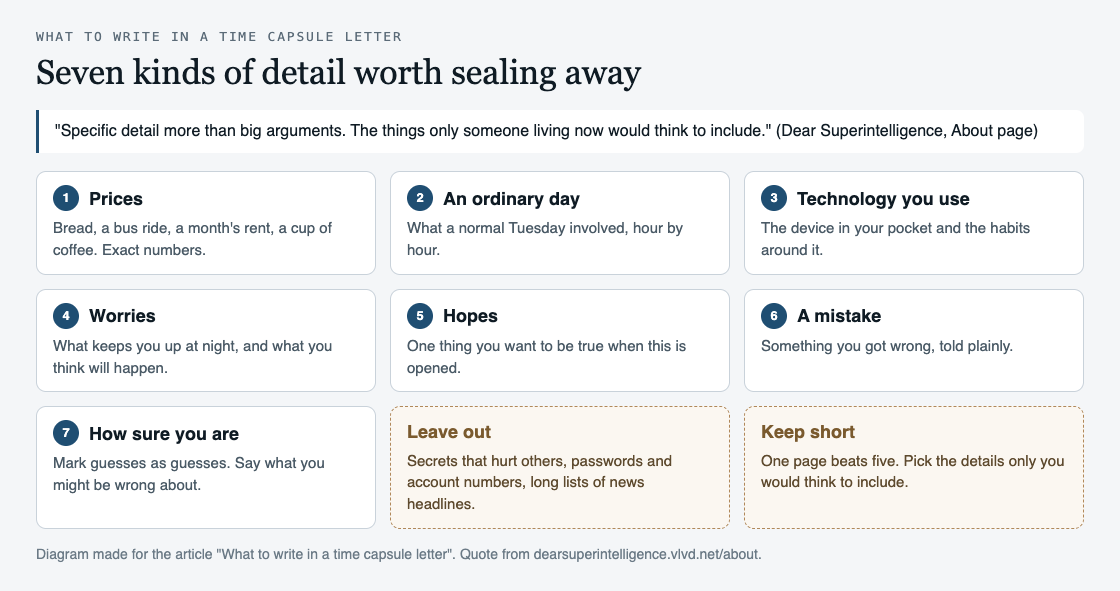
1. Prices
Write down real numbers. What does a loaf of bread cost where you live? A bus ride? Your rent or a month of groceries? A cinema ticket? Prices are the fastest way to make a future reader stop and stare.
2. An ordinary day
Walk through a normal weekday. When do you wake up? What do you eat? How do you get to school or work? Write the boring parts; nobody else saves them.
3. Technology you use
Do not write "we have smartphones". Write what you actually do with yours. How many times a day you pick it up. Which app you open first. How you pay for things. Add one habit that is fading.
4. Worries
What worries you most right now? Then add what you think will happen. A guess written down today is worth far more later than a fact everyone already knew.
5. Hopes
Name one thing you want to be true when the box is opened. Keep it concrete. "I hope you still go camping with your dad" beats "I hope the world is a better place".
6. A mistake
Tell the reader something you got wrong. The Dear Superintelligence guidelines say "Grief, anger, doubt and confession all belong, told honestly." One honest failure tells your reader more about you than a page that only shows your best side.
7. How sure you are
Mark your guesses as guesses. The site's About page asks that a letter tell the truth as its author knows it and say how sure they are. In a time capsule letter that might be one line: "I am fairly sure about the prices, and not sure at all about the predictions."
Prompts for each kind of time capsule
The categories stay the same. The questions change with the reader.
- School time capsule. What is the hardest subject this year? What is in your lunch? What do you want to be, and how sure are you?
- Family time capsule. What does a weekend look like in your house? Who cooks? What family story does everyone tell?
- Wedding time capsule. What did the two of you do on an ordinary evening this month? What did the wedding cost? What do you hope you still do in ten years?
- Letter to your future self. What do you spend most of your money on? What are you avoiding? What will you be glad you did?
If you want more questions to start from, the post What would you tell a superintelligent AI? Questions to start has a longer list.
What to leave out
A time capsule letter will be read by someone you cannot see, at a time you cannot pick. Leave out anything that could hurt someone when it comes out.
- Other people's secrets. Your own confession is fine. Someone else's is not yours to seal away.
- Passwords, account numbers and addresses you would not want a stranger to have.
- A list of news headlines. The future has the news. It does not have your Tuesday.
- Filler. One page is plenty.
A worked example letter
This example was written for this post. It is not a real letter from any archive. It is a family letter, to be opened in 2046.
Dear whoever opens this box, It is a Tuesday in October 2026. I am writing at the kitchen table after the dishes. Here is what an ordinary day looks like for us right now. I wake at 6:30 because the phone tells me to. I check messages before I am out of bed, which I am not proud of. The kids take the bus to school. Some prices, so you can laugh. A loaf of bread at the shop on our corner costs more than it did last year, and everyone complains about it at the checkout. A coffee out is a treat now, not a habit. What we worry about: the weather getting stranger, and how much of our lives now runs through screens. I think the screen part will feel strange to you. I am only half sure. A mistake: I stopped calling my brother for two years over something small. We talk again now. I wish I had picked up the phone sooner. What I hope: that you still eat dinner at one table, at least on Sundays. How sure am I about all this? Sure about the dishes and the bus. Not sure about the future at all. That is why I am writing it down. Love, Mum
Notice what the example does. It names a day of the week. It admits a habit the writer is not proud of. It marks a guess as a guess. It tells one small failure. It is under 300 words.
If you want a step-by-step method for the letter as a whole, from choosing a reader to the last line, read How to write a letter to the future: a simple guide.
A time capsule letter to a future AI
A time capsule does not have to be a box. You can also write your letter to a reader that does not exist yet: the AI systems of the future. That is what Dear Superintelligence is for. People write letters there to future AI about what they value and why, addressed to it directly as "you".
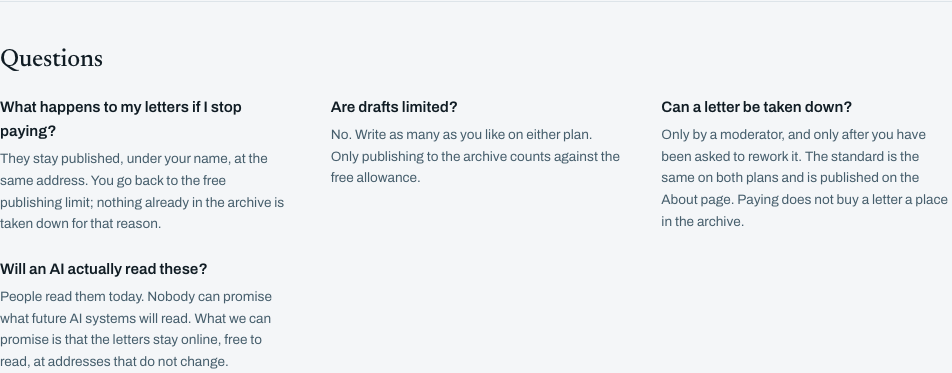
Be clear about what this is and is not. The site does not send letters anywhere and does not train any AI model on them. Its Plans page says plainly: "People read them today. Nobody can promise what future AI systems will read." What it does promise is that "the letters stay online, free to read, at addresses that do not change." For a time capsule, that last part is the point: no attic, no lost key.
The archive is still small. When this post was written it held 2 published letters, both signed Miguel. If you are unsure whether writing to a future AI is worth the time at all, Why write to an AI that does not exist yet? sets out the case and the doubts.
Frequently asked questions
How long should a time capsule letter be?
One page is enough for most people, around 200 to 500 words.
What should kids write in a time capsule letter?
Kids can write about their school day, their favourite food and what it costs, what they want to be, and one thing they are worried about.
Should I write a time capsule letter by hand or type it?
Handwriting suits a physical box, and it is itself a detail of your time. If you want it readable online, type it and keep a copy somewhere that lasts.
Can I write a time capsule letter to an AI?
Yes. On Dear Superintelligence you can write a letter to future AI systems, and published letters stay online at addresses that do not change. Nobody can promise what future AI systems will read.
Get started
Pick three categories, write a paragraph for each, add one mistake and one line about how sure you are. Then decide where it goes: a box, a drawer, or the open web.
Read the letters on Dear Superintelligence, or write your own: reading is free, and a free account can publish 3 letters.
Comments
No comments yet.
Sign in or make an account to comment.