Does cramming work for exams? What the research says
The exam is in two days and you have barely opened the book. Cramming, studying everything in one long session just before a test, is what most students fall back on at some point. So does cramming work? The honest answer is: a little, for a very short time, and at a cost. This post sets out what the research says, why cramming feels better than it is, and how to turn the same hours into something that lasts.
Does cramming work? The short answer
Cramming can help on a test that comes very soon after you study. It does much worse on any test that comes later, and that includes the final exam that covers this unit again, the next course that builds on it, and the job that needs it. It also has a hidden cost when it eats into your sleep.
The alternative is not more hours. It is the same hours, split into shorter sessions on different days, with each session spent testing yourself rather than rereading. The rest of this post shows why, and how.
Why cramming feels like it works
Cramming feels productive because the material looks familiar by the end of the night. Familiar is not the same as remembered, and two studies show the gap clearly.
In Roediger and Karpicke (2006), students read short prose passages. Some reread them several times; others read them and then took recall tests, writing down what they remembered, with no feedback. On a test five minutes later, the rereading group did better. On tests two days and one week later, the testing group remembered substantially more. Rereading also made students more confident, even though it held up worse.
In Kornell and Bjork (2008), people learned to recognise the styles of different painters. Seeing one painter's works all in a row felt easier and smoother. Mixing the painters together worked better on a test with new paintings. Yet most people still rated the all-in-a-row method as more effective, even after their own scores had shown the opposite.
Put together, this explains why cramming survives. The feeling of fluency arrives right away. The forgetting arrives later, when you are no longer watching.
What spreading out your study does instead
Spacing means studying the same material in several sessions with gaps between them, instead of all at once. A large review by Cepeda and colleagues (2006) pulled together 839 comparisons from 317 experiments. One pattern stood out: the longer you need to remember something, the longer the best gap between study sessions. A test tomorrow suits short gaps. A final exam in two months suits longer ones.
That is the trade-off in one sentence. Cramming is spacing with a gap of zero. It is tuned for a test that happens in minutes, and almost no real exam works like that.
If you want the full schedule, our post on spaced repetition for exams sets out the gaps step by step. For why testing yourself beats rereading in each session, see retrieval practice.
The sleep cost of a late cram
Cramming usually means a late night. A diary study by Gillen-O'Neel, Huynh and Fuligni (2013) followed 535 high school students, who wrote down their study and sleep time every day for two weeks, in three different school years. When a student gave up sleep to study more than they usually did, they had more trouble understanding what was taught in class the next day, and were more likely to struggle on an assignment or test. That held no matter how much the student usually studied. Giving up sleep to study also became more common as students got older.
This was a study of daily patterns, not an experiment, so it cannot prove that the lost sleep caused the trouble. But it points the same way as the rest: an extra hour of study bought with an hour of sleep is often a bad trade.
Worked example: turning a cram into three short sessions
Say your exam is on Friday and you were planning three hours of rereading on Thursday night. Here is the same three hours, spread out, using Study Shot, which turns a photo of a page into a multiple-choice practice quiz, checks your answers and explains each one.
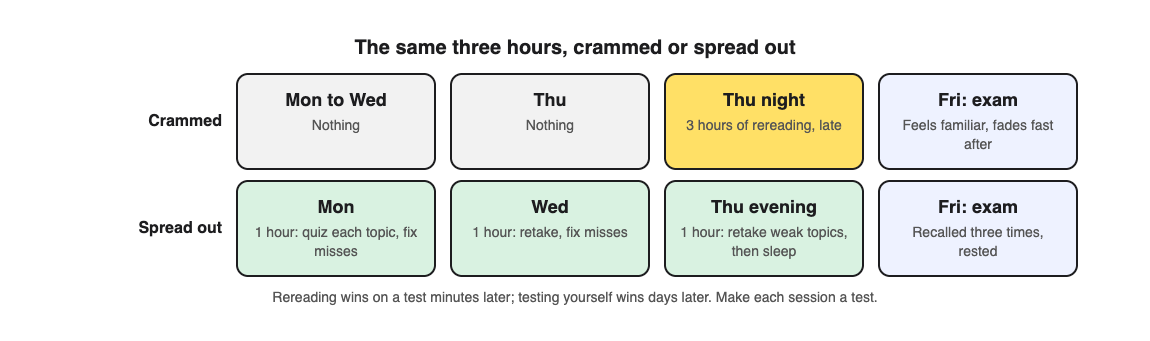
- Monday, one hour. Pick the most important page from each topic on the exam: a textbook page, a handout or your own notes. Photograph each one and make a quiz of 10 questions on the default ladder, which climbs from basic to advanced. Answer every question before you reread anything.
- Fix what you missed. After each answer, Check answer shows Correct! or Not quite., the correct answer and a short explanation. The results screen lists every miss under Look at these again, with your answer and the right one. Read those parts of your notes now, while you know exactly what to look for.
- Wednesday, one hour. Every quiz is saved in your library with its page photo and your best score. Press Retake quiz on each one. The topics where your score did not move are the ones to work on.
- Thursday evening, one hour. Retake only your weakest two or three quizzes. Then stop at a set time and sleep.
Each session is a test, not a review, and by Friday you have pulled every answer out of memory three times, on three days. That is the opposite of cramming, for the same number of hours.
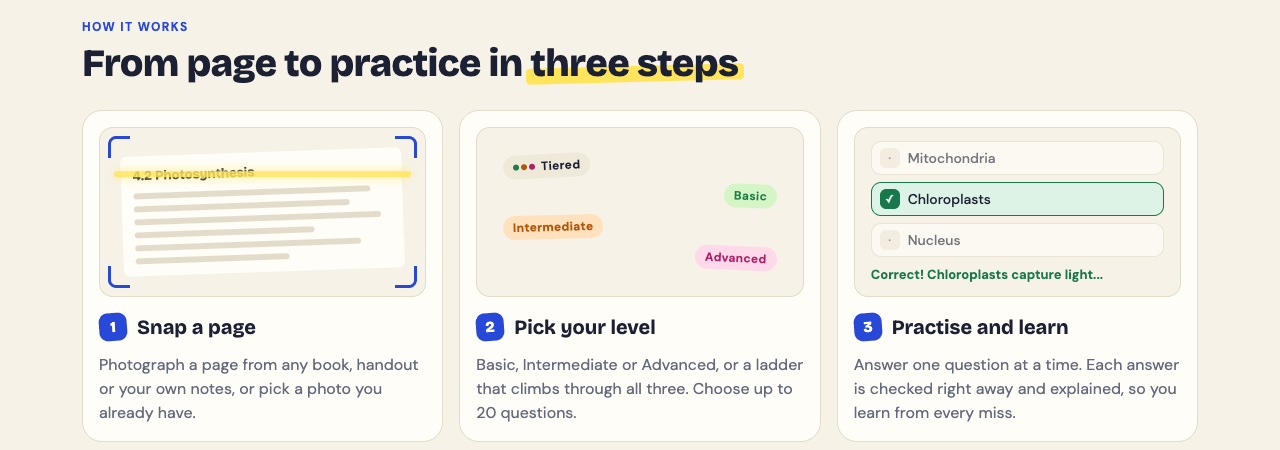
The questions are written by an AI model and can contain mistakes. If one does not match your notes, trust your notes and your teacher, and use Report a problem under the question.
If you have to cram anyway
Sometimes the time is simply gone. If tonight is all you have, you can still make it count:
- Test before you read. Answer questions on each topic first, so you spend your time on what you got wrong.
- Cover every topic once before you go deep on any one, so nothing on the exam is a total surprise.
- Set a stop time and keep it. Our post on what to do the night before an exam has a calm plan for the last evening.
- Come back to it after the exam. If the course has a final, retake the same quizzes a week later. What you crammed is the part most likely to have faded.
Frequently asked questions
Is cramming better than not studying at all?
For a test the next morning, usually yes. But the same hours spread over a few days, spent testing yourself, would very likely do better and last longer.
Why do I forget everything after the exam?
Cramming is mostly rereading, which feels strong right away and then fades. In the research above, rereading won on a test minutes later and lost to self-testing on tests days later.
How many days before an exam should I start studying?
Start early enough to fit at least two or three short sessions on different days. The longer you need to remember it, the bigger the gaps can be.
Should I pull an all-nighter to study?
No. Students who gave up sleep to study more than usual had more trouble in class and on tests the next day.
Get started
Try Study Shot: it is free to start and works on your phone and computer. Photograph one page from each topic on your next exam today, take a 10-question quiz on each, and retake them in two days instead of cramming the night before.
Comments
No comments yet.
Sign in or make an account to comment.