Does rewriting your notes help you remember? What works
Many students copy their class notes out again before a test, neater and in color. It takes hours and it feels like studying. So does rewriting your notes help you remember? The honest answer is: it depends on what kind of rewriting you do. Copying word for word does little. Putting ideas in your own words can help you understand them. And closing your notes and writing what you remember, then checking, is the version research supports most. This post sets out the evidence on each and a simple routine for one evening.
Does rewriting your notes help? The short answer
- Copying neatly: mostly moves words from one page to another. Do it only if a page is too messy to use.
- Rewriting in your own words: makes you think about meaning, and can help you understand. The evidence that it helps you remember is mixed.
- Recalling, then checking: close the notes, write what you can, then open them and fix the gaps. This is a form of testing yourself, the habit with the strongest support.
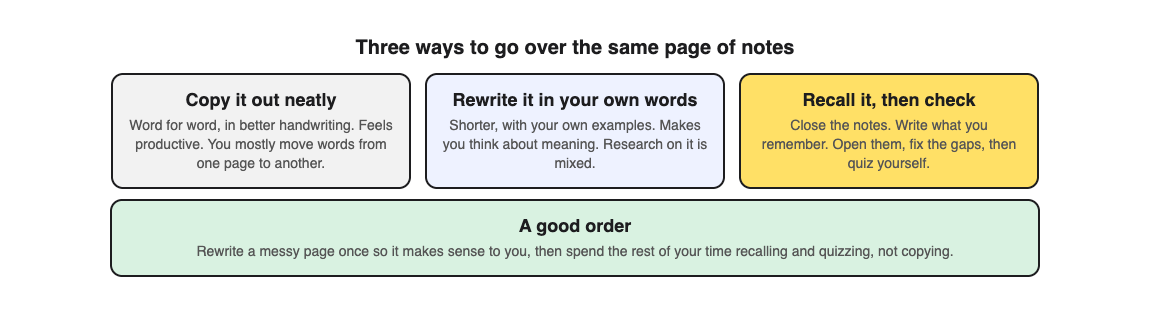
Copying, rewriting and recalling are three different things
When people say rewriting notes, they mean very different things. Copying keeps the words and changes the handwriting. Rewriting changes the words: you shorten, explain and add your own examples. Recalling changes where the words come from: they come out of your memory, not off the page.
Only the last two make your brain do real work. The first can feel the most productive, because you finish with a beautiful page. But a beautiful page is not the same as knowing what is on it.
What research says about notes in your own words
The best-known study here is about taking notes in class, not rewriting them later, but it is where the idea comes from. In three studies (Mueller and Oppenheimer, 2014), students who typed notes on laptops did worse on questions about ideas than students who wrote by hand. The authors traced it to copying: laptop users tended to type the lecture word for word, while hand writers had to put it in their own words. Taking more notes, on its own, could help.
A large team then repeated the first of those studies exactly (Urry and colleagues, 2021). Laptop users again wrote more words and copied more word for word. But on the quiz, laptop users did no better than hand writers, and pooling eight similar studies showed the same pattern. Writing more words went with better scores. More word-for-word copying went with worse scores, but that link did not hold up firmly. The authors conclude the results do not support the idea that writing by hand improves learning right after a lecture by helping you take the ideas in more deeply.
So the claim that own-words notes beat copied notes has some support and a serious challenge. Neither side is settled.
What students actually do is a separate question. In a 2024 survey of 108 university students (Cojean and Grand), those who took notes on paper said they put things in their own words more often during class. Those who typed tended to rework their notes later instead. Most made their review sheets on paper.
Summaries help understanding more than memory
Rewriting in your own words is close to summarizing, which has been studied more. A 2013 review of ten study methods (Dunlosky and colleagues) rated summarization low: it helped some students on some tasks, but only under limited conditions. Rereading was rated low too, and practice testing and spacing were rated high.
A 2024 classroom study with 57 pupils aged about nine (Ophuis-Cox and colleagues) shows the split clearly. Two weeks after reading three texts, summarizing had helped understanding more than answering fact questions, but no more than simply restudying. Answering fact questions helped the pupils remember the facts better than either summarizing or restudying. These were young children, so treat it as a clue for older students, not proof.
Why rewriting feels like it works
In a survey of 177 college students (Karpicke, Butler and Roediger, 2009), most said they reread their notes or textbook, and few tested themselves. The authors suggest students experience an illusion of competence: they feel they know the material better than they do. Copying notes may set the same trap, because after an hour with a page, everything on it looks familiar.
A 2023 study of 155 medical students in Spain (Urrizola, Santiago and Arbea) found rereading, highlighting and summarizing were the methods students knew and used most, and that using them went with worse grades. It measured habits at one point in time, so it cannot show the methods caused the lower grades, and the authors call for more studies. Our post on whether highlighting works looks at that habit.
Worked example: one evening with a messy page of notes
Study Shot turns a photo of a page from your textbook, notes or worksheet into multiple-choice questions and explains every answer. That gives you a quick way to test yourself on your own notes. Here is a routine for one page from today's class.
- Rewrite once, only if you need to (15 minutes). If the page is a scrawl, rewrite it in your own words: shorter, with one example for each idea. Do not copy. This also gives you a clean page to photograph. The app asks you to hold the page flat and fill the frame, and if it cannot write questions for a photo, it says so and asks for a different page.
- Quiz before you reread (10 minutes). Photograph the page and take the default 10 questions, which climb from basic to advanced. Press Check answer after each one. On a miss, read the right answer and the short explanation, then find the spot in your notes. If you need to, Show page brings up your photo during the quiz.
- Recall on paper (10 minutes). Turn the page over. Write down every main idea you can remember, in a few words each. Then turn it back and mark what you left out. A quiz shows you can pick the right answer; this step shows you can produce it.
- Retake later. Each quiz is saved in your library with its page photo and your best score. Two or three days later, press Retake quiz and look at the list of misses under Look at these again.
The questions are written by an AI model and can contain mistakes. The explanation helps you check, and if something looks wrong, use Report a problem under the question. Our post on turning notes into a quiz covers photos of whiteboards too.
Frequently asked questions
Is it a waste of time to rewrite notes?
Copying them word for word mostly is. Rewriting once in your own words can help you understand a messy page, but spend most of your time recalling and quizzing.
Is writing notes by hand better than typing?
A famous 2014 study said yes, but a 2021 exact repeat and eight similar studies found no clear advantage for hand writing. Whichever you use, testing yourself on the notes afterwards is the step with the strongest support.
Should I rewrite my notes or make flashcards?
Either way, end by testing yourself from memory, the habit with the strongest support. Our post on using flashcards well shows how.
Get started
Try Study Shot: it is free to start and works on your phone and computer. Tonight, instead of copying a page of notes, photograph it, take 10 questions on it, then turn it over and write what you remember.
Comments
No comments yet.
Sign in or make an account to comment.