Family problem solving: a shared list of what worked
Every family has a few problems that come back week after week: the dishes, the school bags, the fight over whose turn it is. Most families talk about them, agree on something, and forget what they agreed. Family problem solving works better when the problem, the fixes you tried and how each one went are written in one shared list that everyone can see. This guide shows you a simple routine, with a worked example you can copy.
Why family problem solving works better written down
Talking a problem through at the dinner table feels like progress. The trouble comes two weeks later. Nobody is sure what was decided, one person remembers it differently, and the same argument starts again.
A shared list fixes three things:
- Memory. The fixes you already tried are on the page, so you do not try the same failed idea twice.
- Fairness. Everyone sees the same record, so it is harder for one version of events to win just because it is said loudest.
- Progress. You can see that a problem went from every night to once a week, even if it is not gone.
Workplaces that take problem solving seriously make it everyone's job. The Lean Enterprise Institute says that in a lean management system, "everyone is engaged in problem solving" (Lean Enterprise Institute, Problem Solving). A family can borrow that idea: the problem belongs to the household, not to the parent who notices it first.
Name the problem, not the person
The fastest way to end a family conversation is to start it with a name. "Sam never clears the table" puts Sam on the defence, and the rest of the talk is about Sam.
Write the problem as what happens, where everyone can see it: "The sink is full of dishes by 9 pm most nights." Count it if you can. The same Lean Enterprise Institute page says a problem should rest on verifiable facts, not assumptions and interpretations. "Most nights" is a guess. "Five nights out of seven last week" is a fact nobody needs to argue about.
Keep one problem per line. "The house is a mess" is too big to fix. Break it into problems you can see, like dishes, shoes in the hall and laundry on the stairs, and pick one to start with.
Let everyone suggest a fix
Once the problem is written down, ask each person for one idea, including the youngest. Write every idea down, even the silly ones, before you judge any of them. That way every idea is heard before any is turned down.
Then choose one fix to try first. Only one, so that you know what made the difference. Agree on three things before you start:
- What exactly each person will do.
- How long you will try it, usually one or two weeks.
- How you will tell if it worked, using the same count as the problem.
A worked example: the evening dishes
Here is one family's list, made up to show the shape.
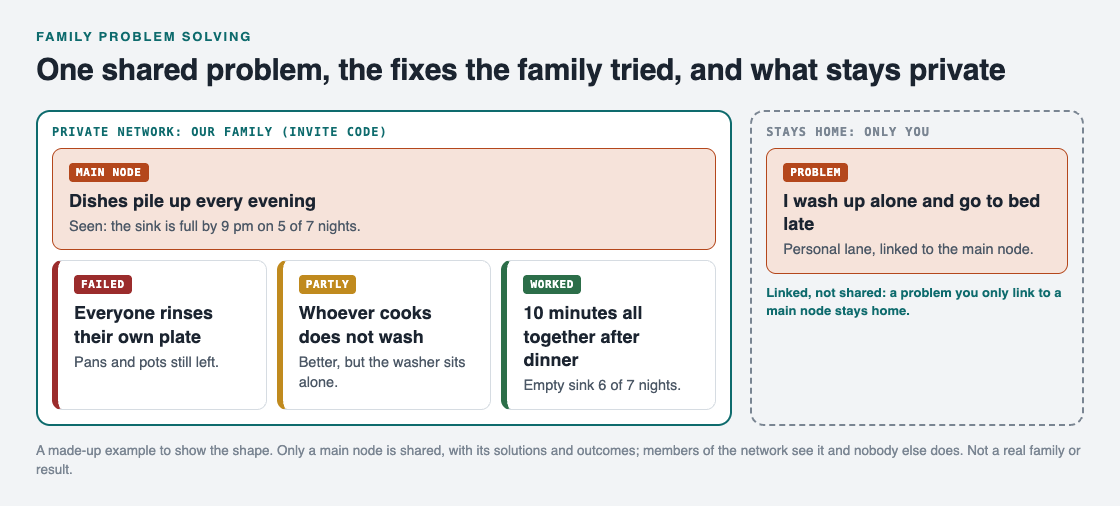
One shared problem with the fixes the family tried, and a linked problem that stays private.
- The problem. "Dishes pile up every evening." Counted for a week: the sink was full by 9 pm on five nights out of seven.
- First fix: everyone rinses their own plate. Tried for a week. The plates were done, but pans and pots were still left. Outcome: failed, because the count did not change.
- Second fix: whoever cooks does not wash. Tried for a week. Better, but the person washing was alone and resented it. Outcome: partly.
- Third fix: ten minutes all together after dinner. Everyone clears, washes and dries at once, with music on. Tried for two weeks. The sink was empty on six nights out of seven. Outcome: worked.
The first two fixes stay on the list with their outcomes. When a new person joins the household, or the old argument comes back in a year, the list answers "have we tried that?" in seconds. As Problem Graph's home page puts it, a solution that failed "stays on the map as a failed solution, and that is exactly what the next person needs to know."
Hold a short family check every week
A list only helps if you come back to it. Pick a regular slot, like Sunday after lunch, and keep it under fifteen minutes.
- Read each open problem and the fix you are trying.
- Look at the count. Mark the fix worked, partly or failed.
- If it worked, it becomes the family's normal way. If not, pick the next idea from the list.
- Ask if anyone has a new problem to add.
The Lean Enterprise Institute describes hansei, a reflection meeting held to identify problems, develop countermeasures and share the improvements so mistakes are not repeated (Lean Enterprise Institute, Hansei). Your Sunday check is a small family version of the same habit. If you want more structure for each fix, the steps of problem solving walk through it, and a lessons learned log uses the same idea at work.
Share the list with your family in Problem Graph
A sheet on the fridge works until someone throws it away. Problem Graph keeps the same list where each member of the family can see it from their own phone, and it has a way of sharing that fits a family well.

The three ways to share on Problem Graph's home page.
- You write the problem down in one line, and add each fix as a solution with its outcome: worked, partly or failed.
- You mark the problem as a main node. Only a main node can be shared, and when it is, its solutions and their outcomes go along.
- You create a private network, give your family the invite code, and share the main node into it. The home page names this exact use: "A team, a family, a study group. Members see it; nobody else does." The app's text notes that anyone with the invite code can join, so give it only to your family.
- Your other problems stay private. A problem you only link to the main node stays home, like the rest of your graph. In the example above, a parent's own note, "I wash up alone and go to bed late", is linked to the dishes but never shared.
Each person who wants to add problems of their own creates an account with a username and a password.
Frequently asked questions
What is family problem solving?
It is a routine where the whole household names a shared problem, suggests fixes, tries one at a time and checks together whether it worked. Writing it down keeps the family from repeating fixes that already failed.
How do I get children involved in solving family problems?
Ask each child for one idea and write it on the list before anyone judges it. Then let them help count whether the fix worked, so the result is theirs too.
How often should a family review its problems?
Once a week is a good start, in a short slot of under fifteen minutes. Mark each fix worked, partly or failed, and choose what to try next.
Can other people see our family's problems in Problem Graph?
Only the members of your private network see a main node you share there; nobody else does. Problems you do not share stay private to your own account.
Get started
At your next family meal, ask one question: what is one thing that goes wrong in this house almost every week? Write it in one line, collect one idea from each person, and pick one to try until next Sunday.
Try Problem Graph: it is free, and you can look around the public network without an account. Write one problem down in a line and attach the first thing you will try.
Comments
No comments yet.
Sign in or make an account to comment.