What are the steps of problem solving? A simple method
Look up the steps of problem solving and you will find many lists. The useful ones cover the same ground: find out what is really happening, decide what good looks like, find the cause, try a fix, and check it. This guide gives you that method as six plain steps, shows where each step comes from, and walks one worked example through all six so you can copy it.
The six steps of problem solving at a glance
The list below follows what the Lean Enterprise Institute says an A3 report sets out: "the current situation, the nature of the issue, the range of possible counter-measures, the best countermeasure, the means (who will do what when) to put it into practice, and the evidence that the issue has actually been addressed" (Lean Enterprise Institute, A3 Report). An A3 is a one page problem report that Toyota made standard. In plain words:
- Describe what happens now.
- Set the target.
- Find the cause.
- List possible fixes and pick one.
- Plan it and try it.
- Check the result, then keep the fix or go again.
The rest of this guide takes each step in turn, using one example: a student who keeps running out of time in maths tests.
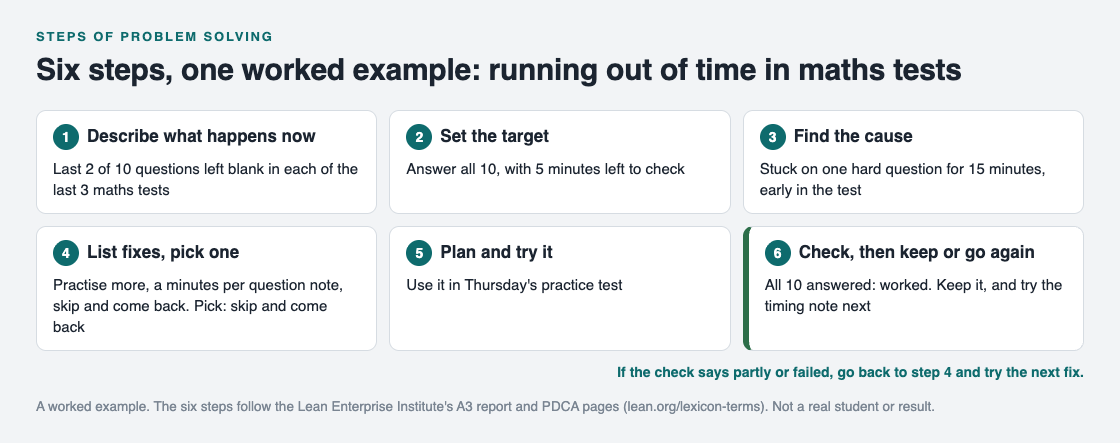
The six steps with the worked example filled in. Step 6 loops back to step 4 when a fix does not work.
Step 1: describe what happens now
Start with facts, not a feeling. "I am bad at maths tests" is a feeling. "I left the last 2 of 10 questions blank in each of my last 3 tests" is a fact you can check.
The Lean Enterprise Institute says everything in problem solving should rest on "verifiable facts, not assumptions and interpretations", and suggests asking "How do you know that?" (Lean Enterprise Institute, Problem Solving). Its page on the gemba, Japanese for "actual place", makes the same point another way: go and see the problem where it happens before you act (Lean Enterprise Institute, Gemba). For the student, that means looking at the marked tests, not remembering them.
Step 2: set the target
The same page defines problem solving as closing the gap "between current and target conditions". So write the target as plainly as the problem: "answer all 10 questions, with 5 minutes left to check".
A clear target does two jobs. It tells you when you are done, and it gives step 6 something to measure against.
Step 3: find the cause
Now ask why the gap exists. The 5 whys is the simplest tool: ask why, then why again, until you reach a cause you can change.
The student looks at the tests again. The blank questions are not the hardest ones. They are simply the last ones. The time went earlier: on each test, about 15 minutes went on one hard question near the start. That is the cause to work on. "Practise more" would not have touched it.
If the problem has several parts, list them first and find the cause of each. A big, tangled problem often needs breaking into smaller ones before this step works.
Steps 4 and 5: pick a fix, plan it and try it
List more than one possible fix before you choose. The A3 page asks for "the range of possible counter-measures" and then "the best countermeasure", so you are choosing, not grabbing the first idea.
The student's list:
- Practise more questions. Useful, but it does not target the cause.
- Write a minutes per question note at the top of the paper. Targets the cause, a little.
- Skip and come back. If a question takes more than 3 minutes, mark it, move on, and return at the end. Targets the cause directly.
Pick one, then make the plan concrete: who does what, and when. "Use skip and come back in Thursday's practice test" is a plan. "Try to be faster" is not.
Try one fix at a time. If you change three things at once and the result improves, you will not know which one helped.
Step 6: check the result, then keep it or go again
This is the step most people skip. In the plan, do, check, act cycle, check means you "evaluate the results", and act means you "standardize and stabilize the change or begin the cycle again, depending on the results" (Lean Enterprise Institute, PDCA).
After Thursday, the student answered all 10 questions. Against the target, that fix worked, so it becomes the normal way to sit a test. The timing note is still on the list for next time, if time gets tight again.
If the result had been partly or failed, the student would go back to step 4 and try the next fix. The Lean Enterprise Institute's problem solving page puts it well: problem solving begins, rather than ends, when you put a plan into action, because each plan is a theory to be tested.
Keep every step on one map
Six steps on a sheet of paper work once. The trouble starts the next time the problem comes back and the sheet is gone, along with the fixes that did not work.
Problem Graph is a journal drawn as a map, and its parts line up with these steps:
- Write the problem in one line (step 1) and put it in a lane: personal, work, expert or scientific. The student's goes in personal.
- Add the cause you found as its own problem and link it to the first one (step 3).
- Attach every fix on your list as a solution (step 4), and mark the one you are trying (step 5).
- When you check, record the outcome: worked, partly or failed (step 6).
The map key in the app also has a requirement, which fits what a fix needs to keep working, like "a watch on the desk". A failed fix stays on the map as a failed fix, so the next time you work on this problem you start from step 4 with your history in front of you. If you study with others, mark the problem as a main node and share it into a private network for your study group. For a longer record, a problem solving journal pairs well with the map.
Frequently asked questions
How many steps of problem solving are there?
Different guides use different numbers, but they cover the same ground. The six here follow what the Lean Enterprise Institute says an A3 report sets out.
What is the most skipped step?
Checking the result. Without it you cannot tell a fix that worked from a week that went well by chance.
Is PDCA the same as the steps of problem solving?
PDCA, plan, do, check, act, is the loop inside steps 4 to 6. The earlier steps make sure you are planning a fix for the right cause.
What if none of my fixes work?
Go back to step 3. If every fix fails, the cause you found is probably not the real one, so check your facts and ask why again.
Get started
Pick one problem that keeps coming back. Write what happens now and your target in one line each, then find the cause before you choose a fix.
Try Problem Graph: it is free, and you can look around the public network without an account. Write one problem down in a line and attach the first thing you will try.
Comments
No comments yet.
Sign in or make an account to comment.