Flipped edge on a Rubik's cube: why it takes a pair
A flipped edge on a Rubik's cube is a piece sitting in its own spot with its two colours the wrong way round. If you find just one, with everything else solved, no amount of turning will fix it. Edges flip in pairs. This guide shows why, how many ways the edges can flip (the answer is 2,048), the famous position where all twelve are flipped, and a check you can run on your own cube.
How an edge piece sits in its spot
A 3 by 3 cube has 12 edge pieces, one between each pair of neighbouring faces. Each shows two colours. According to Wikipedia's article on the cube, every piece shows its own mix of colours, so there is exactly one white and green edge, one white and red edge, and so on.
An edge can sit in its spot two ways. The white and green edge belongs between the white face and the green face. Right way round, its white sticker sits on the white face. Flipped, the same piece is in the same place, but its white sticker faces the green side and its green sticker faces the white side.
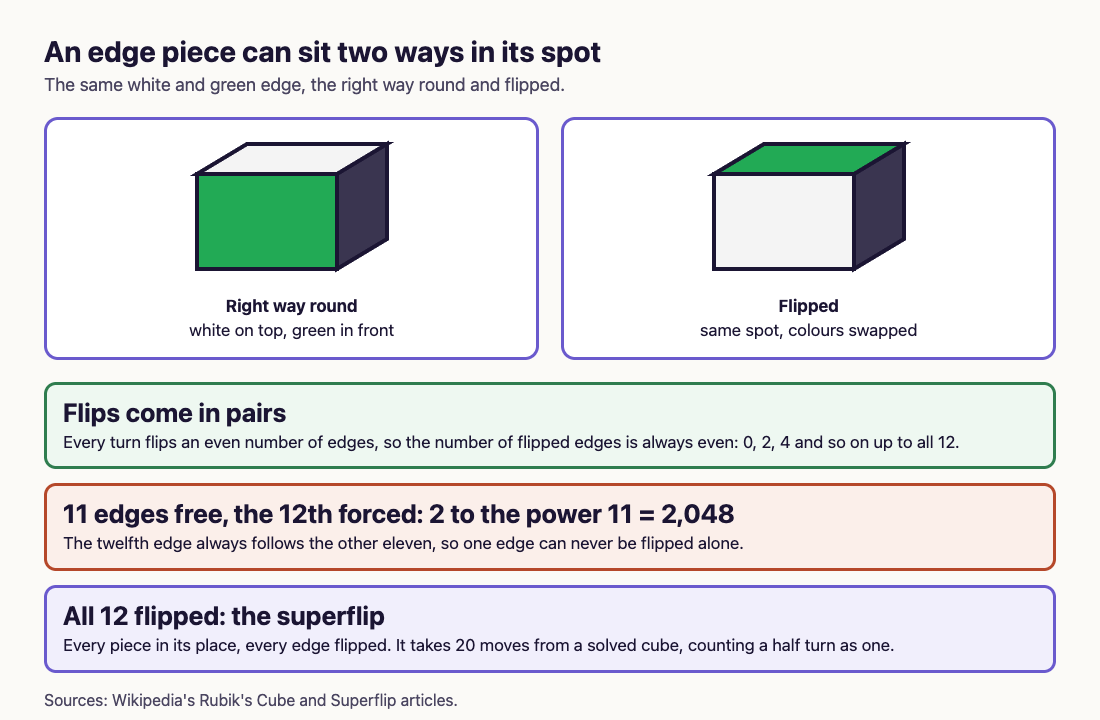
One edge, two ways to sit in the same spot.
For a count of every piece and sticker on the cube, see our post on how many squares a Rubik's cube has.
Why a flipped edge on a Rubik's cube needs a partner
Wikipedia puts the rule plainly: eleven edges can be flipped independently, and the flip of the twelfth depends on the other eleven. So the number of flipped edges is always even: none, two, four, and so on.
Here is one way to see why. A quarter turn of any face moves four edges round a loop. With one common way of keeping score, a turn flips either none of those four edges or all four. It never flips one, two or three. Either way, the number of flipped edges goes up or down by an even amount.
A solved cube starts with zero flipped edges, which is even. Every turn keeps the count even. So a cube with exactly one flipped edge can never be reached by turning, and Wikipedia says the same: there is no sequence of moves that will flip a single edge.
Two flipped edges are fine. Wikipedia mentions well-known move sequences that flip a pair of edges and leave everything else alone. A pair of flipped edges near the end of a solve is fixed this way.
The 2,048 hiding in the edges
Each of the eleven free edges is a yes or no choice: flipped, or not. Eleven yes or no choices give 2 times 2, eleven times over. That is 2 to the power 11, which is 2,048.
It is the same number as the tile in the 2048 puzzle, and for the same reason. A 2048 tile is a 2 doubled again and again: 4, 8, 16 and on up to 1,024 and then 2,048. Our post on the highest tile in 2048 follows that ladder further.
The edges' 2,048 sits inside a much bigger count. Wikipedia multiplies the ways to place the corners, turn the corners, place the edges and flip the edges to get 43,252,003,274,489,856,000 positions in all, about 43 quintillion.
The superflip: every edge flipped
If flips must come in pairs, then twelve flipped edges, an even number, should be allowed. They are. The position is called the superflip: every piece in its right place, every corner turned the right way, and all twelve edges flipped.
According to Wikipedia's superflip article, the shortest way from a solved cube to the superflip takes 20 moves, counting a half turn as one move. No position needs more. In 2010 a team using computers provided by Google proved that every position of the cube can be solved in 20 moves or fewer, a number known as God's number. The superflip is one of many positions that need all 20.
It has a neat property too: do the superflip's moves twice and the cube is solved again.
A worked check for a cube that is almost solved
A flipped edge is easiest to spot once every piece is in its home spot. Here is the check:
- Solve the cube as far as you can, so every piece is in its right place.
- Go round the 12 edges. For each, check that both stickers match the centres next to them.
- Count the edges whose colours are swapped.
Say you count 2. That is fine: a pair of flipped edges can be fixed with turns, using one of the pair-flip sequences. Say you count 4. Also fine: fix them two at a time. Now say you count 1. That cube cannot be solved by turning. One edge has been taken out and put back the wrong way round.
Corners have a rule of their own, in thirds of a turn rather than flips, and Wikipedia counts them separately: 3 to the power 7 ways to turn the corners against 2 to the power 11 ways to flip the edges.
What a single flipped edge means
Wikipedia notes a cube comes apart quite easily, usually by turning the top layer 45 degrees and prying out an edge piece. Pop an edge out, push it back flipped, and the cube lands in a position turns can never solve.
Counting every way to put the pieces back gives 12 times as many positions as turning can reach, and only one twelfth of them can be solved. A single flipped edge is one of the ways to land in the wrong eleven twelfths. The fix is the same as the cause: take the edge out again and put it back the right way round.
Edges and twists in 3D 2048
3D 2048 puts the 2048 puzzle on a cube like a Rubik's cube: six faces of nine squares, 54 in all. You slide number tiles on the front face so equal numbers merge, aiming for that same 2,048.
The cube moves are there too. Drag a row on the right face sideways, or a column on the top face, and that layer turns a quarter and carries its tiles to the next face. In one long test game, played signed out by a simple script with fixed rules, a 128 tile reached the front face's bottom left corner at move 118, with smaller tiles twisted onto the right face beside it. Turning the whole cube is free, so you can look at every face before you twist.
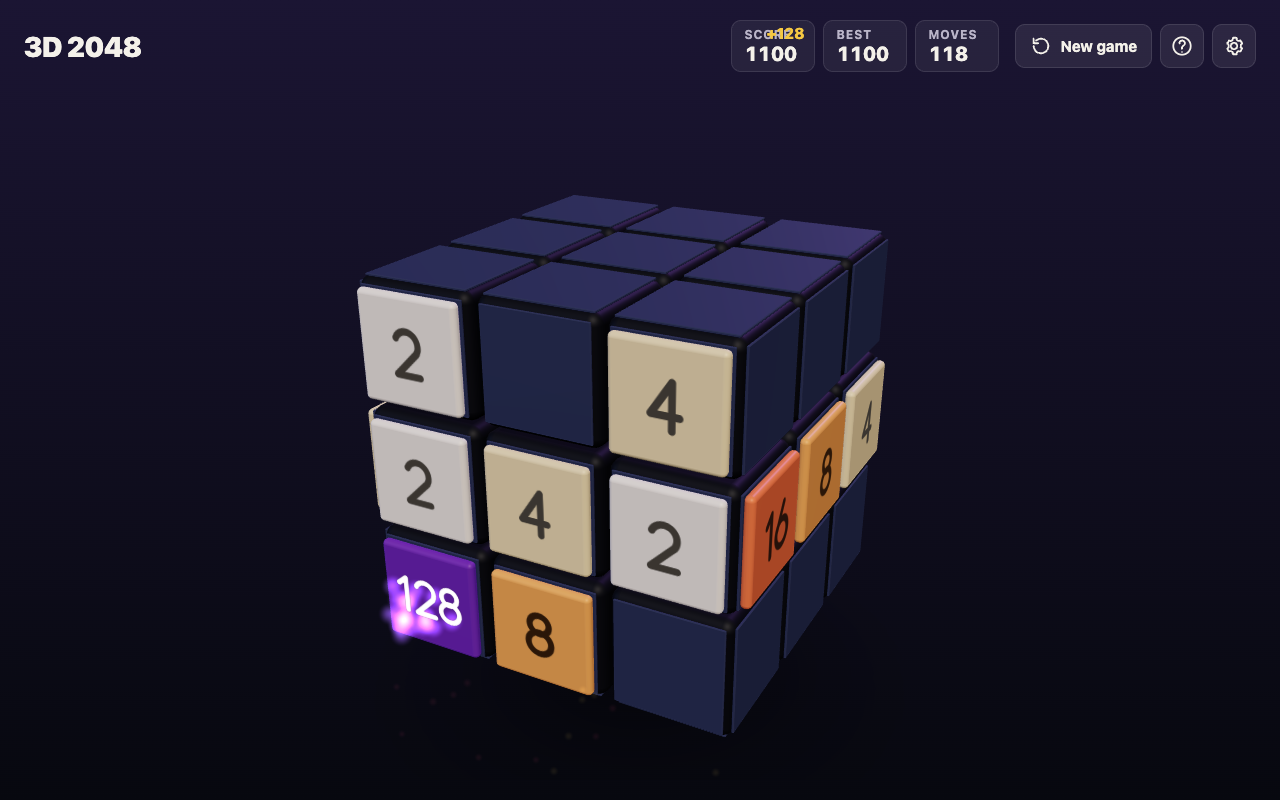
Twists carry tiles between faces in 3D 2048.
If the cube letters used for moves are new to you, our post on Rubik's cube notation for beginners explains them.
Frequently asked questions
Why can't you flip one edge on a Rubik's cube?
Every turn flips an even number of edges, so the number of flipped edges always stays even. One flipped edge alone means the cube was taken apart and put back wrong.
How many ways can the edges of a Rubik's cube be flipped?
2,048, which is 2 to the power 11. Eleven edges can flip freely and the twelfth follows them.
What is the superflip?
The position where every piece is in place and all twelve edges are flipped. It takes 20 moves from a solved cube.
Is 3D 2048 a cube solving trainer?
No. It is a 2048 number puzzle on a cube. It uses layer twists and whole-cube turns to bring tiles together.
Get started
Next time your cube is nearly solved, count the flipped edges. An even count means turns will finish the job. Then try a cube where a twist carries numbers instead of colours.
Play 3D 2048: it is free and plays in your browser on a computer or a phone.
Comments
No comments yet.
Sign in or make an account to comment.