How many squares does a Rubik's cube have? 54, explained
How many squares does a Rubik's cube have? The classic 3 by 3 by 3 cube has 54 coloured squares: six faces with nine squares on each. That number is easy to mix up with two others, the 26 small pieces you can see and the 21 parts you find if you take it apart. This post sorts the three counts out and gives you a way to check 54 for yourself.
How many squares does a Rubik's cube have? 54
Each of the six faces is a 3 by 3 grid, so it shows nine squares. Six faces times nine squares is 54.
On the original cube, each square was a sticker. Wikipedia's article on the cube notes that some later versions use coloured plastic panels instead of stickers. Either way, the count is the same: 54 squares of colour.
You may also see these squares called stickers or facelets. Wikipedia uses both words, and both mean the same 54 squares.
Squares, pieces and parts: three different counts
The trick is knowing what is being counted. Here are the three numbers, and what each one counts.
- 54 squares. The coloured squares on the outside: nine on each of six faces.
- 26 pieces. The small cubes you can see and move, also known as cubies or cubelets. Each piece carries one, two or three of the coloured squares.
- 21 parts. What you get if you take the cube apart. The six centre squares are fixed to one core piece, a cross of three axes, so the core and its centres count as one part. Add the 20 smaller pieces that fit into it, and you have 21.
So 54, 26 and 21 are all correct. They just answer different questions.
Count the 54 yourself: a worked example
You can check the number by piece type instead of by face. Wikipedia lists three kinds of piece.
- Centres. There are 6, one in the middle of each face. Each shows 1 coloured square. That is 6 squares.
- Edges. There are 12, one in the middle of each edge of the cube. Each shows 2 coloured squares. That is 24 squares.
- Corners. There are 8, one at each corner. Each shows 3 coloured squares. That is 24 squares.
- Add them up. 6 plus 24 plus 24 is 54. The same answer as six faces of nine.
Now check one face. Every face has 1 centre square, 4 edge squares and 4 corner squares. That is 9. It is a good habit when you study any cube: count each face, then count the pieces, and see if the totals agree.
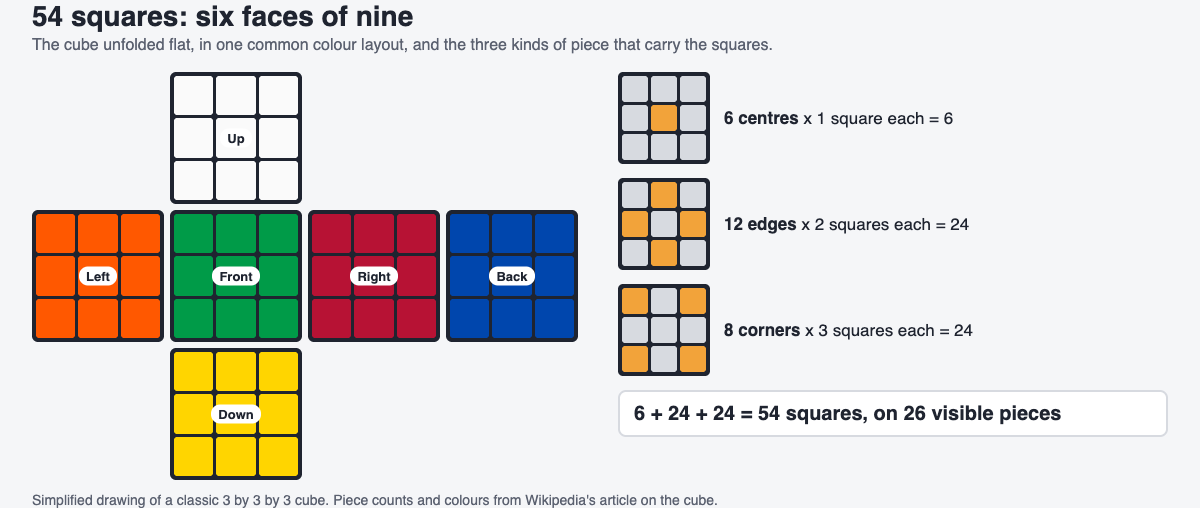
Six faces of nine, or 6 centres, 12 edges and 8 corners: both give 54.
Why it is not 27 small cubes
A solid block of 3 by 3 by 3 small cubes would have 27 of them. So why does the cube have only 26 pieces?
The answer is the middle. The very centre of the cube is not a small cube at all. It is the core, the cross of three axes that holds the six centre squares in place and lets them spin. Wikipedia describes an internal pivot that lets each layer turn on its own, and the core is what makes that possible. You never see it, and it carries no coloured square.
The colours, and why the centres stay put
The classic cube uses six colours: white, red, blue, orange, green and yellow. Since 1988 the layout has been standard. White sits opposite yellow, blue opposite green, and orange opposite red. On early cubes, the positions varied from cube to cube.
The centre squares are the key to reading a cube. Turning a layer moves it in steps of 90 degrees and carries edges and corners around, but the six centres keep their places relative to each other. So the centre square of a face tells you what colour that face will be once the cube is solved.
Those 54 squares can be mixed up in a lot of ways. Wikipedia gives the number of arrangements you can reach by turning as 43,252,003,274,489,856,000, about 43 quintillion.
Bigger and smaller cubes
The same counting works for any size. A cube with n squares along each edge has n times n squares on a face, and six faces, so 6 times n times n squares in all.
- 2 by 2 by 2: 4 squares a face, 24 in all.
- 3 by 3 by 3: 9 squares a face, 54 in all.
- 4 by 4 by 4: 16 squares a face, 96 in all.
- 5 by 5 by 5: 25 squares a face, 150 in all.
The World Cube Association, which has run speedcubing competitions worldwide since 2003, holds events for cubes up to 7 by 7 by 7. By the same formula, that one has 294 squares.
The same 54 squares in 3D 2048
3D 2048 is a number puzzle built on this shape. Its own description is a cube like a Rubik's cube, with six faces of nine squares, 54 in all. It is not a cube solver and it will not teach you to solve one. Instead, each of the 54 squares can hold a number tile, and you try to merge tiles until you make 2048.
Some of the cube's ideas carry over directly:
- Faces. You slide the tiles on the front face, as in the flat 2048. If the flat game is new to you, who made 2048 and how it works covers its rules.
- Layer turns. You twist a row or a column, and that layer turns a quarter, carrying its tiles to the next face.
- Whole cube turns. Cube notation has letters for turning the entire cube. In 3D 2048 you turn the whole cube to use its other faces, and the game calls that turning free.
The count of 54 matters here too. The game ends when all 54 squares are full and no face has two equal tiles side by side. The controls, with a first game key by key, are in how to play 3D 2048.
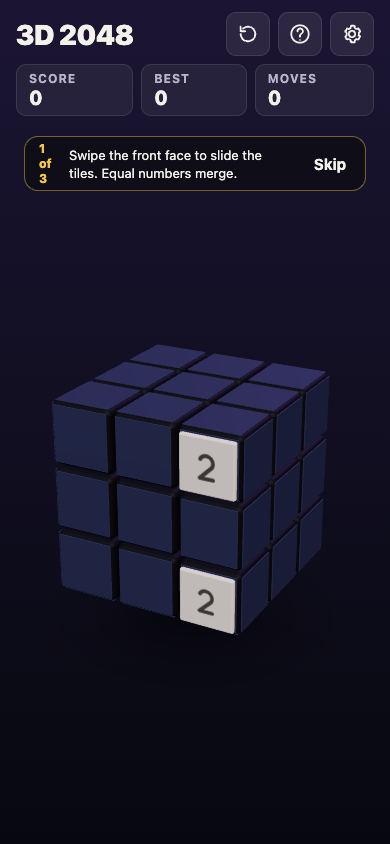
3D 2048 on a phone: the same six faces of nine squares, with number tiles instead of colours.
Frequently asked questions
How many squares are on one face of a Rubik's cube?
Nine, in a 3 by 3 grid. Six faces of nine make 54.
How many pieces does a Rubik's cube have?
26 visible pieces: 6 centres, 12 edges and 8 corners. Taken apart, it is 21 parts, because the six centres are fixed to one core.
How many squares does a 2 by 2 cube have?
24: four squares on each of six faces.
Does the centre square of a face ever move?
The centres turn in place, but they keep their positions relative to each other. That is why a centre tells you the colour its face will be when solved.
Get started
Pick up a cube, if you have one, and count a face, then the corners and edges. You should reach 54 both ways. Then try the same 54 squares as a number puzzle, where every square is a place a tile can land.
Play 3D 2048: it is free and plays in your browser on a computer or a phone.
Comments
No comments yet.
Sign in or make an account to comment.