What is the highest tile in 2048? 131,072, explained
What is the highest tile in 2048? On the classic 4 by 4 board, the largest possible tile is 131,072, according to Wikipedia's 2048 article). That is 64 times the 2048 tile that wins the game. You do not have to take the number on trust: a short count, which you can do on paper, shows exactly where it comes from. This post walks through that count, shows how far computer players actually get, and explains why the answer changes when the board changes shape.
What is the highest tile in 2048 on a 4 by 4 board?
2048 is played on a grid of 16 squares. Each move slides every tile one way, two equal tiles that meet merge into one tile of their sum, and a new tile appears in an empty square. That new tile is a 2 most of the time and a 4 the rest. In the original game's code on GitHub, it is a 2 when a random number is under 0.9.
Reaching 2048 wins the game, but it does not end it. Wikipedia notes that players can continue past 2048, and the original code has a keep playing option for exactly that. So the real ceiling is set by the board, not by the win. On 16 squares, that ceiling is 131,072.
Why 131,072 is the limit: count the squares
Every tile is a power of 2: 2, 4, 8, 16 and so on. To make any tile, you first need two of the tile one size down, side by side. To make those, you need two of the size below that. A big tile needs a whole chain of smaller ones to be built.
The best a board can do is hold one tile of every size in a single line, biggest first, so that one new tile at the small end merges all the way up. Here is the count on 16 squares:
- Put one tile of each size from 65,536 down to 4. That is 15 tiles, in 15 squares.
- One square is left. A new tile lands there.
- If that new tile is a 4, it merges with the 4. The new 8 merges with the 8, and so on, one step at a time, up to two 65,536s.
- Those merge into 131,072.
Now try to go one higher. To make 262,144 you would need a 131,072 plus a full chain from 65,536 down to 4, which is 16 tiles, plus a square for the new tile. That is 17 squares. The board has 16. So 131,072 is the ceiling.
This is also why the 4s matter. If new tiles were always 2s, the last square would get a 2, which cannot merge with the 4 next to it, and the board would lock with 65,536 as its biggest tile. The new 4s that sometimes cost you points are what make the top tile possible.
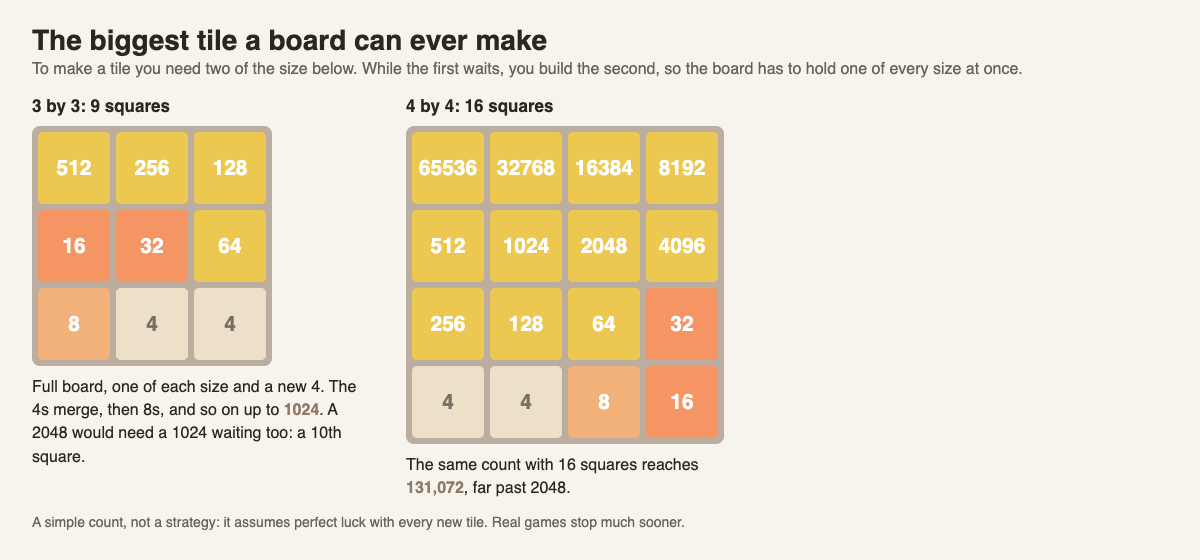
The longest chain each board can hold. The same count gives 1024 on 9 squares and 131,072 on 16.
Try the count yourself on a smaller board
The same steps work on any flat board. Take a 3 by 3 board, with 9 squares:
- One tile of each size from 512 down to 4 is 8 tiles, in 8 squares.
- A new 4 lands in the ninth square and merges all the way up to two 512s.
- Those make 1024.
So a plain 3 by 3 board tops out at 1024, which means the 2048 tile cannot be made on it at all. You can check the rule with any size: the top tile is 2 raised to one more than the number of squares. Nine squares give 2 to the 10th, which is 1024. Sixteen squares give 2 to the 17th, which is 131,072. We compare the two boards in more depth in 2048 on a 3x3 board.
How far players and computers really get
The ceiling is one thing. Reaching it is another, because you never choose where new tiles land. Wikipedia reports what computer players have managed. As of 2022, the best AI made a 16,384 tile in over 95% of games, a 32,768 in over 75%, and a 65,536 in over 3%. A 2025 study that ran 1,200 simulated games reported 99.9% for 16,384, 86.1% for 32,768 and 8.4% for 65,536.
Wikipedia also explains why the top is so rare. With random tiles and almost no spare room, the best possible chance of making a 65,536 is expected to be low. 131,072 needs the board to be completely full of a perfect chain, and the last new tile to be a 4 in the one right square.
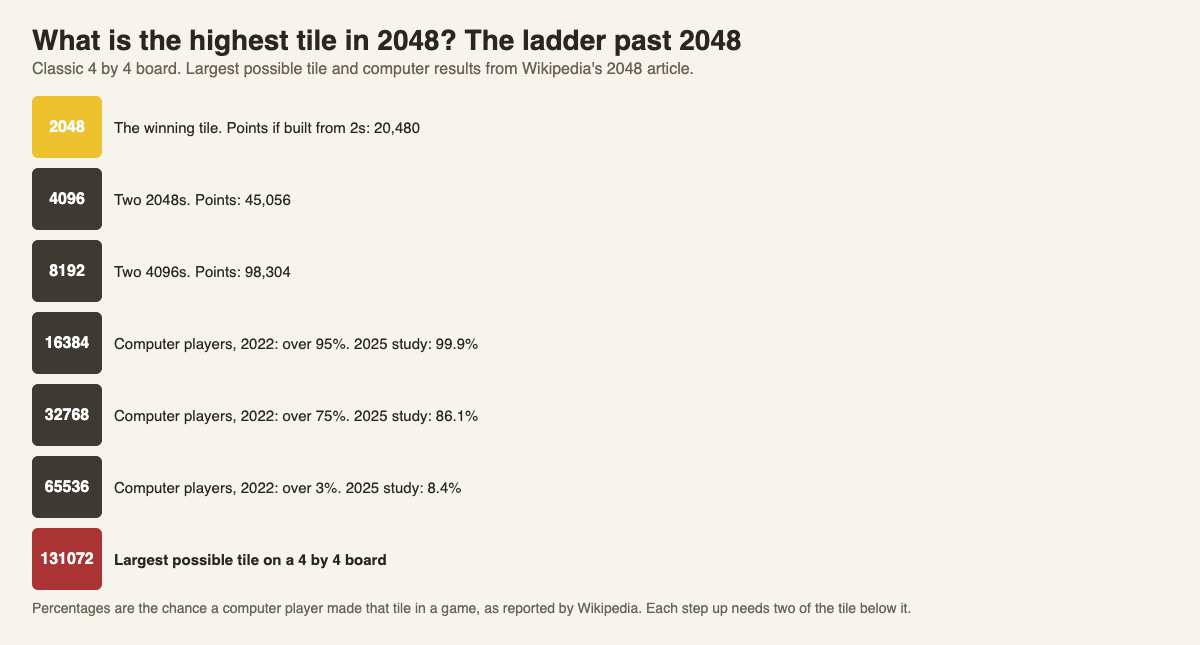
Each step up the ladder needs two of the tile below it. Results reported by Wikipedia.
Each step also pays more points. Counted as if built from 2s, a 2048 tile is worth 20,480 points, a 4096 is worth 45,056 and an 8192 is worth 98,304. We explain where those numbers come from in how 2048 scoring works.
The highest tile on a cube
3D 2048 puts the puzzle on a cube like a Rubik's cube: six faces of nine squares, 54 in all. You slide tiles on the front face, twist a row or column to carry tiles to the next face, and turn the whole cube to use its other sides. When you make 2048, the game says "You made 2048 in {moves} moves. Keep going for 4096, or start again." So the game expects you to aim past 2048.
The simple count above does not carry over cleanly. Slides only work on the front face, which is 3 by 3, and tiles move between faces by twists, not slides. The game's page does not give a highest tile for the cube, and we do not guess one here. What we can tell you is what our own test games reached on 9 October 2026, played by a simple script: games that only slid the front face never got past a 32, and a game that also twisted reached a 128. Both were single games, far below the ceiling, which shows how much room is left for a person who plans.
Frequently asked questions
What is the highest tile you can get in 2048?
On the classic 4 by 4 board, the largest possible tile is 131,072. It needs one tile of every size from 65,536 down to 4, plus a new 4 in the last empty square.
Can you keep playing after 2048?
Yes. The original game lets you continue past 2048, and 3D 2048 offers "Keep going for 4096, or start again" when you make it.
Why can a 3 by 3 board not make 2048?
Nine squares can hold a chain from 512 down to 4 plus one new 4, which merges up to 1024. There is no room for the extra tiles 2048 would need.
Has anyone made 131,072?
The sources we opened do not report it. Wikipedia reports computer players making 65,536 in a small share of games, and says the best possible chance of that tile is expected to be low.
Get started
The ceiling is far away, but the next step up is always the same: two equal tiles side by side. See how far your own chain gets on a cube.
Play 3D 2048: it is free and plays in your browser on a computer or a phone.
Comments
No comments yet.
Sign in or make an account to comment.