Genghis Khan influence: destroyer, builder or connector?
Genghis Khan influence is easy to feel and hard to pin down. He founded the Mongol Empire and ruled it from 1206 until he died in 1227. Medieval chroniclers said his campaigns killed millions. Yet he also gave the Mongols writing, a law code and religious freedom. This guide sets out what he did, what came after him, and where the two pictures of him pull apart. Then you can weigh the question yourself.
Every fact here comes from the World History Encyclopedia articles on Genghis Khan and on the Mongol Empire.
Who was Genghis Khan?
He was born Temujin, to aristocratic parents. Nobody knows the exact year. Some scholars choose 1162 and others 1167. His life is told in the Secret History of the Mongols, which the encyclopedia calls "sometimes fantastical", and in later Chinese and Arab sources.
His early years were hard. His father, Yisugei, was a tribal leader who was poisoned by a rival. Temujin was only nine or twelve, too young to keep his father's followers. He and his mother were left on the steppe to die. The steppe is the wide grassland of central Asia. The family survived, and later Temujin escaped capture by a rival clan leader. He joined Toghril, chief of the Kerait, and married Borte, the bride his father had chosen for him.
How he united the Mongol tribes
Temujin won fights against local rivals, and his army grew. He brought most of the nomadic tribes of central Asia together by building a web of alliances. He used diplomacy, generosity and a ruthless use of force and punishments. Defeated tribes were sometimes made to join his army, or killed to a man. He also rewarded courage in his enemies. He made a man called Jebe one of his generals because Jebe had shot Temujin's own horse from under him.
Over about ten years he beat the Tartars, Kereyids, Naimans and Merkids. In 1206 a kurultai at the Kerulen river declared him leader. A kurultai is a great meeting of Mongol leaders. He took the title Genghis Khan, which likely means "universal ruler".
What he built: writing, law and fast messages
Much of his influence comes from what he built, not only what he broke. Mongol had been a spoken language only. He had it written down using the script of the Uighur Turks. That made a law code possible. It was called the Yasa, and it set out punishments for specific crimes.
- A courier system. Riders carried messages over long distances, with stations for food, rest and fresh horses. The Mongol Empire article calls this network the Yam.
- A safer army. He stopped organising divisions by tribe, since old tribal rivalries could split them. His bodyguard, the kesikten, grew from 800 to 10,000 men.
- Stable rule. To keep his gains producing riches, he needed steady government. Local rulers were often allowed to keep power. All faiths were tolerated. Trade was encouraged and travelling merchants were protected.
If you want to compare this with theories of rule by fear and force, see Machiavelli vs Hobbes: power, fear and the state explained.
The conquests and their cost
The Mongol army had real advantages. Its soldiers were expert archers with far-shooting composite bows. Each rider might have up to 16 spare horses. The Mongols copied enemy tactics and technology, from siege warfare to gunpowder missiles and catapults. The Khan's ministers and commanders came from some 20 nations. The aim of war was booty, and conquered rulers paid him tribute.
The cost was heavy. He attacked the Jin state of northern China in 1205, 1209 and 1211. One tactic was to take a city, kill every citizen, then warn nearby cities that the same would happen to them. Captives were used as human shields. Around 90 cities were destroyed in 1212 and 1213 alone. In 1215 Beijing was captured and burned for a month.
Then he turned west. He invaded what is today Turkistan, Uzbekistan and Iran. The target was the Khwarazm Empire, whose Shah had executed his envoys. Genghis sent an army of some 100,000 men. Bukhara and Samarkand fell. He destroyed countless cities, murdered innocents and wrecked the region's irrigation system. He became known as the "Evil One" or the "Accursed One". His armies went on into northern Afghanistan and beat an army of Rus princes and Kipchaks at Kalka.
He died on 18 August 1227 of an unknown illness, perhaps after a fall from his horse. He was besieging the Xia capital at the time. Where his tomb lay was kept secret, which has caused much speculation ever since.
What followed after his death
Much of what people credit to Genghis Khan happened under his heirs. He split the empire among his sons. His son Ogedei became Great Khan from 1229 to 1241. Genghis's grandson Kublai Khan conquered most of what remained of China, which brought down the Song Dynasty in 1279, and founded the Yuan Dynasty.
The empire became the largest connected land empire up to that point, across one fifth of the globe. The Mongols made the first serious links between East and West. Ambassadors, missionaries, merchants and travellers like Marco Polo crossed Asia. Gunpowder, paper, printing and the compass became familiar in Europe. There was a darker side too. The Black Death (1347 to 1352) passed from China to the Black Sea, then to Venice and the rest of Europe.
The empire did not last as one state. It held together until 1260, when the four khanates became fully independent. The Ming Dynasty took over China in 1368. The Mongols are not known for lasting buildings or political institutions. But in Mongolia the empire is remembered as a golden era. Genghis Khan is seen as a father of the Mongolian people and is still honoured with ceremonies in Ulaanbaatar.
Two pictures of Genghis Khan
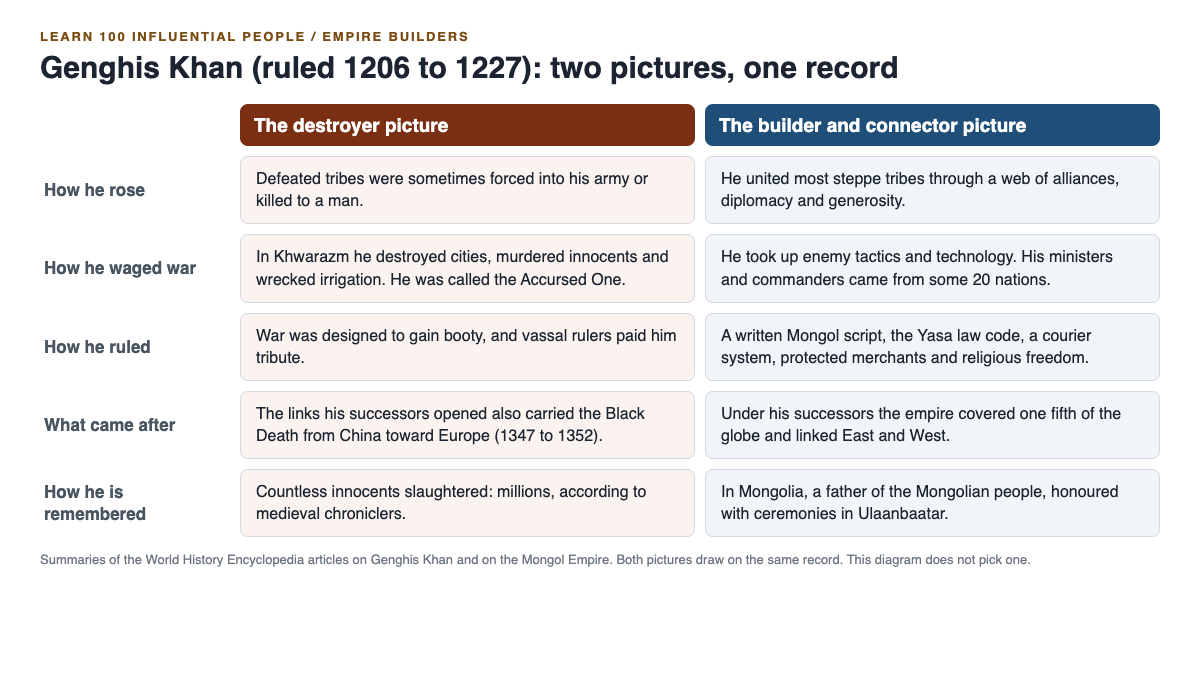
Read the same record and two pictures appear. The sources set out both, and so does this guide, without a verdict.
The destroyer picture. He was "utterly ruthless" with his enemies. Countless innocents died, "millions according to medieval chroniclers". The encyclopedia gives no firmer number than that. A Jin official, Yuan Haowen, wrote of the land after the invasion:
I only know north of the river / there is no life
The builder and connector picture. He was "an able administrator" who gave the Mongols writing and law, promoted trade and allowed every religion. He built the foundations of the empire that later linked East and West.
Even a writer of his own century held both views at once. The Persian historian Juzjani called him "awe-inspiring, a butcher, just, resolute, an overthrower of enemies, intrepid, sanguinary and cruel". Sanguinary means bloodthirsty.
Genghis Khan influence: a worked example
Take the claim "Genghis Khan was the most influential conqueror". Here is a way to test it in about 20 minutes, using only the two encyclopedia articles.
- Write the claim in one line.
- List what he did himself, 1206 to 1227. He united the tribes, created written Mongol and the Yasa, set up couriers, allowed all faiths and conquered from northern China to Persia and Afghanistan.
- List what came after, and label it. One fifth of the globe, the Yuan Dynasty, East and West connected. All of this came under his heirs. Decide if you count it as his influence, since he "built the foundations".
- Put the costs on the same page. Destroyed cities, wrecked irrigation, the massacres in Khwarazm. Add the Black Death, which the Mongol Empire article lists among the less welcome results of these links.
- Check the sources. The Secret History is sometimes fantastical. The "millions" is a medieval chroniclers' figure. Say so in your answer.
- Test the word "most". These sources cover one man. To rank him, run the same steps for each rival, such as Alexander or Cyrus.
- Write a careful conclusion. For example: "On these sources, Genghis Khan changed his own people's language, law and rule, and began an empire that linked East and West at a huge human cost. Whether he was the most influential depends on how I count his heirs' work and how I weigh that cost."
For a wider method, read most influential people in history: how to judge any list.
Frequently asked questions
Why was Genghis Khan so influential?
He united the Mongol tribes and gave them writing, a law code and religious freedom. He also began an empire that, under his heirs, covered one fifth of the globe and linked East and West.
What does the name Genghis Khan mean?
It likely means "universal ruler". It is also spelled Chinggis Khan.
How many people did Genghis Khan kill?
The encyclopedia says countless innocents were slaughtered, "millions according to medieval chroniclers". It gives no firmer figure.
Where is Genghis Khan buried?
Its location was kept secret, which has caused much speculation ever since. Medieval sources place it near the sacred mountain Burkan Kuldun.
Get started
Genghis Khan appears in the Basic course Empire Builders on Learn 100 Influential People, with Cyrus, Alexander, Caesar, Augustus, Constantine and Qin Shi Huang. Basic means "the best-known names, no background needed." Lessons take about 9 minutes, with questions where you choose, put in order, match, sort and estimate a number. Like this guide, the site does not pick a side: 38 cards set out where researchers disagree, and every lesson lists its sources. Sign in with your email and an emailed code. Accounts are for people aged 13 or older.
Comments
No comments yet.
Sign in or make an account to comment.