Gutenberg's printing press: why it was so important
Gutenberg's printing press is on almost every list of world-changing inventions. But "it changed the world" is easy to say and hard to check. This guide shows what books were like before Johannes Gutenberg, how his movable metal type worked, what changed after it, and where historians still disagree. You will also test the big claim on one real case: the Reformation.
Why Gutenberg's printing press was so important
Gutenberg was a German printer who lived from about 1398 to 1468; the exact year of his birth is unknown. His father was a wealthy goldsmith in Mainz, and Johannes is thought to have learned metalwork in the mint. By 1450, his press was working in Mainz.
The short answer to why it mattered fits in three words: speed, price and sameness. World History Encyclopedia's article on Gutenberg says that before him, books were copied by hand or printed from carved wooden blocks. Both were slow and expensive, so few people could afford a book. After him, books "could be produced quickly, cheaply, and uniformly." Every copy was exactly like every other. In a world where a copyist's slip could change the meaning of a text, that was new.
Books before Gutenberg
It is tempting to imagine a world with no books and no readers. That is not quite right. The historian Malcolm Vale, quoted in the same article, writes that "a lay readership was in existence well before Johannes Gutenberg began to print with movable type." Making manuscripts by hand was a thriving trade.
There was also a faster method. Woodblock printing had reached Europe from China before 1300, and China had used it since the 9th century. A printer carved a whole page into a block of wood, inked it and pressed paper onto it. The catch: every page needed a new block, and blocks wore out.
Demand kept growing. The clergy, new universities and grammar schools all wanted books, and traditional book-makers struggled to keep up in the first half of the 1400s. So the problem Gutenberg solved was real, and people were waiting for a solution.
How movable type worked
Gutenberg's plans were never found, so what we know comes from presses documented later. The idea, though, is clear: make each letter once, in metal, and reuse it.
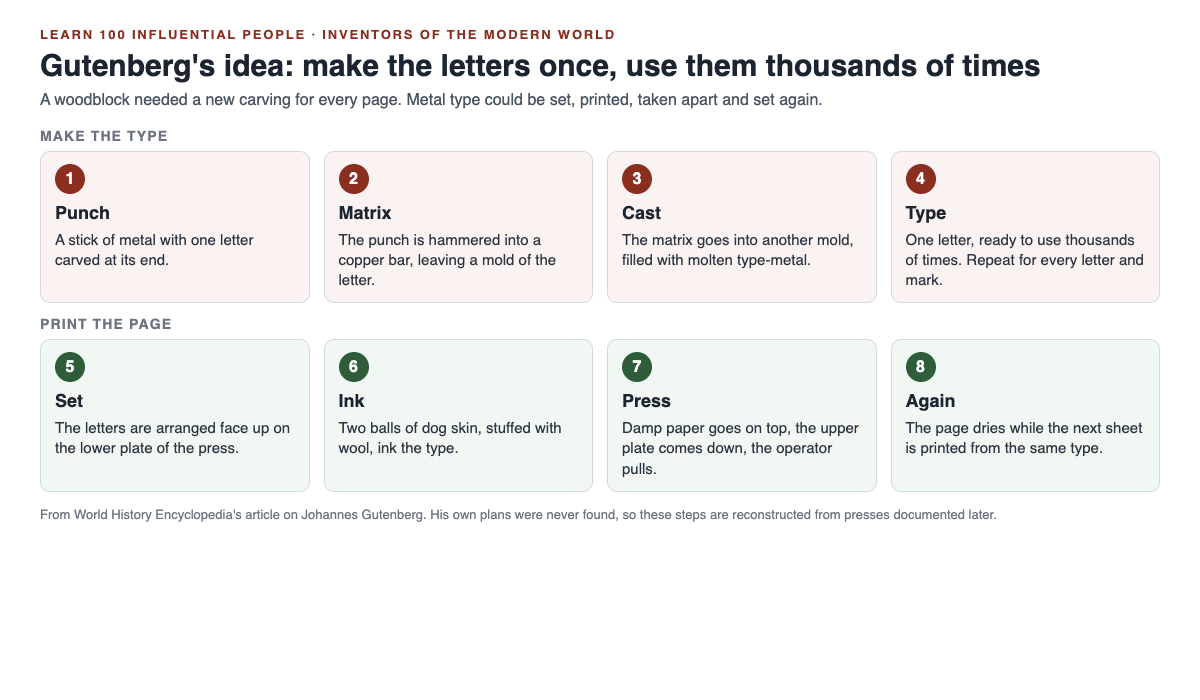
- Make the letters. A metal punch with a letter carved on its end was hammered into copper to make a mold of the letter. Molten metal poured into that mold made a piece of type that could be used thousands of times.
- Set the page. The letters were arranged face up in the press.
- Ink and press. The type was inked, damp paper laid on top, and a plate pressed down by pulling a crank.
- Repeat. The same type printed sheet after sheet, then could be taken apart and set for the next page.
The result, says World History Encyclopedia, was a press that could produce more books in a week than had been possible in months or up to a year.
What changed after the press
Gutenberg's best-known work is his Bible, published in 1456 (some sources say 1455). It had 42 evenly spaced lines per page, which made it easy to read. But some of his first paying jobs were humbler: indulgences, printed slips the Church sold to believers to shorten time in purgatory.
The World History Encyclopedia article on the printing revolution lists what followed across Europe:
- Printed books cost around one-eighth of the price of a handmade one.
- By one estimate, 2 million books were printed in Europe in the first decade of the 1500s, up to 20 million by 1550 and around 150 million by 1600.
- More authors were published, including unknown writers, and books in everyday languages gained ground on Latin.
- Literacy rose. At the end of the medieval period, at most 1 in 10 people could read long texts.
- Censorship grew too. The first list of forbidden books was issued by the Senate of Milan in 1538.
Gutenberg himself did badly out of it. He had borrowed 800 guilders from a businessman, Johann Fust, roughly three years' wages for an unskilled worker, and later borrowed the same again. In 1456, Fust demanded repayment, sued, won, and was awarded the press. Fust and his partner Peter Schoffer then took credit for the invention. In 1465 an archbishop recognized Gutenberg and gave him a yearly allowance, but he died in relative poverty in 1468. By 1520, Europe had over 200 printing centers.
Worked example: test the big claim on the Reformation
You can check "the press changed the world" on one case, using three questions. The case is Martin Luther, who in 1517 attacked the sale of indulgences in his 95 Theses.
- What was there before? Earlier reformers, John Wycliffe and Jan Hus, had made many of the points Luther would later make. World History Encyclopedia's article on the press and the Reformation says they lacked the means to reach a large audience; woodblock printing was too slow and costly.
- What changed? Luther's 95 Theses became a bestselling pamphlet within a year. The historian Mark U. Edwards Jr. counted at least 2,551 printings of Luther's German works between 1518 and 1544, against 514 by Catholic writers: "about five printings of Luther for every Catholic printing."
- What did not change? Most people still could not read. Pamphlets were usually read aloud to a crowd in the town square or the pub. Cheap books did not mean people could suddenly read them.
Now write one sentence that uses all three answers. For example: the press did not create Luther's ideas or a nation of readers, but it let one man's argument travel further and faster than Wycliffe's or Hus's ever could. Notice the irony, too: indulgences were among the first things Gutenberg printed, and they were what Luther attacked.
The same three questions work on any "this person changed everything" claim. Our guide to judging any list of the most influential people uses the same habit of asking what changed, for whom, and compared with what.
Where historians disagree
Two debates are worth knowing, set out here with no verdict.
Who invented it? The invention in Europe is usually credited to Gutenberg, but there are other claims, including the Dutch printer Laurens Janszoon Coster, and Fust and Schoffer themselves. Outside Europe, there is evidence of movable metal type in Korea in 1234, during the Goryeo Kingdom. The printing revolution article says that whether the idea travelled from Asia to Europe, or Gutenberg came to it on his own, "is still a point of debate amongst scholars." The article on the Reformation leans the other way, saying the Asian presses do not seem to have been his source.
Invention or demand? One reading puts the press at the center. World History Encyclopedia says it "facilitated and empowered" the Renaissance, the Reformation, the Age of Enlightenment and the Scientific Revolution by spreading ideas on a new scale. Another reading stresses what already existed: a reading public, a busy manuscript trade, and demand for religious books that was itself a main driving force behind the invention. On that view, the press answered a need that was already there, and handmade books carried on long after it arrived.
Frequently asked questions
When did Gutenberg invent the printing press?
His press was working in Mainz by 1450. His famous Bible followed in 1456, though some sources give 1455.
Was Gutenberg the first to use movable type?
No. There is evidence of movable metal type in Korea in 1234. Gutenberg is credited with movable metal type and the press in Europe.
Did Gutenberg get rich from his invention?
No. His investor sued him in 1456 and took the press, and he died in relative poverty in 1468.
Why did the printing press matter for the Reformation?
It let Luther's 95 Theses become a bestselling pamphlet within a year. Earlier reformers with similar points had no way to reach that many people.
Get started
Gutenberg is part of Inventors of the Modern World, an Intermediate course on Learn 100 Influential People, alongside Cai Lun, Watt, Edison, Tesla, Bell, the Wright brothers and Ford. Intermediate courses cover "How ideas, faiths, inventions and markets spread and changed the world." Lessons take about 9 minutes, cards set out where researchers disagree, and every lesson lists its sources. If you want a starter set of names first, see our list of famous people in history every student should know. Sign in with your email and an emailed code; accounts are for people aged 13 or older.
Start Learn 100 Influential People: short hands-on lessons on the people who shaped history, with every side of the debate and the sources to read next.
Comments
No comments yet.
Sign in or make an account to comment.