Famous people in history every student should know
Famous people in history can feel like an endless list. This post does not give you another ranking. It gives you a small starter set of 10 people, grouped by field, and a simple way to learn each one so the knowledge stays. Start here, learn these well, and add more later.
Famous people in history: why start small
A long list is easy to read and hard to remember. Learn 100 names at once and you end up with 100 names and little else.
A small set works better. Ten people are enough to cover faith, ideas, power, science, invention, revolution and money. They are few enough to learn properly. And once you know ten people well, each new person you meet has something to connect to.
The ten below are not "the" ten. They are one sensible place to start. Each one is covered by a course on Learn 100 Influential People, and each short description comes from a source you can open and read for yourself.
A starter set of 10, grouped by field
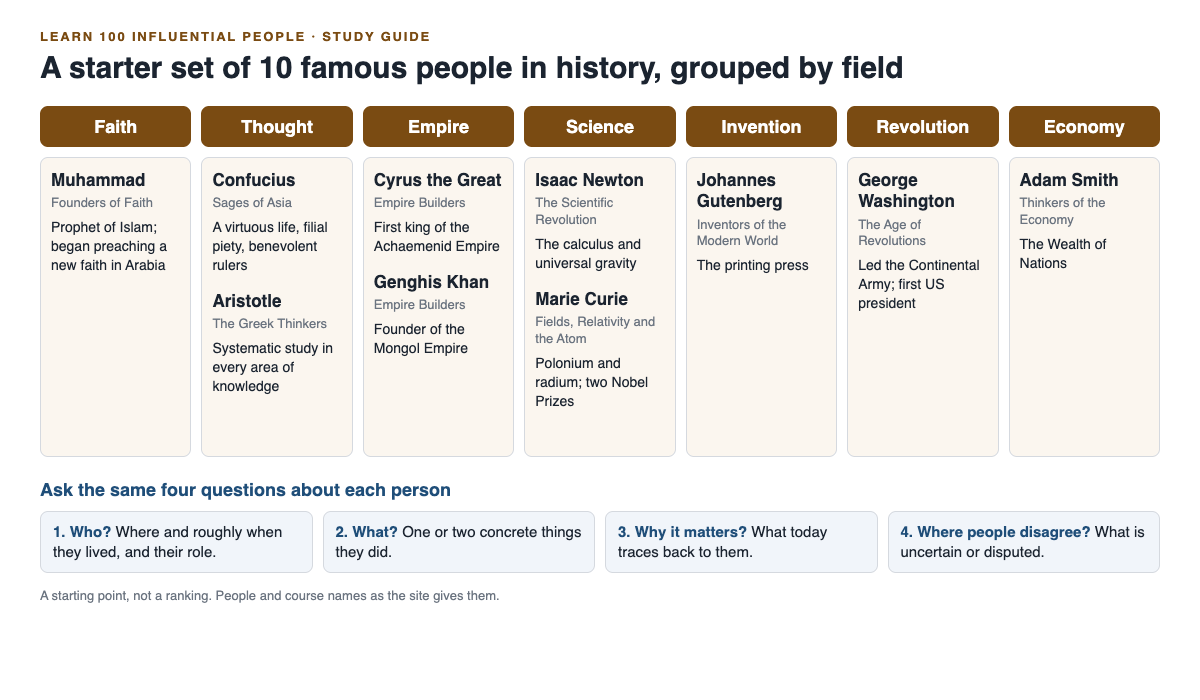
Faith
- Muhammad. He is honoured today as the Prophet of Islam. According to Islamic tradition, he received a revelation from God and began preaching a new faith in Arabia, and by his death he had united most of the Arabs under Islam.
Thought
- Confucius. A Chinese philosopher whose ideas, known as Confucianism, have influenced Chinese culture up to the present day. He stressed a virtuous life, filial piety (devotion to your parents), ancestor worship, and rulers who are benevolent and frugal.
- Aristotle. A Greek philosopher who brought systematic, scientific study to every area of knowledge. He wrote on subjects as different as biology, politics, physics, ethics and logic.
Empire
- Cyrus the Great. The first king of the Achaemenid Empire. He led campaigns against Media, Lydia and Babylonia, and kept local government mostly in place, which won him the loyalty of local elites.
- Genghis Khan. The founder of the Mongol Empire, ruthless with his enemies. He was also an able administrator who introduced writing to the Mongols, created their first law code and promoted trade.
Science
- Isaac Newton. Best known for inventing the calculus and for the theory of universal gravity, set out in his book the Principia.
- Marie Curie. With Pierre Curie, she extracted two previously unknown elements, polonium and radium. She became the first person ever awarded two Nobel Prizes.
Invention
- Johannes Gutenberg. The inventor of the printing press. Before it, books were copied by hand or printed from wooden blocks. After it, books could be made quickly, cheaply and all alike.
Revolution
- George Washington. He led the Continental Army to victory in the American Revolutionary War, then served as the first president of the United States.
Economy
- Adam Smith. Author of The Theory of Moral Sentiments and The Wealth of Nations. A central argument of the second book is against the idea that government officials need to guide the economic decisions of ordinary people.
Four questions to ask about each person
Reading a description once is not learning it. Ask the same four questions every time.
- Who were they? Where and roughly when did they live, and what role did they have?
- What did they do? Name one or two concrete things: a book, an invention, a war, a law, a discovery.
- Why does it still matter? What in today's world traces back to them?
- Where do people disagree? What is uncertain, disputed or judged in more than one way?
The fourth question is the one students skip, and it is often the most useful. For several people in the starter set, the sources themselves warn you. The World History Encyclopedia says of Confucius that "it is difficult to separate reality from myth", and that his earliest written record dates from some four hundred years after his death. For Cyrus, the stories of his birth and youth come from Greek authors who give contradictory accounts. Genghis Khan's life is told partly in the "sometimes fantastical" Secret History of the Mongols. Whether he was mainly a destroyer or a builder is a real debate, which our post on Genghis Khan's influence walks through.
Worked example: Isaac Newton through the four questions
Here is what the four questions look like for one person. All of it comes from the Stanford Encyclopedia of Philosophy entry on Isaac Newton.
Who was he? He lived from 1642 to 1727, was born in Woolsthorpe, a small village near Grantham, and entered Trinity College in 1661.
What did he do? He invented the calculus in the mid to late 1660s. He set out the theory of universal gravity in his Principia. He also made major discoveries in optics. And the entry adds something students rarely hear: he put no less effort into chemistry, alchemy, theology and study of the Bible than into mathematics and physics.
Why does it still matter? The entry calls the Principia "the single most important work" in the change from early modern natural philosophy to modern physical science.
Where do people disagree? In his own time, Christiaan Huygens and Leibniz opposed his theory of gravity. They saw it as calling on "an occult power of action at a distance", since Newton offered no mechanism by which gravity could act. And the entry notes that what textbooks now call "Newtonian mechanics" consists mostly of results others achieved on the continent between 1740 and 1800.
Now close the page and check yourself with three questions:
- Name two things Newton is best known for.
- Which two thinkers objected to his theory of gravity, and why?
- What surprising fields did he spend as much effort on as physics?
If you can answer all three from memory, you know Newton better than most people who can only name him.
A two-week plan with short daily sessions
You do not need long sessions. This plan uses about 10 minutes a day, most days. The pattern is simple: learn one new person, answer questions from memory, and come back to earlier people after a gap. Our guide on how to learn world history in 10 minutes a day explains why answering from memory beats rereading.
- Days 1 to 3: Muhammad, Confucius, Aristotle. One person a day, four questions each.
- Day 4: Review. Answer the four questions for all three from memory, then check.
- Days 5 to 7: Cyrus, Genghis Khan, Newton.
- Day 8: Review days 5 to 7, plus one question on each of days 1 to 3.
- Days 9 to 11: Marie Curie, Gutenberg, Washington.
- Day 12: Adam Smith.
- Day 13: Review days 9 to 12.
- Day 14: Review all ten. Sort them by field from memory, and say one sentence about each.
A week later, do one more full review without looking. Whatever you miss, go back to that person first.
Why lists of famous people differ
You will meet other lists with different names in a different order. Each list depends on what its author counts as influence: reach, how long it lasted, whether it was good or harmful, and which part of the world the author knows best.
So do not treat any list as the final word, including this one. Use it as a starting point and ask how it was made. Our guide on how to judge any list of the most influential people in history gives you the questions to ask.
Frequently asked questions
How many famous people should a student learn first?
Start with about ten. That is enough to cover several fields and few enough to learn each person properly before adding more.
Should I memorize dates?
Learn rough dates once you know who someone was and what they did, so each date has a person to attach to.
Why include where people disagree?
Because the record is often uncertain. Knowing that a question is disputed, and what each side says, is part of knowing the person.
Is this list the right one?
No list is the only right one. This is a starter set chosen to cover many fields; swap in people you care about once the method feels easy.
Get started
Every person in the starter set is covered by a course on Learn 100 Influential People, from Founders of Faith to Thinkers of the Economy. It has 46 lessons of about 9 minutes, and questions where you choose, put in order, match, sort and estimate a number. Questions from lessons you finish come back spaced out, up to 5 a day. And 38 cards set out where researchers disagree, while every lesson lists its sources so you can read the original work. Sign in with your email and an emailed code. Accounts are for people aged 13 or older.
Start Learn 100 Influential People: short hands-on lessons on the people who shaped history, with every side of the debate and the sources to read next.
Comments
No comments yet.
Sign in or make an account to comment.