Homer's Iliad and Odyssey: Who He Was and What Survives
If you are searching for Homer's Iliad and Odyssey, who he was and what survives, the short answer is this. Homer is the name given to the poet of two Greek epic poems, probably written in the 8th century BCE after a long oral tradition. We know almost nothing about the man, but both poems survive complete, and that is rare for a work this old.
If you want Homer in a short, structured lesson, Learn 100 Influential People includes him in its Art, Letters and Music course, with questions that check what you read and the sources for every lesson.
Who was Homer? What we actually know
Less than most people expect. The poet does not talk about his own family or life inside the poems, which sets him apart from Hesiod. Writing is generally believed to have started around 700 BCE, so there is no contemporary source on Homer either. The descriptions of his life that we have are Hellenistic and even Roman, and they come long after the poems.
The Greeks themselves thought Homer came from Chios or Ionia, and they credited him with both the Iliad and the Odyssey. They thought him the greatest writer there ever was and called him simply "the poet". Some details in the poems give the claims a grain of support. The dialect is an archaic form of Ionian Greek, and the Iliad shows a familiarity with the geography of Asia Minor. That is why Smyrna, Chios and Ios have all been named as his birthplace. Many places claim him, and the evidence cannot settle it.
One detail is worth keeping in mind. World History Encyclopedia notes that Homer "composed" his works rather than wrote them, because the poems were created and passed on orally and were not written down until much later. That one fact explains most of what follows.
The Homeric Question: one poet, two, or a tradition?
The argument over who made the poems is called the Homeric Question. It is old. The ancients had a name for the people who thought the two epics had different authors: the chorizontes, "the separatists". Some people go further and doubt that a single person stood behind either poem. The modern form of the question says the poems are layers of earlier material rolled into one story, which could explain inconsistencies in the narrative and the formulaic language. On that view, the poems were sung in episodes by performers called rhapsodes. The idea was first argued by F. A. Wolf in his 1795 work Prolegomena ad Homerum.
The question reaches the second poem too. Some scholars see the Odyssey as Homer's work in later life, which would explain its different subject and style. Others hold that it is by another author for exactly those differences. World History Encyclopedia says the issue is unlikely ever to be resolved. You can read the two positions side by side without picking one, and the poems stay great either way. As that source puts it, whether Homer was a she, a he or a they does not lessen the Iliad and the Odyssey.
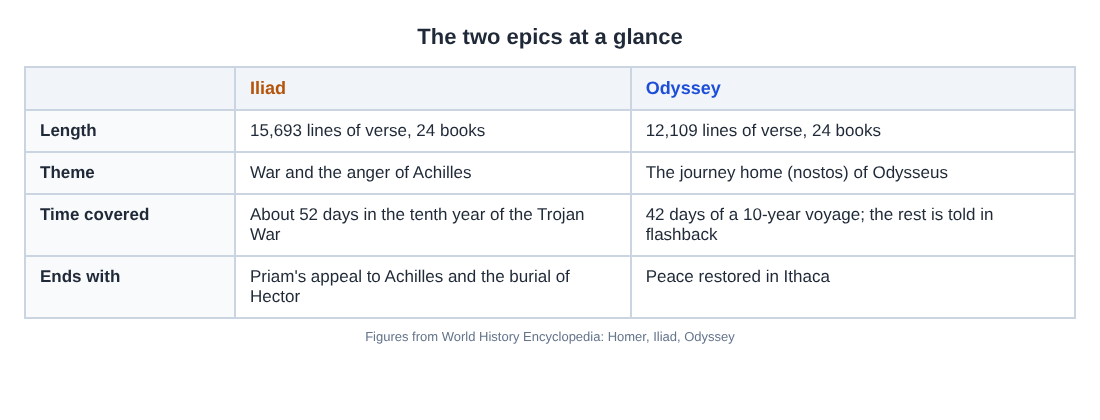
The two epics at a glance, with figures from World History Encyclopedia.
The Iliad: what the poem covers and what it leaves out
The Iliad has 15,693 lines in 24 books. The division into 24 books, one for each letter of the Greek alphabet, was already in place by the time of Herodotus. Its subject is announced in its first line: "Sing, Muse, of the wrath of Achilles". The poem covers only about 52 days of the Trojan War, in the tenth and final year. Its audience already knew why the war started and how it would end, so the poem starts in the middle.
The plot in five steps:
- Agamemnon takes Achilles' prize, the girl Briseis, and Achilles sits out the war in anger (Book 1).
- Without him, the Greeks are driven back to their camp, and Achilles refuses Agamemnon's offer of treasure (Books 8 and 9).
- Patroclus, his closest friend, fights in Achilles' armour and is killed by Hector (Book 16).
- Achilles returns, chases Hector around the walls of Troy three times and kills him (Book 22).
- Priam, Hector's father, comes to the Greek camp, and Achilles hands over the body for burial. The Iliad ends here (Book 24).
What the poem leaves out surprises many readers. There is no wooden horse, no death of Achilles and no fall of Troy. World History Encyclopedia describes Hector's death as Homer's metaphor for the fall of the city, "if not the actual war".
The Odyssey: the journey home and its structure
The Odyssey has 12,109 lines, also in 24 books. It follows Odysseus, king of Ithaca, on his voyage home after the Greeks finally sacked Troy. The voyage lasts ten years and the wider absence twenty. Like the Iliad, the poem covers only a small slice of time, 42 days, and tells the rest in flashback.
- Books 1 to 4: on Ithaca, 108 suitors have taken over the palace and press Penelope to remarry. Athena sends Telemachus to look for his father.
- Books 5 to 8: Odysseus is held by the nymph Calypso, then washes up among the Phaeacians.
- Books 9 to 12: at the Phaeacian court he tells his adventures himself: the Cyclops, the Sirens, Scylla and Charybdis.
- Books 13 to 24: he lands on Ithaca disguised as a beggar, wins the contest of the bow, and takes revenge on the suitors.
So the best-known monsters are a story inside the story. The last half of the poem is about recognition. His old dog Argus knows him. The servant Eurycleia recognises him by an old scar. Penelope sets a shooting contest through twelve axe heads, and only Odysseus can string the bow. World History Encyclopedia also notes that some scholars treat Book 23 as the real end, on stylistic grounds, with Book 24 as loose ends tied off.
How the oral tradition shaped the epics
Both poems repeat themselves: the same epithets, the same introductory phrases, the same fighting descriptions and the same recurring scenes. That is the mark of the oral tradition behind them. A singer retelling a story that the audience already knows works with building blocks like these, and they help a listener follow a very long song.
For a reader today, this changes how Homer should be read. He is less like a novelist with a pen and more like the last and greatest voice in a craft that had run for centuries. The audiences of the time already knew the characters and the outline of the war. What they came for was how the poet told it. The Iliad, for example, reveals the grief of the Trojan family beside the glory of the Greek camp. In Book 6, two champions, Diomedes and Glaucus, find they are of mutual descent and exchange armour instead of fighting.
Homer's Iliad and Odyssey: what survives and how
The poems we read are the end of a long chain of copying and editing.
- Athens. According to World History Encyclopedia, the poems were first compiled, organised and edited under the Athenian ruler Peisistratus.
- Alexandria. Scholars there divided the poems into 24 books each. The Greek text that survives comes down from the scholars Zenodotus, Aristophanes of Byzantium and Aristarchus, and from their comments on the texts.
- Print. The first printed editions of Homer appeared in Florence in 1488, from Chalcondyles of Athens.
The poems have come down to us in a continuous tradition, which is why Homer is the earliest poet in Western culture whose works have survived intact. They were also studied as part of Greek education, and scenes from them appeared in sculpture, on pottery and on the tragic and comic stage. Other stories were never part of these two poems. The wooden horse, the death of Achilles and the sack of Troy are told elsewhere, and Homer only points toward them.
There is also the matter of what was behind the legend. The site of Troy in Anatolia was first excavated by Heinrich Schliemann in the late 19th century CE. Of its many layers, Troy VI (c. 1750 to 1300 BCE) is the most likely candidate for the city of the Iliad, with strong walls and towers. How much of the war the poems preserve is still discussed.
Homer's lasting legacy, in the words of World History Encyclopedia, is that his works are still studied. They shaped Greek culture first, then Hellenistic and Roman culture and the world far beyond. If you want to see how the Roman world looked a few centuries on, our post on Augustus and the Roman Empire is a good next stop.
A worked example: read the poems in a week
You do not have to start at line one of each poem. Here is a plan that takes about a week, with one short sitting a day:
- Day 1: Iliad Book 1, the quarrel between Agamemnon and Achilles.
- Day 2: Iliad Book 6, Hector, Andromache and the meeting of Diomedes and Glaucus.
- Day 3: Iliad Book 24, Priam in the Greek camp.
- Day 4: Odyssey Book 1, the suitors in the palace and Athena's advice to Telemachus.
- Day 5: Odyssey Book 9, the Cyclops.
- Day 6: Odyssey Book 19, the scar and Eurycleia.
- Day 7: Odyssey Book 22, the revenge, and Book 23, the reunion.
After each sitting, write one sentence on what Homer chose to show and what he left out. By Day 7 you will have seen both poems' main turns, and you will have noticed the difference in theme: war and anger in one, the journey home in the other.
Frequently asked questions
Was Homer a real person?
Nobody can prove it either way. There is no contemporary source on him, and the later descriptions of his life are not reliable. World History Encyclopedia says the poems' greatness does not depend on whether Homer was a he, a she or a they.
Which should I read first, the Iliad or the Odyssey?
Many readers begin with the Odyssey, because it has monsters, travel and a clear plot about getting home. The Iliad is more concentrated, on war, anger and loss. Both have 24 books, and the week plan above samples each one.
Does the Iliad include the Trojan horse?
No. The poem ends with the burial of Hector, before Troy falls. The wooden horse is told about in the Odyssey, where Menelaus and a bard both refer to it.
Did the same person write both poems?
That is part of the Homeric Question and it is still open. Ancient scholars already doubted it, and some modern ones think the Odyssey is the work of another author because its subject and style differ.
Get started
If you want Homer in a short, structured form, Learn 100 Influential People puts him in the Art, Letters and Music course, among its short lessons of about 9 minutes with questions to check what you remember. The site sets out where researchers disagree and lists the sources for every lesson, so you can go on to read the original work. You sign in with your email and an emailed sign-in code to keep your progress. You can see how it handles your data on the privacy page, or read more on the about page.
Start Learn 100 Influential People: short hands-on lessons on the people who shaped history, with every side of the debate and the sources to read next.
100 people who shaped history, from Moses to the web.
Visit influentialpeople.vlvd.net↗

Comments
No comments yet.
Sign in or make an account to comment.