How does a Rubik's cube turn? Layers and faces explained
How does a Rubik's cube turn? Each face sits on one layer of pieces, and that whole layer turns a quarter at a time around a hidden core. The core is a cross of three axes that holds the six centre pieces and lets them spin. This guide shows what is inside, which pieces move when you turn a face, and how the same move works in a number puzzle on a cube.
How does a Rubik's cube turn? The short answer
A 3 by 3 by 3 cube looks like 27 small blocks, but it is not built that way. According to Wikipedia's article on the cube, the pieces' positions change when you twist an outer third of the cube by 90 degrees. Here is the whole idea in four lines:
- The core stays put. It is a cross of three axes in the middle of the cube.
- The six centres are fixed to the core. They can spin in place, but they never change places with each other.
- The other pieces ride around the centres. They lock into each other and into the core, so a layer holds together while it turns.
- A turn is a quarter turn. Every move is a step of 90 degrees, or two steps for a half turn.
If you want the count of coloured squares instead, our post on how many squares a Rubik's cube has covers that. This one is about movement.
What is inside: a core and 26 pieces
Wikipedia describes 26 small pieces, also called cubies or cubelets. There are three kinds:
- 6 centres. One in the middle of each face, showing one colour.
- 12 edges. One on each edge of the cube, showing two colours.
- 8 corners. One on each corner, showing three colours.
The 27th spot, the very middle, holds the core. The six centres are attached to it, so a centre can rotate but can never leave its face. The edges and corners are not attached to anything. Each one has a hidden part that reaches inward and hooks behind its neighbours. That is why the cube does not fall apart when you turn a layer: the pieces hold each other in.
The fixed centres matter for a second reason. Because they never change places, the centre of a face tells you which colour that face will be when the cube is solved.
Three layers on every axis
Pick any direction through the cube, say left to right. Slice the cube along it and you get three layers: a left layer, a middle layer and a right layer. You can do the same top to bottom and front to back. So the cube has three axes, with three layers on each.
The outer layers are the faces. Each outer layer holds 9 pieces: 1 centre, 4 edges and 4 corners. The middle layer holds 4 centres and 4 edges, wrapped around the core. Add the three layers and you get 8 corners, 12 edges and 6 centres, the full 26.
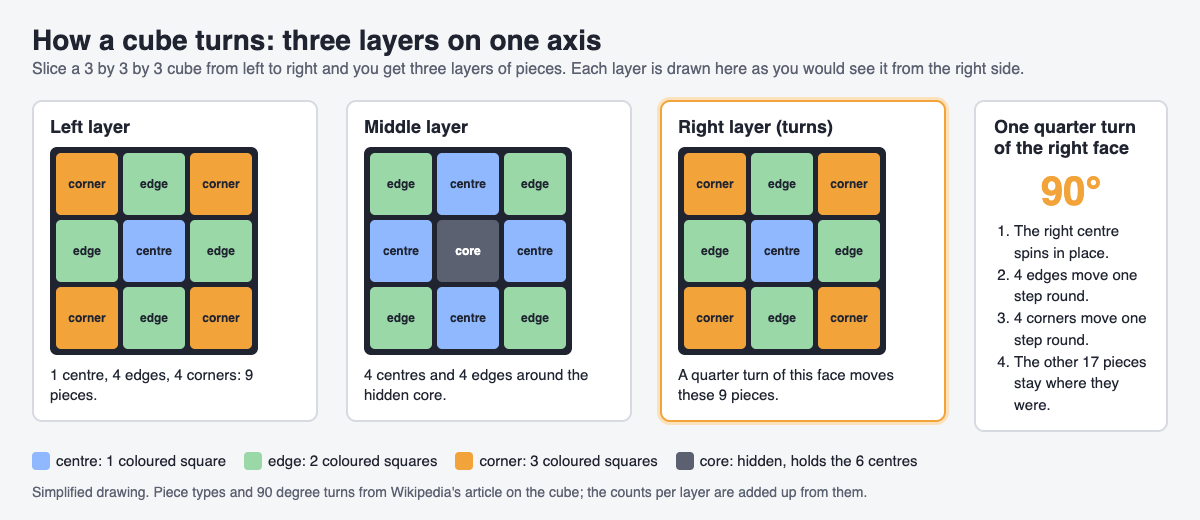
The three layers on one axis. A quarter turn of the right face moves its 9 pieces and leaves the other 17 alone.
A worked example: one quarter turn of the right face
Take a cube, or picture one. Follow these steps and watch which pieces move.
- Hold it still. One face points at you. That is the front. The face on your right is the right face.
- Note the right column of the front. It has three squares: a corner at the top, an edge in the middle and a corner at the bottom.
- Turn the right face a quarter, away from you. Grip only the right third of the cube and roll its top toward the back, 90 degrees. Seen from the right side, that is a clockwise turn.
- Look at the front again. The three squares from its right column are now on the top face. The top's right column went to the back, the back's to the bottom, and the bottom's came up to the front.
- Look at the right face. Its centre spun in place. Its 4 edges and 4 corners each moved one step round.
Count what changed. 9 pieces turned with the layer: 1 centre, which only spun in place, plus 4 edges and 4 corners, which changed places. The other 17 pieces did not move at all. In coloured squares, the 9 on the right face turned with it, and 3 squares on each of the 4 neighbouring faces moved to the next face, 21 squares in all.
Now turn the same face three more times in the same direction. After four quarter turns, every piece is back where it started. That is a useful check whenever you are not sure what a move did.
Turning a face versus turning the whole cube
There are two kinds of movement, and it helps to keep them apart.
- A layer turn moves one third of the cube against the rest. Pieces change places.
- A whole-cube turn moves everything together. No piece changes places; you just look at a different side.
Cube notation has letters for both. The faces are F, B, U, D, L and R: front, back, up, down, left and right. A letter on its own is a clockwise quarter turn as you look at that face, so the worked example above is R. A prime mark, as in R′, means anticlockwise, and a 2, as in R2, means a half turn. The letters x, y and z mean turning the entire cube, and M, E and S are used for the middle layers. That is enough to read a simple move; the full notation is a topic for another day.
The same turn in 3D 2048
3D 2048 puts the 2048 number puzzle on a cube like a Rubik's cube, with six faces of nine squares. It uses both kinds of movement you just read about.
- Slide. You swipe the front face, or press the arrow keys, and tiles slide as in 2048. Two equal tiles merge.
- Twist. You drag a row on the right face sideways, or a column on the top face. That layer turns a quarter and carries its tiles to the next face. This is the layer turn from the worked example.
- Turn. You drag the space around the cube, or press Shift and an arrow key, and the whole cube turns. The game says turning is free. This is the whole-cube turn.
Try the worked example in the game. Make a few slides first so the front has some tiles. Then press on the top row of the right face and drag it sideways. That layer turns a quarter and carries its tiles to the next face, just as the right column of a cube went from the front to the top. Watch the Moves counter in the top bar: a twist counts as a move. In our test game, four slides and then one twist took it from 4 to 5.
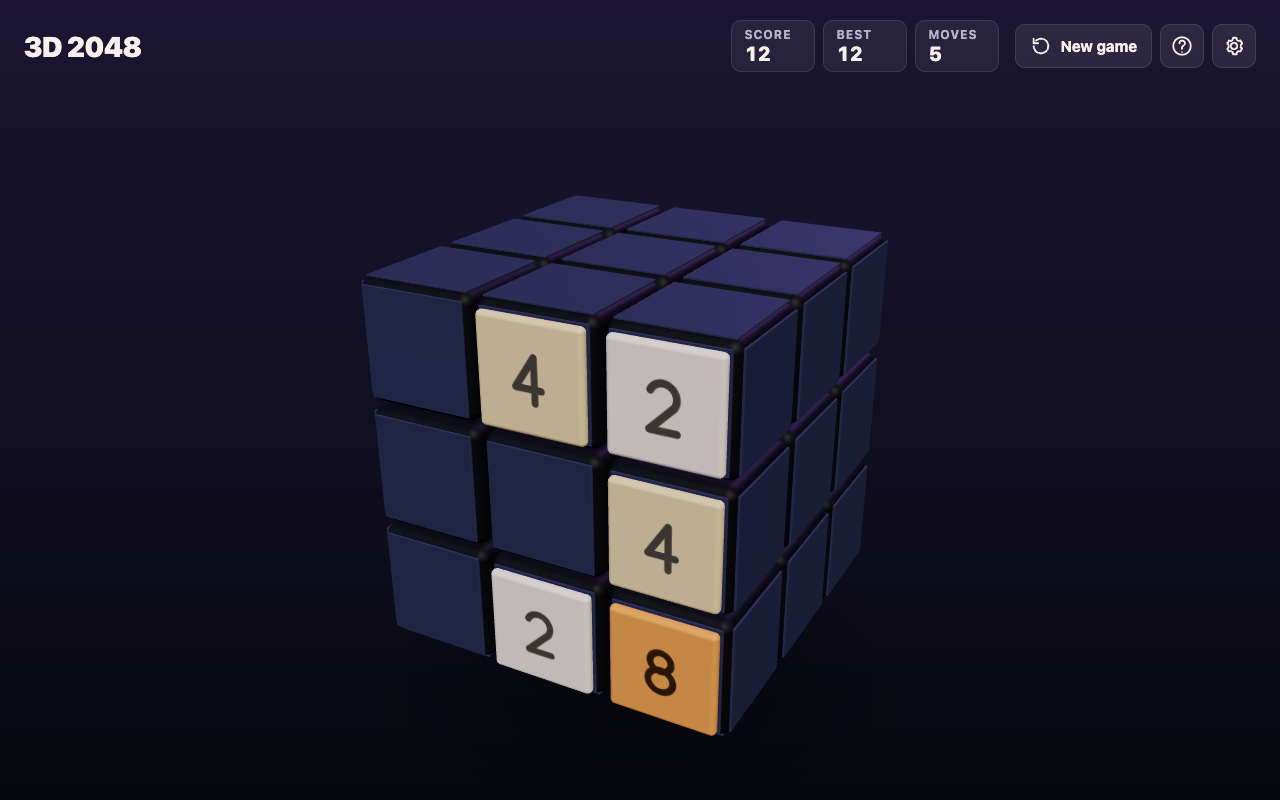
3D 2048 after four slides and one twist of a row on the right face. The Moves counter reads 5.
Two details differ from a plain cube. A twist adds a new 2 or 4, so it needs one empty square for that tile. A whole-cube turn adds nothing, so you can turn as often as you like to look around. The game will not teach you to solve a cube; it uses the same moves for a different goal. The full controls are in how to play 3D 2048.
Frequently asked questions
Why do the centre pieces never move?
They are fixed to the core, a cross of three axes. A centre can spin in place, but it stays on its face.
How many pieces move in one face turn?
Nine turn with the layer: 1 centre, which spins in place, and 4 edges and 4 corners, which change places. The other 17 pieces stay where they are.
Can you turn the middle layer?
Yes. A middle layer can turn like a face, and cube notation uses M, E and S for those turns.
Is a twist in 3D 2048 the same as a cube turn?
The movement is the same: one layer turns a quarter and carries what is on it to the next face. In 3D 2048 the twist also adds a new tile, so it needs one empty square.
Get started
Pick up a cube, turn the right face once, and count the 9 pieces that moved. Then try the same quarter turn with number tiles on it.
Play 3D 2048: it is free and plays in your browser on a computer or a phone.
Comments
No comments yet.
Sign in or make an account to comment.