What was a siege tower and how did it work?
A siege tower was a tall wooden tower on wheels, pushed up to a castle wall so soldiers could fight from the top and then cross onto the battlements. That is the short answer. The longer one is more interesting, because a siege tower did two jobs at once, and it was also one of the biggest, slowest and most flammable targets on the field.
This guide explains how a siege tower worked, using English Heritage and the Royal Armouries, and follows the royal siege tower at Kenilworth in 1266, which met a well-aimed stone. At the end it shows the Siege tower attacker in the free browser game Two Towers.
The problem a siege tower solved
A castle wall is too high to step over, so the simplest attack is ladders. English Heritage's guide to medieval siege warfare calls this escalade, and says it left the attackers very exposed to the defenders' arrows, stones and scalding liquids. A man on a ladder cannot hold a shield and climb at the same time.
Attackers tried to make ladders safer. English Heritage says escalade was done under covering fire from archers and siege engines, to keep the defenders back from the edge of the wall. Covering fire from the ground has a limit, though: it has to shoot upward, at people standing behind stone.
A siege tower answered that. Instead of climbing up a wall in the open, attackers climbed inside a wooden building and arrived at the top level with the defenders.
How a siege tower worked
English Heritage describes the parts:
- Wheels, so the whole tower could be pushed up to the wall.
- Several levels, filled with soldiers and joined by ladders inside.
- A fighting platform on top, from which the attackers shot arrows at the battlements.
- A drawbridge, dropped onto the parapet, the low wall along the top of the battlements, so the assault troops could cross.
The Royal Armouries' Hundred Years' War pages describe them the same way, as multi-storey wooden towers wheeled up to the walls so soldiers could climb over the battlements. Some were very tall: one used at Lisbon in 1147 was said to be 29 metres (95 feet) high.
Two jobs: high ground and a bridge
English Heritage's list of ten things about sieges separates the two jobs clearly:
- A shooting platform. The tower gave crossbowmen and archers a higher, and therefore better, position to shoot from. Defenders on a wall lose their advantage when the enemy is level with them, or above.
- A way in. Wheeled against the wall, it let attacking soldiers climb onto the battlements and storm the castle.
A tower did not have to reach the wall to be useful. Even standing back, it could keep the defenders' heads down while rams, miners or ladders did other work.
The weak point: wood burns
The same English Heritage page names the problem. Siege towers were made of wood, so they were susceptible to fire, and defenders tried their best to set them alight before they could be used. A tower was also huge and slow, so every machine on the walls had time to aim at it while it was pushed across open ground.
That is why the defenders' own siege engines mattered so much. A castle that could hit a tower before it arrived could stop it without a fight on the walls.
A worked example: the tower at Kenilworth, 1266
English Heritage's account of the siege of Kenilworth Castle includes one siege tower, and what happened to it.
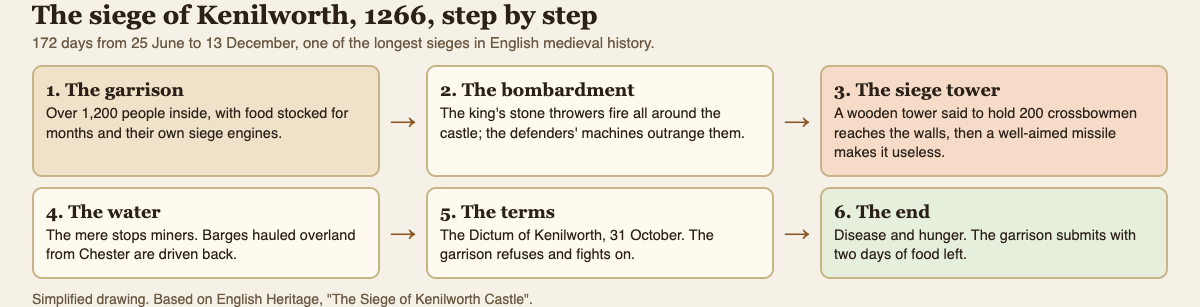
Kenilworth in six steps. Step 3 is the siege tower.
- The garrison. More than 1,200 people held the castle, with food for months and their own siege engines.
- The king's army. Henry III arrived with 2,000 wooden screens, 60,000 crossbow bolts and nine siege engines. The siege began on 25 June 1266.
- The duel of machines. The king's stone throwers were outranged by the castle's, and he sent to London for larger ones.
- The tower. One of his wooden siege towers, apparently holding 200 crossbowmen, was brought right up against the castle walls. A single well-aimed missile from the defenders made it useless.
- Other ways in. The castle's water defences stopped the king's men from tunnelling under the walls. Barges hauled overland from Chester for an attack across the lake were driven back.
- The end. The garrison held until December, then submitted with only two days of food left, weakened by disease.
At 172 days, it was one of the longest sieges in English medieval history. The tower, the biggest single machine on the field, did not decide it. Hunger did.
Why siege towers faded
The Royal Armouries notes that wooden siege engines were gradually replaced by artillery such as bombards, early cannon that could break walls from a distance. Once walls could be knocked down, there was less need to build a wooden tower to climb over them.
For the other machines a besieging army brought, see our guide to medieval siege weapons explained. For how defenders prepared, see how castles defended against a siege.
The Siege tower in Two Towers
In Two Towers, a free tower defense game in your browser, the Siege tower is one of the attackers marching on your gate. It is huge and slow, and when it falls or reaches the wall, three Shieldbearers climb out. Its card says siege towers were wheeled up to the walls so attackers could cross onto the ramparts, as the crusaders did at Jerusalem in 1099.
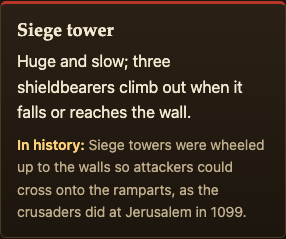
That gives you the Kenilworth problem in small. Shieldbearers carry a tall shield that stops most arrows, but stones, bolts and fire still hurt them. A Trebuchet, Ballista or Fire Tower beside the gate is your answer to what climbs out. The game gives one line of history per card, not a full account.
Each answer works differently. A Trebuchet throws slow, long-range stones that hurt everyone where they land, so it can hit the Shieldbearers as they bunch up. A Ballista sends a heavy bolt through a line of attackers and ignores armor. A Fire Tower throws fire pots that leave the road burning, and fire burns through armor.
Frequently asked questions
What was a siege tower used for?
Two things: a high platform for crossbowmen and archers to shoot from, and a way onto the wall, using a drawbridge dropped onto the parapet.
How tall was a siege tower?
Tall enough to reach the battlements. The Royal Armouries mentions one at Lisbon in 1147 that was said to be 29 metres (95 feet) high.
How did defenders stop siege towers?
Mostly by hitting or burning them before they arrived. Towers were wooden and slow, and at Kenilworth one was made useless by a single well-aimed missile.
Get started
Play Two Towers: it is free and plays in your browser on a computer or a phone. Watch for the Siege tower, have stones or fire ready for the Shieldbearers inside, and read the history line on each card as you go.
Comments
No comments yet.
Sign in or make an account to comment.