How Long Should a Free Trial Be for an AI Product?
How long should a free trial be? Long enough for a typical user to get one real result and come back for a second, and no longer than your model bill can carry. The right number comes from two figures you can work out in an evening: time to value and cost per trial user.
If you have not yet decided whether to offer a trial at all, start with the post on free plan or free trial, and which your startup should offer. Its most useful point is that you price the free user first and pick the model second. This post picks up where that one stops. You have chosen a trial, and now you need its length.
Age of AI Entrepreneur helps you put real numbers on a trial: its short lessons, each with its sources, cover what a model request costs and how to price an AI product, after you sign in with your email and an emailed code.
Why trial length matters more for AI products than for classic SaaS
In classic software, an idle trial user costs you almost nothing.
An AI product is different. Every time a trial user clicks "generate," you call a model and pay for the tokens going in and coming out. A longer trial means more calls, and more calls mean a bigger bill for people who may never pay.
There is a second pull in the other direction. AI output varies. A user often needs a few tries before they trust the tool with real work. Cut the trial too short and they leave before that trust forms. So length pushes on both your costs and your conversions, and is worth setting on purpose.
Start with time to value: how long until a user gets the first real result
Time to value is the gap between sign-up and the first result a user would actually use: the first thing they paste into an email, publish, or send to a client.
To measure it, walk through your own product as a new user and write down each step:
- How many screens until the first output?
- Does the user need to upload their own data first?
- Does the result need a second pass before it is usable?
- When does the job come up again in their week or month?
That last question matters most. One good result proves the tool works. A second good result, on a new task, proves it fits the user's routine. Your trial should cover the time it takes to reach that second result, plus a small buffer.
Work out what one trial user costs you in tokens and compute
Now put a price on a trial user. The basic formula is short:
Cost per trial user = requests per active day × cost per request × active days in the trial
Cost per request comes from your model provider's token prices and the size of your prompts and outputs. Count the system prompt, any retrieved context, and the reply; LLM token pricing explained walks through that sum.
Then take one more step. Most trial users will not convert. So the number that matters is:
Trial cost per paying customer = cost per trial user ÷ conversion rate
If that figure eats a large share of a customer's first month of revenue, your trial is too long, too generous, or both. The lesson "Model APIs, Tokens and What a Request Costs" in The AI Product Stack covers how to estimate a request's cost, and "Revenue, Costs and Unit Economics" in Business Basics for Builders covers the margin side. You sign in with your email and an emailed code to open a course.
7, 14 or 30 days: how long should a free trial be for your product
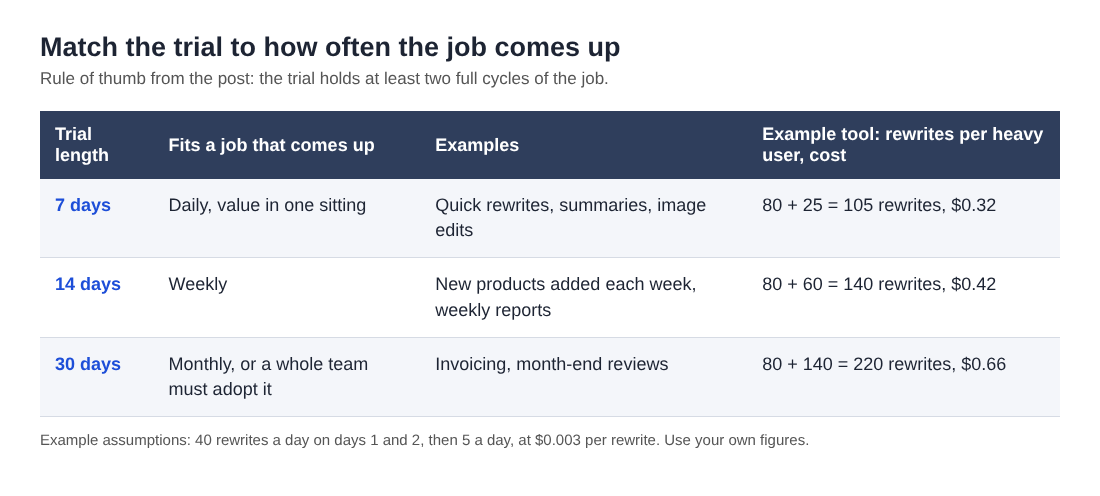
Use the cycle of the job, not a habit, to choose. A simple rule: the trial should hold at least two full cycles of the task your product does.
- 7 days suits tools that deliver value in one sitting and get used daily. Think quick rewrites, summaries, or image edits. It also suits products where each request is expensive, since a short window caps exposure.
- 14 days suits weekly workflows. A user needs to try the tool on a few real tasks across two work weeks. Many small business tools fall here.
- 30 days suits monthly jobs, like reports, invoicing, or month-end reviews. It also suits products a whole team must adopt, where getting colleagues on board takes time.
If your job runs monthly and you offer 7 days, most users never see the task come up.
Worked example: sizing the trial for a small AI writing tool
Say you are building a tool that rewrites product descriptions for small online shops. All the figures below are assumptions for the example. Plug in your own.
Time to value. A shop owner pastes a description and gets a rewrite in about three minutes. That is the first result. But the real proof comes when they add new products the next week and the tool saves them time again. Shop owners in your target group add products about weekly. Two cycles means two weeks. That points to 14 days.
Cost. Assume a heavy trial user does 40 rewrites a day for the first two days, testing their whole catalogue. Then they settle at 5 a day. Assume each rewrite costs you $0.003 in tokens.
- Days 1 and 2: 2 × 40 = 80 rewrites
- Days 3 to 14: 12 × 5 = 60 rewrites
- Total: 140 rewrites × $0.003 = $0.42 per heavy trial user
If 1 in 10 trial users converts, the trial cost per paying customer is about $4.20 in the worst case where every trial user is heavy. Compare that with your monthly price and margin. If it is a small slice, the trial is affordable.
What about 30 days? That adds 16 more days at 5 rewrites a day: 80 + (28 × 5) = 220 rewrites, or $0.66. The extra cost is small. But the shop owner has already seen two weekly cycles by day 14. A longer trial just delays the decision. So you pick 14 days.
The real risk here is not the average user. It is the one person who pastes in 5,000 products on day one. Length alone does not stop that. A usage cap does.
Time-based trials vs usage credits: capping cost without cutting value
You have three ways to shape a trial:
- Time only. Simple to explain. Exposes you to bulk users.
- Credits only. A fixed number of requests with no deadline. Caps cost, but users may ration their credits and never reach the second result.
- Both. "14 days or 200 rewrites, whichever comes first." This caps cost and still creates a clear moment to decide.
For most AI products the third option works well. Set the credit cap above what a real user needs to reach value twice. In the example, a heavy user needed 140 rewrites, so 200 gives room without leaving the door wide open. Show the remaining count so nobody hits the wall by surprise.
The lesson "Pricing AI Products" in Launch, Price and Get Paid looks at how usage costs shape pricing choices like this one. Sign in with your email and an emailed code to open it.
When a free plan beats any trial length, and how to decide
Sometimes no trial length fits. A free plan may suit you better when value builds slowly over months, when free users bring in other users by sharing or inviting, or when your cost per free user is close to zero. If none of those apply, a trial with a clear end and a usage cap is usually easier to run. If you charge by use rather than a flat fee, usage-based pricing vs subscription covers how that changes the free offer. For the full side-by-side reasoning, the free plan or free trial post covers the choice in depth.
Frequently asked questions
Is a 7-day free trial too short?
Not if your users can get value twice within a week. It is too short when the job your product does only comes up weekly or monthly, because users never see the second result before the trial ends.
Should a free trial ask for a credit card?
Asking for a card filters out casual sign-ups and reduces abuse of your model budget, but it also means fewer people start the trial. Test both if you can, and watch cost per paying customer, not just the number of sign-ups.
Do longer free trials convert better?
There is no general rule. A longer trial helps only if users need the extra time to reach value; past that point it mostly adds cost and delays the decision.
Get started
Count the days to a user's second real result, price a trial user, and add a cap. If you are still choosing between a trial and a free plan, read free plan or free trial: which should your startup offer first. Then work through Launch, Price and Get Paid after you sign in with your email and an emailed code.
Start Age of AI Entrepreneur: short hands-on lessons on how to build a business in the age of AI, each with the sources to read next.
Building a business in the age of AI, from a first project to a company.
Visit aientrepreneur.vlvd.net↗
Comments
No comments yet.