Usage Based Pricing vs Subscription for AI Products
Usage based pricing vs subscription is the first pricing choice most AI founders have to make, and it is harder than it looks. The short answer: use a subscription when each customer costs you a small, steady amount to serve. Use usage based pricing when cost varies a lot from one customer to the next. Use a base plan with included usage when you are not sure yet.
You can work through this choice step by step in the Launch, Price and Get Paid course. It has a lesson called Pricing AI Products, plus lessons on the MVP and on launching to your first ten customers. You sign in to open it.
Age of AI Entrepreneur is a web app of short hands-on lessons on building, launching and growing a business with AI. You sign in with your email and an emailed code. This post covers one slice of that: how to pick a pricing model and test it.
Why AI products make the pricing choice harder
Most older software costs almost nothing to serve once it is built. One more user adds a sliver of server cost. That is why flat monthly plans became the default.
An AI product is different. Every request you send to a model has a cost, and that cost depends on how much text goes in and how much comes out. Your heaviest customer can cost you many times more than your lightest, even if both pay the same. The lesson Model APIs, Tokens and What a Request Costs in The AI Product Stack covers how to work out what a single request costs.
So the pricing model is not only a sales decision. It decides who carries the cost risk: you or your customer.
How subscription pricing works and where it breaks
A subscription charges a flat amount per month or year. The customer knows the bill in advance. You know your revenue in advance. That makes it easy to buy, easy to explain and easy to forecast.
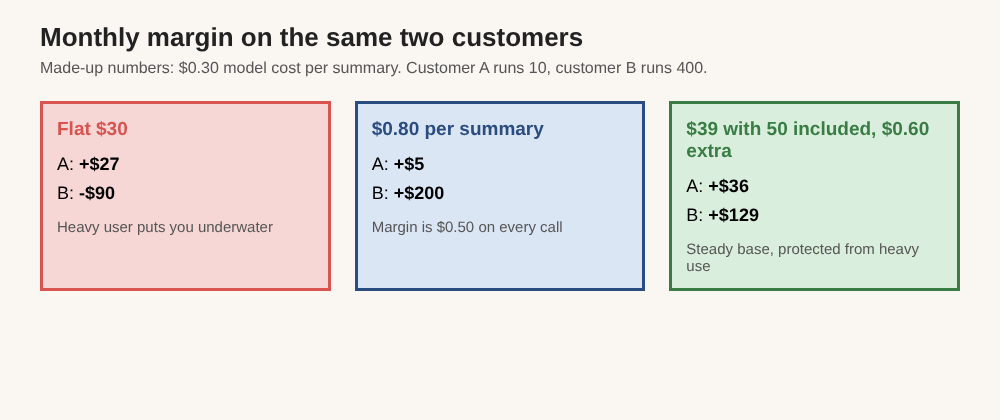
It breaks when your costs scale with use. Take a tool that summarizes sales calls. Say each summary costs you $0.30 in model fees. These numbers are an illustration, not a benchmark.
- Customer A runs 10 calls a month. Your cost is $3.
- Customer B runs 400 calls a month. Your cost is $120.
- Both pay a flat $30.
You make money on A and lose money on B. Worse, B is probably your happiest customer, because they use the product the most. Flat pricing punishes you for being useful.
A second problem is that you can end up cutting your best users off with hard limits, which feels bad to the customers who value you most.
How usage based pricing works and where it breaks
Usage based pricing charges for what the customer actually consumes: per summary, per document, per thousand words, per task completed. Your revenue rises and falls with your costs, so a heavy user can never put you underwater.
In the example above, charging $0.80 per summary gives you $0.50 of margin on every call, whether the customer runs 10 or 400.
It breaks in other places:
- Bill shock. A customer who does not watch their usage gets a large invoice and blames you.
- Hesitation. If every click costs money, people use the product less. Less use often means less value seen, and then they cancel.
- Unpredictable revenue. A slow month for your customers is a slow month for you.
- The wrong unit. If you charge per token but the customer thinks in reports or leads, the bill makes no sense to them.
The fix for the last problem is to charge for something the customer already counts, such as calls summarized, and not something only you can see, such as tokens.
Usage based pricing vs subscription side by side: cost risk, revenue predictability and buyer trust
Compare the two on three things.
Cost risk
With a subscription, you carry the risk. If usage spikes, your margin shrinks. With usage pricing, the customer carries it, and your margin stays steady.
Revenue predictability
Subscriptions win here. You can plan hiring and spending on a known monthly number. Usage revenue needs a few months of history before you can forecast it with any confidence.
Buyer trust
This one depends on the buyer. A flat price says "you will not be surprised." A usage price says "you only pay for what you get." Both can build trust. Each fails if the buyer cannot predict or understand the bill. Whichever you choose, make the price easy to explain in one sentence.
Hybrid models: a base plan with included usage
Most AI products end up somewhere in the middle. You charge a flat monthly fee that includes a set amount of usage, then charge for anything above it.
Using the same example with $0.30 per summary:
- The plan costs $39 a month and includes 50 summaries.
- Your worst-case model cost inside the plan is $15, so the margin is covered.
- Extra summaries cost $0.60 each.
The customer gets a predictable base bill and can use the product freely up to a point. You get steady revenue and protection from heavy users. The weak spot is complexity: two numbers to explain instead of one. Keep the included amount generous enough that most customers never see an overage charge, so the overage works as a safety valve and not a surprise.
How to choose based on your cost per user and customer type
Start with your numbers. The lesson on unit economics in Business Basics for Builders is a good grounding for this, and the post How to Calculate Unit Economics for an AI Product works through the arithmetic. Then do this small exercise:
- Estimate your model cost for a light user, a typical user and a heavy user over a month.
- Divide the heavy cost by the typical cost.
- Look at how that ratio sits against the price you would charge.
As a rule of thumb, not a law: if heavy users cost only a little more than typical ones, a flat subscription is safe and simpler. If heavy users cost many times more, you need either usage pricing or a hybrid with a cap.
Then think about who is buying.
- Individuals and small teams tend to want one flat price they can approve without thinking.
- Businesses often accept usage pricing when it tracks something they already measure, like tickets handled or documents processed, and when they can set a spending limit.
- Products where value is tied to each result fit usage pricing well. Products people open daily with no clear unit fit subscriptions well.
If you are still deciding what to build, keep the first product small. A small product also makes your cost per request easy to measure.
How to test your launch price with your first customers
You will not get the price right on paper. Treat your first price as a hypothesis and test it, in the same way the build, measure, learn loop treats the product itself. That loop is covered in the MVP and the Build-Measure-Learn Loop lesson of the launch course.
A practical way to run the test:
- Pick one structure to start. A hybrid is a sensible default for an AI product, because it limits your downside while you learn.
- Log cost per account from day one. Track model spend for each customer, not just in total. Without this you cannot see who is costing you money.
- Ask about the bill, not only the product. In early calls, ask "Was the price what you expected?" and "How would you describe what you are paying for?"
- Watch behavior near limits. If customers stop using the product as they near the included amount, your limit is too tight or your overage is too scary.
- Change one thing at a time. Adjust the included amount, then the overage, then the base price. Changing all three hides what worked.
You only need a small group to learn from. The lesson Launching and the First Ten Customers in the launch course walks through that stage. For finding them, see How to Get Your First 10 Customers for an AI Product. Early customers who pay something, even a small amount, give you far better pricing information than people who only say they like the idea.
Pricing also sets your margin, which AI Startup Gross Margin: What's Healthy and How to Improve It covers in more detail.
None of this promises a particular result. A good pricing model protects your margin and makes the offer clear. It does not replace a product people want.
Frequently asked questions
Is usage based pricing better than a subscription for AI products?
Neither is better in every case. Usage pricing protects your margin when costs vary widely between customers, while a subscription is simpler and more predictable when costs are steady.
What is a hybrid pricing model?
A hybrid charges a flat base fee that includes a set amount of usage, then bills extra for anything beyond it. The customer gets a predictable bill and you are protected from heavy users.
How do I know what a request costs me?
Look at how many tokens go into and come out of a typical request, then multiply by your model provider's rates. Measure a light, typical and heavy case so you can see the spread.
Can I change my pricing after launch?
Yes, and you should expect to. Change one variable at a time and tell existing customers clearly, so you can see what each change did.
Get started
Work out your cost per request, pick the simplest model that keeps your margin safe, and test it with real customers. To go through it step by step, sign in to Age of AI Entrepreneur with your email and an emailed code, then open the Launch, Price and Get Paid course. Its three short lessons cover the MVP, pricing AI products and your first ten customers. You can find more reading on the site's blog.
Building a business in the age of AI, from a first project to a company.
Visit aientrepreneur.vlvd.net↗
Comments
No comments yet.
Sign in or make an account to comment.