How much should older adults walk? The NHS guide, plainly
How much should older adults walk? The NHS does not give a walking target on its own, but its guidelines for adults aged 65 and over set four aims that walking helps meet: be active every day, do at least 150 minutes of moderate activity a week, work on strength and balance on at least two days, and spend less time sitting. A brisk walk counts as moderate activity, so five 30-minute walks a week would cover the 150 minutes. This guide explains each aim in plain words and builds one example week.
Everything here comes from two NHS pages opened for this article: "Physical activity guidelines for older adults" and "Walking for health".
How much should older adults walk? The four NHS aims
The NHS says older adults should do some type of physical activity every day, and that it can help improve health and reduce the risk of heart disease and stroke. Adults aged 65 and over should aim to:
- be physically active every day, even if it is just light activity
- do activities that improve strength, balance and flexibility on at least 2 days a week
- do at least 150 minutes of moderate intensity activity a week, or 75 minutes of vigorous activity if you are already active, or a mix of both
- reduce time spent sitting or lying down, and break up long periods of not moving with some activity
Before you start, the NHS says to speak to a GP if you have not exercised for some time, or if you have medical conditions or concerns, and to make sure the activity and how hard you work suit your fitness.
Light, moderate or vigorous: where walking fits
The NHS sorts activity into three levels, and walking can sit in any of them depending on your pace.
- Light activity is moving rather than sitting or lying down. Walking at a slow pace counts, along with getting up to make a cup of tea, moving around your home, dusting, vacuuming, making the bed and standing up.
- Moderate activity raises your heart rate and makes you breathe faster and feel warmer. "Walking for health" is the first example the NHS lists, along with water aerobics, cycling, dancing, pushing a lawn mower and hiking.
- Vigorous activity makes you breathe hard and fast, so you cannot say more than a few words without pausing. Hiking uphill is one of the NHS examples. It says 75 minutes of vigorous activity can give similar benefits to 150 minutes of moderate activity, and that most moderate activities become vigorous if you put in more effort.
So a slow stroll to the shops counts towards being active every day, and a brisk walk counts towards the 150 minutes.
The talk test for a brisk walk
How do you know your walk is brisk enough to count as moderate? The NHS walking page says a brisk walk is about 3 miles an hour, faster than a stroll. The simpler test needs no watch: you can still talk, but you cannot sing the words to a song.
The walks do not need to be long. The NHS says a brisk 10-minute daily walk has lots of health benefits and counts towards the weekly 150 minutes. For more on pace, see our guide to what counts as a brisk walk.
Why strength and balance matter alongside walking
Walking covers the moderate activity aim, but the NHS also asks adults over 65 to work on strength, balance and flexibility on at least two days a week. It says that if you have fallen, or are worried about falling, these exercises will help make you stronger and feel more confident on your feet.
Its examples of muscle-strengthening activities include carrying heavy shopping bags, yoga, pilates, tai chi, lifting weights, resistance bands, exercises using your own body weight, and heavy gardening such as digging. Do them to the point where you need a short rest before repeating. They can fall on the same days as your walks or on different days, but the NHS says they come in addition to the 150 minutes, not instead of them.
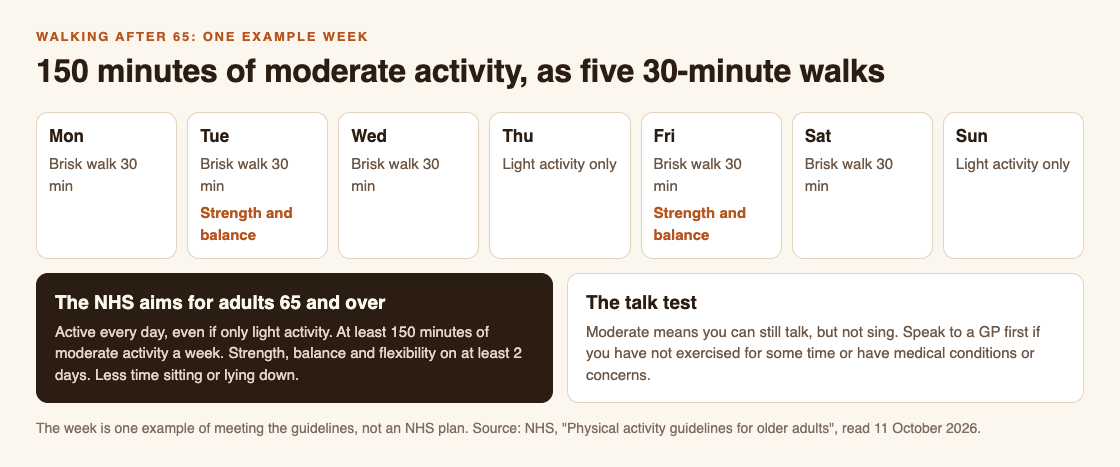
One example week that meets the NHS aims. It is an illustration, not an NHS plan.
One example week of walks: a worked example
Here is one way an adult over 65 who is already able to walk briskly could meet all four aims. It is an example built from the NHS guidelines, not an NHS plan, and it assumes a GP has no concerns.
- Monday, Wednesday and Saturday: a 30-minute brisk walk, at a pace where you can talk but not sing.
- Tuesday and Friday: a 30-minute brisk walk, plus a strength and balance session, such as tai chi or exercises with your own body weight.
- Thursday and Sunday: light activity only, such as a slow walk to the shops, gardening or moving around the house.
- Every day: break up long spells of sitting, for example by getting up to make a cup of tea.
That adds up to 150 minutes of brisk walking, two strength and balance days, activity every day, and less sitting. If 30 minutes at a time is too much, shorter walks still help: the NHS says even a brisk 10-minute walk counts towards the 150 minutes.
If you are not very active yet
The NHS says that if you are not very active but are able to walk, increase your walking distance gradually. If your joints are a problem, check whether your local swimming pool holds exercise classes, since water supports the joints as you move. Our beginner's walking plan builds up step by step.
Keeping it going
The NHS gives several ways to make walking a habit. Walk to the shops, use the stairs instead of the lift, leave the car behind for short journeys, take a stroll with family or friends after dinner, or keep a regular walk with a friend. Walking in a group, it says, is a great way to start, make new friends and stay motivated, and our guide to finding a walking partner covers how.
Comfortable shoes that support your feet and do not cause blisters will do. On longer walks, the NHS suggests taking water, a healthy snack, a spare top, sunscreen and a sun hat. Listening to music or a podcast can take your mind off the effort, and variety helps too: parks, heritage trails, canal towpaths, riverside paths, commons and nature reserves all make rewarding walks.
Giving a walk a goal with Cat Go
Cat Go is a game that plays in your web browser: "Walk anywhere, photograph a real cat, lure it with food and catch it." Treat stops sit on the map, and the card tells you how far away the nearest one is: "Walk within ... m to collect kibble, and sometimes tuna." At the stop it says "You're here. Grab what's in the bowl.", and afterwards the stop shows "Refilling - ready in ... min." The kibble and tuna are food inside the game, never real food.
When you meet a cat on your walk, you take its photo, pick its breed, and keep it in your Catdex with the place you found it. The game asks for your location: "Cat Go needs your location to find treat stops and to record where each cat was caught. Nothing else is shared."
Frequently asked questions
How many minutes a week should someone over 65 walk?
The NHS asks adults 65 and over for at least 150 minutes of moderate activity a week, and a brisk walk counts. Walking is not the only way to reach it, but five 30-minute brisk walks would cover it.
Does a slow walk count?
Yes, as light activity. The NHS lists walking at a slow pace as light activity, which helps meet the aim of being active every day, but it does not count towards the 150 minutes of moderate activity.
Is walking enough on its own for older adults?
Not quite. The NHS also asks for strength, balance and flexibility activities on at least two days a week, on top of the 150 minutes.
Should I see a GP before I start walking more?
The NHS says to speak to a GP first if you have not exercised for some time, or if you have medical conditions or concerns.
Get started
Pick one of this week's walks and give it a goal. Open Cat Go in your browser, allow location and the camera, and head for the nearest treat stop.
Comments
No comments yet.
Sign in or make an account to comment.