How to find new walking routes near you, street by street
Walking the same loop every day gets dull fast, and a dull walk is an easy one to skip. If you are wondering how to find new walking routes near you, the good news is that you rarely need a car or a trip to the countryside. Most new routes are hiding a few streets from your door. This guide gives four simple ways to find them, a four-week plan to try, and a game that gives you a reason to turn down a street you have never walked.
Why a new route helps you keep walking
Walking pays off even in small doses. The NHS Walking for health page says a brisk 10-minute daily walk has lots of health benefits and counts towards the 150 minutes of weekly exercise it recommends for adults. Brisk means about 3 miles an hour: you can still talk, but you cannot sing the words to a song.
The hard part is not the walking. It is wanting to go. Harvard Health puts it simply in Step up your running and walking workouts: it is easy to get into a rut when you cover the same ground over and over. Its first suggestion, from Dr. Aaron Baggish of Massachusetts General Hospital, is to explore different locations and commit to trying a new route once a week or once a month.
A new route gives you something to look at, a small question to answer ("where does this path go?"), and a reason to get out of the door. For more on keeping a daily walk fun, see How to make a daily walk more fun.
How to find new walking routes near you: start with your usual loop
The easiest new route is the one you already know, changed a little. Harvard Health suggests two tweaks: go at an earlier or later time, or walk your loop in the opposite direction.
It sounds too small to matter, but try it. Walking the other way, you see the fronts of houses you only ever saw from behind, and corners you always turned now open onto streets you never looked down. A morning walk and an evening walk on the same pavement feel like two different places.
Then add one change at a time:
- Turn left at the one junction where you always turn right.
- Take the side street that runs parallel to your usual road.
- Add a short detour of five minutes, and come back to your loop after it.
One new street on a familiar walk is already a new route. You do not have to plan a whole circuit.
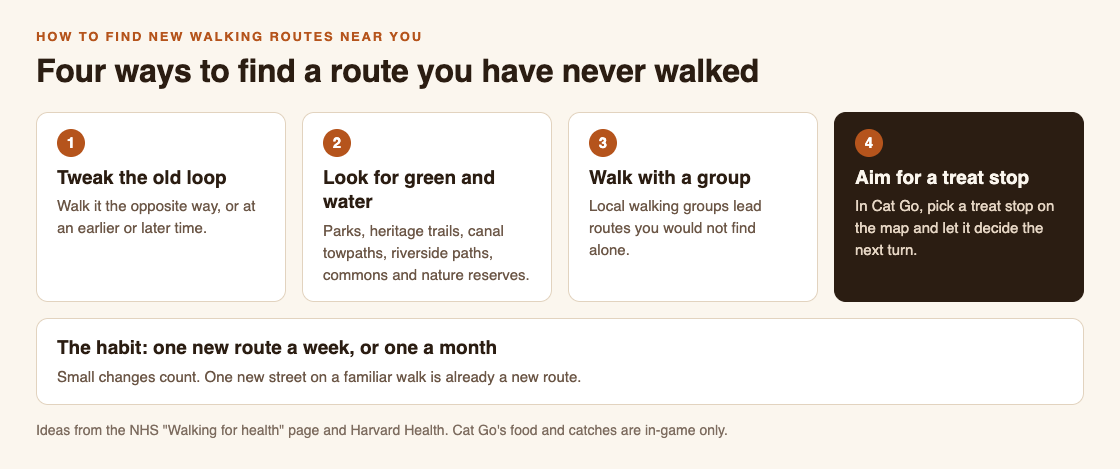
Four ways to find a route you have never walked, and the habit that ties them together.
Look for green and water close to home
The NHS page makes a point that is easy to forget: you do not have to travel to the countryside to find a rewarding walk. Towns and cities offer interesting walks, it says, including parks, heritage trails, canal towpaths, riverside paths, commons, woodlands, heaths and nature reserves.
Use that list as a checklist. Open a map of your area and look for each one:
- Green patches: parks, commons and woodland, even small ones.
- Blue lines: a canal or river often has a path beside it that you can join and leave at bridges.
- Marked trails: heritage trails often follow a theme, so the route comes with a story.
Harvard Health's Dr. Baggish also notes that there are websites and apps that map popular routes for walkers, with different distances, terrain and scenery. A map is enough to start, though. Find the nearest green or blue patch you have never visited, and make it the turning point of your next walk.
Walk with a group, or turn the walk into a hunt
Other people know routes you do not. The NHS says walking in a group is a great way to start walking, make new friends and stay motivated, and it points to the Ramblers, which organises group walks for people of all ages and fitness levels and lists many locally organised walks on its website. Harvard Health suggests a walking club, or simply inviting someone to join you.
If you would rather walk alone, give the walk a mission. Living Streets suggests in its "have an adventure" tip turning your walk into a scavenger hunt, taking photos of the pretty things you see, or finding out about local history. A hunt pulls you down streets you would never choose otherwise. For a ready-made list of things to look for, see Things to look for on a neighbourhood walk.
A worked example: four weeks, four new routes
Here is a simple plan built on Harvard Health's "new route once a week" idea. Keep your normal walks; just make one walk each week a new one.
- Week 1: flip it. Walk your usual loop in the opposite direction, at a different time of day. Note one thing you never noticed before.
- Week 2: one detour. Pick one side street off your loop and follow it for five minutes before rejoining your route.
- Week 3: green or blue. Find the nearest park, towpath or riverside path on the map that you have never walked, and make it your turning point.
- Week 4: someone else's route. Join a local group walk, or ask a friend to show you their favorite walk.
By the end of the month you have four new routes and a habit of looking for more. If you are not very active yet, the NHS advice is to increase your walking distance gradually, so start each new route short.
Let Cat Go pick the next turn
Sometimes the hardest part is choosing which street to try. Cat Go can make that choice for you. It is a game that plays in your web browser. In the site's own words: "Walk anywhere, photograph a real cat, lure it with food and catch it. Every catch keeps its breed and where you found it."
The game's home screen is a map with treat stops on it. Here is how a walk goes:
- Open the map and pick a treat stop you have not visited. The card tells you how far away it is, and to walk within a set distance to collect kibble, and sometimes tuna.
- Walk there by a street you do not usually take. At the stop the game says "You're here. Grab what's in the bowl." and you tap Collect treats.
- The stop then shows when it will be refilled, so for your next walk, pick a different stop in a new direction.
- If you meet a real cat on the way, photograph it, say which breed it is, and toss your in-game treats to win it over. A caught cat is "Saved to your Catdex with its breed and the place you found it", so your Catdex slowly becomes a record of where your walks have taken you.
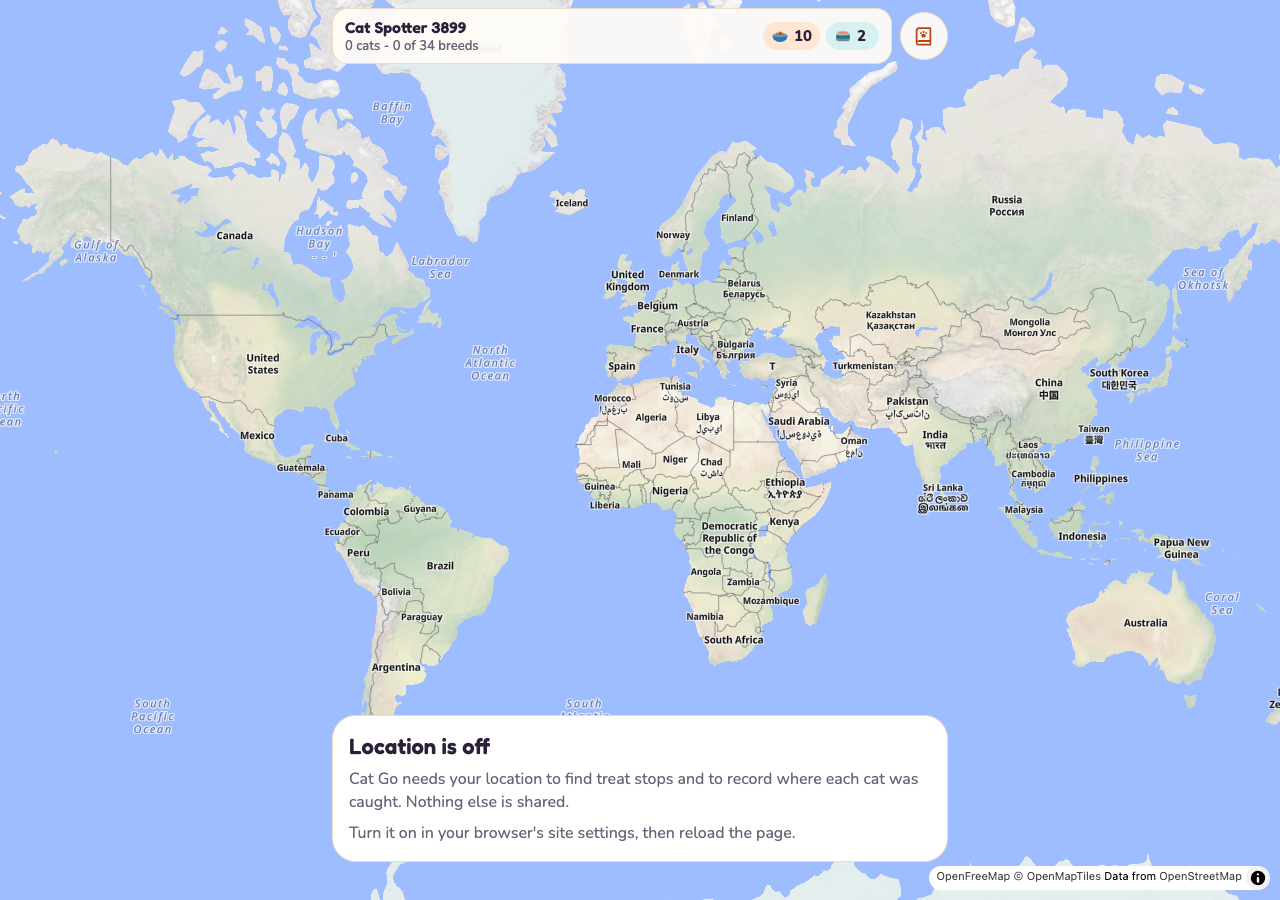
The map is where treat stops appear once location is on.
Kibble, tuna and the catch are all inside the game; the real cats are only photographed. Cat Go needs location and the camera allowed in your browser. In its own words, it uses your location "to find treat stops and to record where each cat was caught. Nothing else is shared."
Frequently asked questions
How do I find new walking routes near me?
Start by walking your usual loop the other way or at a different time, then look on a map for parks, towpaths and riverside paths you have not tried. Local group walks are another easy way to learn new routes.
How often should I try a new walking route?
Harvard Health suggests committing to a new route once a week or once a month. Even one new street on a familiar walk counts.
Do I need to go to the countryside for a good walk?
No. The NHS says towns and cities offer interesting walks, including parks, heritage trails, canal towpaths, riverside paths and nature reserves.
How does Cat Go help me find new routes?
Its map shows treat stops, and you walk to one to collect in-game food. Picking a stop you have not visited gives you a reason to take a street you have never walked.
Get started
This week, walk your usual loop backwards and take one new turn. Then play Cat Go in your browser: walk anywhere, photograph a real cat, lure it with food and catch it, and keep its breed and the place you found it in your Catdex.
Comments
No comments yet.
Sign in or make an account to comment.