Things to look for on a neighbourhood walk: a simple list
Looking for things to look for on a neighbourhood walk? Start with five: the cats, their coats, their tails, the green spaces you have never cut through, and whatever has changed since last week. A short list like this turns the same streets into something new each time. This guide gives you the list, a 20-minute loop to try it on, and a simple way to keep a record of what you find.
Things to look for on a neighbourhood walk, and why it helps
The NHS page 5 steps to mental wellbeing says evidence suggests there are five steps that can improve your mental health and wellbeing. One of them is to pay attention to the present moment: your thoughts and feelings, your body, and the world around you.
A walk is a good place to practise that. But "notice the world" is hard to do on purpose. A list helps. It gives your eyes a job, so you look up from your phone and actually see the street.
Another of the NHS steps is being physically active. The NHS says being active can improve mental wellbeing by raising your self-esteem and by helping you set goals or challenges and achieve them. A noticing list gives a walk exactly that kind of small, reachable goal.
The list: five things to look for
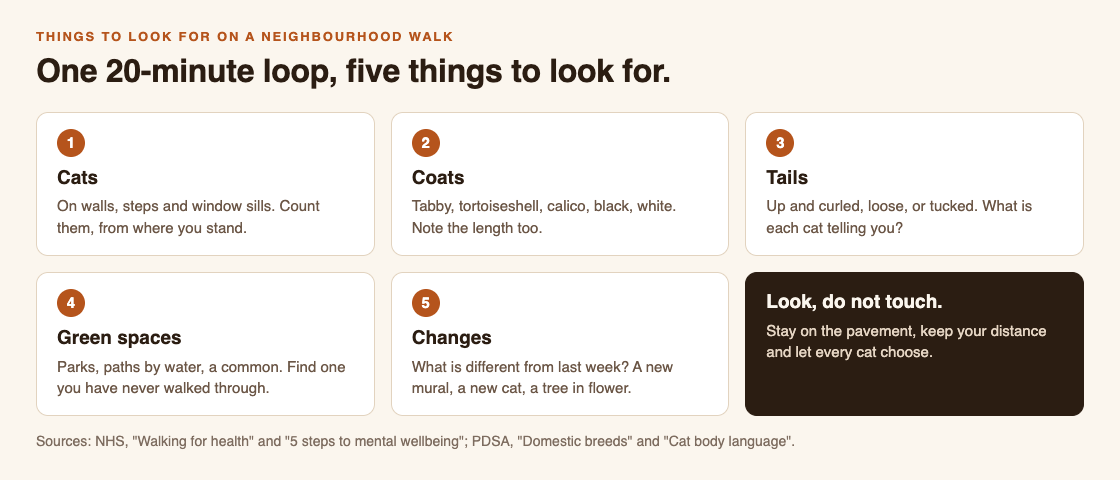
Five things to look for, and one rule.
- Cats. On walls, steps, car roofs and window sills.
- Coats. The colour and length of each cat's fur.
- Tails. What each cat's tail is telling you.
- Green spaces. Parks, paths and patches of green you have walked past but never through.
- Changes. Anything that is different from the last time you came this way.
The rule for all five: look, do not touch. Stay on the pavement and public paths, and never step onto private property for a better view.
Cats, coats and tails: what to notice
Most streets have more cats than you think. Once you start counting, you will see them in the same spots at the same times.
Coats. PDSA, the UK vet charity, says on its domestic breeds page that domestic shorthairs, medium hairs and longhairs are the most common type of cat owned in the UK. Their coats come in tortoiseshell, calico, tabby, and solid colours from black all the way to white. Try to name each one you see. Is that a tabby or a tortoiseshell? Short coat or long?
Tails. PDSA's cat body language guide says a happy cat often holds its tail upright with a little curl at the end. A scared cat might tuck it close. A tail twitching rapidly back and forth often means a cat is getting upset. Reading tails from across the street is a skill, and it gets better with every walk.
Your own behaviour. Cats Protection says on its body language page not to stare at a cat, as it can see that as a threat. Glance, note what you see, and keep walking. Never feed, chase or pick up a cat you meet.
Green spaces and changes: look past the pavement
The NHS Walking for health page makes a point worth remembering: you do not have to travel to the countryside to find a rewarding walk. It lists what towns and cities offer: parks, heritage trails, canal towpaths, riverside paths, commons, woodlands, heaths and nature reserves.
Most neighbourhoods have at least one of these within a few streets. Look at a map before you go and find one you have never walked through.
Then look for changes. This is where the same route stops being boring. A new mural. A tree that has come into flower. A shop that has changed its window. A cat on a wall where there was never a cat before. Noticing change is what makes a walk feel different, even when the route is the same.
A 20-minute neighbourhood walk: a worked example
Here is a loop you can copy tonight. Walk at a pace where, as the NHS puts it, you can still talk but cannot sing. That counts as brisk.
- Minutes 0 to 5: cats. Walk your usual first street and count every cat you see. Note where each one sits.
- Minutes 5 to 10: coats and tails. For each cat, name the coat (tabby, black, tortoiseshell) and the tail (up and curled, loose, tucked). Do this from where you stand.
- Minutes 10 to 15: green space. Turn off your usual route toward the nearest park, path or patch of green. Walk through it, not past it.
- Minutes 15 to 20: changes. Head home a different way and name three things that are new since last week.
Afterwards, write down the count. Three cats, one tabby with a tail up, a new bench in the park. Next week, try to beat it. The NHS says the easiest way to walk more is to make walking a habit, and a list you want to fill in is a reason to go out again. For more on keeping a walking habit, see How to make a daily walk more fun. Walking with children? Try our family walking game plan.
Keep a record of the cats with Cat Go
A notebook works, but a game keeps the record for you. Cat Go is a game that plays in your web browser. In the site's own words: "Walk anywhere, photograph a real cat, lure it with food and catch it. Every catch keeps its breed and where you found it."
Here is how it fits the loop:
- Treat stops give the walk a route. The map shows treat stops. Walk within range to collect kibble, and sometimes tuna. Afterwards the stop shows "Refilling", so there is a reason to pass that way again later.
- The cats you count become catches. Tap the camera, and the screen says "Fit the whole cat in the frame". You pick the breed, toss in-game treats, and a caught cat is "Saved to your Catdex with its breed and the place you found it".
- The changes show up as numbers. The bar at the top counts your cats and your breeds out of the game's 34.
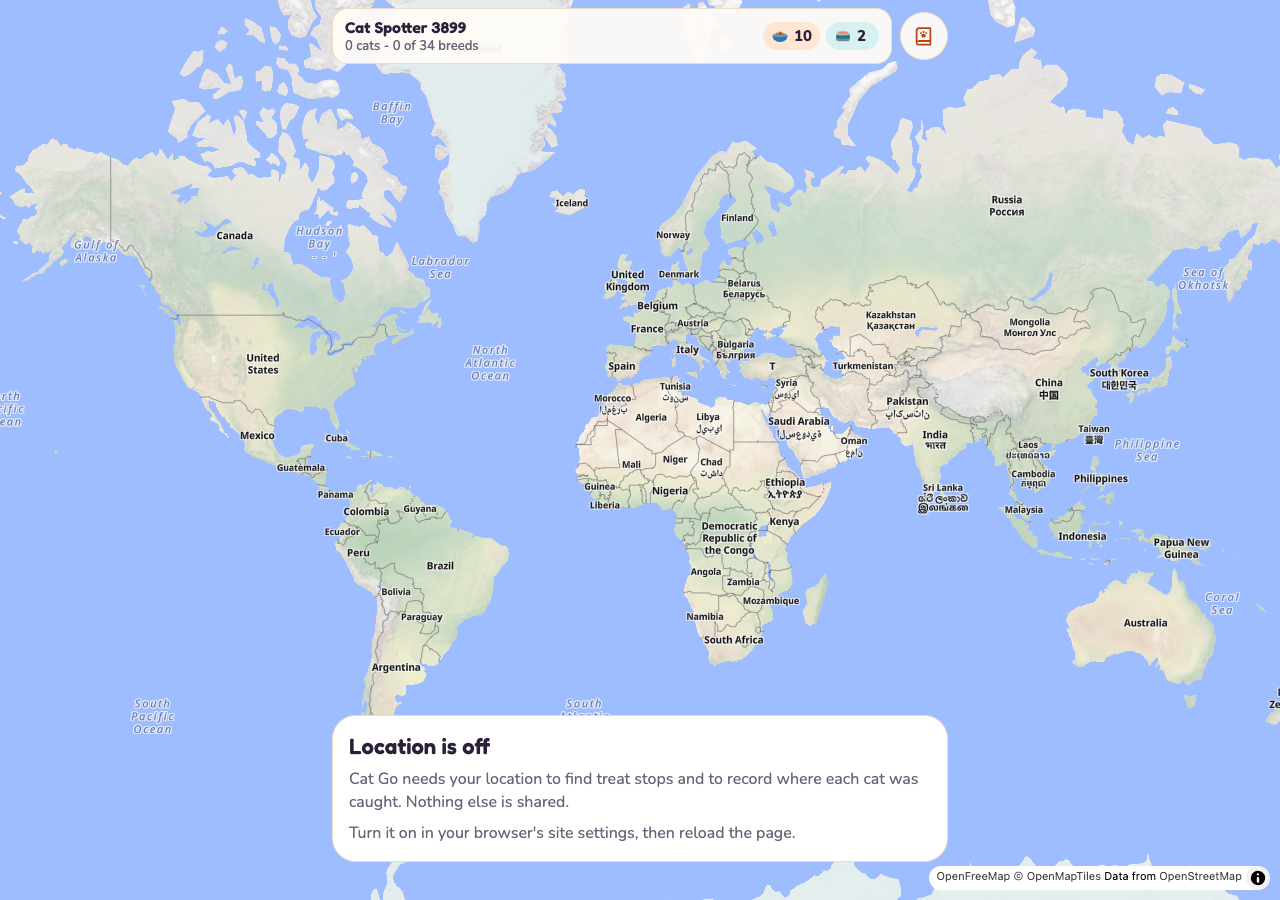
Cat Go's home screen counts the cats and breeds you find.
The food and the catch are inside the game; the real cat only has its photo taken. Cat Go needs the camera and location allowed in your browser. On location, the site says: "Cat Go needs your location to find treat stops and to record where each cat was caught. Nothing else is shared."
Frequently asked questions
What should I look for on a walk around my neighbourhood?
Try five things: cats, their coat colours, their tails, green spaces you have not walked through, and anything that has changed since last time.
How long should a neighbourhood walk be?
Twenty minutes is enough for the full list. The NHS says even a brisk 10-minute daily walk has lots of health benefits.
Is it all right to stop and look at cats on a walk?
Yes, from a distance. Glance rather than stare, stay on public paths, and never feed, chase or touch a cat you do not know.
How does Cat Go help on a neighbourhood walk?
It puts treat stops on your map to walk to, and keeps each cat you photograph in your Catdex with its breed and the place you found it.
Get started
Pick tonight's loop, take the five-part list, and count what you see. Then play Cat Go in your browser: walk anywhere, photograph a real cat, lure it with food and catch it, and keep its breed and the place you found it in your Catdex.
Comments
No comments yet.
Sign in or make an account to comment.