How to keep walking when it rains: a plain wet-day plan
Most walking habits do not end with a decision to stop. They end with a wet week. One rainy morning becomes three, and the routine is gone. If you want to know how to keep walking when it rains, the answer is a plan you make on a dry evening: a smaller walk that still counts, clothes you have already chosen, a way to be seen, a clear line for when you stay in, and an indoor stand-in for the days you do.
This guide builds that plan from public health and safety pages, then gives the short wet-day walk a small target.
Why a short walk in the rain still counts
The NHS page on walking for health says you do not have to walk for hours. A brisk 10-minute daily walk has lots of health benefits and counts towards the 150 minutes of exercise a week the NHS recommends.
Brisk means about 3 miles an hour, faster than a stroll. The NHS test is simple: you can still talk, but you cannot sing the words to a song.
The NHS activity guidelines for adults add that adults should do some physical activity every day, and spread their weekly minutes over 4 to 5 days, or every day. They also ask you to break up long periods of not moving.
Put together, a rainy day does not need your full walk. Ten brisk minutes keeps the habit alive and still counts.
How to keep walking when it rains: write the plan first
Harvard Health's walking and running tips quote a doctor saying that people who choose small, achievable goals and write them down are more likely to get them done.
So write the plan down tonight, while it is dry. Three lines are enough. Here is one you can copy and change:
- Light rain: my normal route, in my rain clothes.
- Heavy rain: my short loop, at least 10 brisk minutes.
- Thunder or flood water: I stay in and do my indoor stand-in.
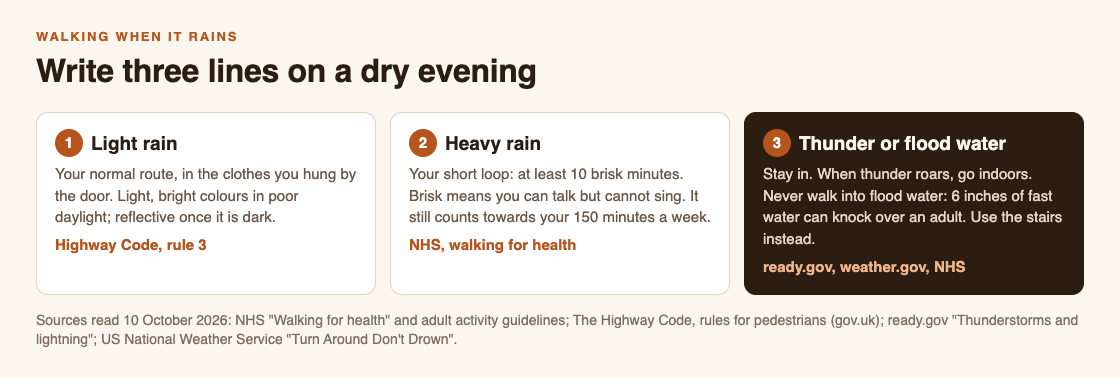
Decide the three cases on a dry evening, then just follow the line that fits the morning.
The point is that a grey morning asks you no new questions. You look out of the window, find the line that matches, and go.
What to wear for walking when it rains
The NHS walking page keeps clothing simple. Any shoes or trainers that are comfortable, give good support and do not cause blisters will do.
For longer walks, it suggests a small backpack with water and a spare top. And if you start taking longer walks regularly, it says you may want to invest in a waterproof jacket, and specialist walking shoes for more challenging routes.
That makes a sensible order for spending. Start with the comfortable shoes you own and a spare top. Buy the waterproof jacket once walking has become a habit worth protecting, not before.
Whatever you choose, hang it by the door the night before. The plan works best when getting ready takes one minute.
Be seen on a dark, wet day
Rain often comes with poor light. The Highway Code's rules for pedestrians cover exactly this.
- Rule 3: in poor daylight, wear or carry something light-coloured, bright or fluorescent. When it is dark, use reflective materials, which drivers using headlights can see up to three times as far away as non-reflective ones.
- Rule 1: use the pavement if there is one, and where you can, avoid walking next to the kerb with your back to the traffic. Stay aware of your surroundings and avoid unnecessary distractions.
- Rule 2: with no pavement, keep to the right-hand side of the road so you can see oncoming traffic, and be ready to walk in single file, especially in poor light.
These are UK rules; road rules differ between countries, so check your own. If your rainy walks often fall after sunset, our guide to walking safely after dark covers the rest of these rules.
When not to walk: thunder and flood water
Some weather changes the plan completely. The US government's thunderstorm and lightning page puts it in four words: when thunder roars, go indoors. It says to move from outdoors into a building or a car with a roof.
Flood water is the other hard line. The US National Weather Service's Turn Around Don't Drown page says that after deaths in vehicles, the next highest share of flood-related deaths comes from walking into or near flood waters. It says 6 inches of fast-moving flood water can knock over an adult, and that it is never safe to drive or walk into flood waters.
After a storm, ready.gov says to follow forecasts on whether it is safe to go outside, and to watch for fallen power lines and trees.
So the third line of your plan is not a failure. It is the plan working.
Indoor stand-ins for the days you stay in
A stay-in day can still have a little movement in it. Both NHS pages name the stairs: the walking page suggests using the stairs instead of the lift, and the adult guidelines list walking up the stairs as activity.
The guidelines also ask you to break up long periods of sitting with some activity. On a stormy day, that might be a few trips up and down the stairs every hour, or standing up and moving between tasks.
Pick one stand-in now and write it as line three of your plan. "Something indoors" is vague. "Stairs, five trips, three times today" is a plan.
Give the short loop a target
A short wet-day loop is easier to start when it ends somewhere. Harvard's tips suggest trying a new route once a week or once a month to keep walks fresh; our guide to finding new walking routes shows how. A game can also give the loop a point.
Cat Go is a game that plays in your web browser. In its own words: "Walk anywhere, photograph a real cat, lure it with food and catch it." The home screen is a map with treat stops on it. Away from a stop, a card tells you to walk within a set distance to collect kibble, and sometimes tuna, which are in-game food. At the stop it says "You're here. Grab what's in the bowl." and shows a Collect treats button. Afterwards the stop shows "Refilling" with the minutes until it is ready again.
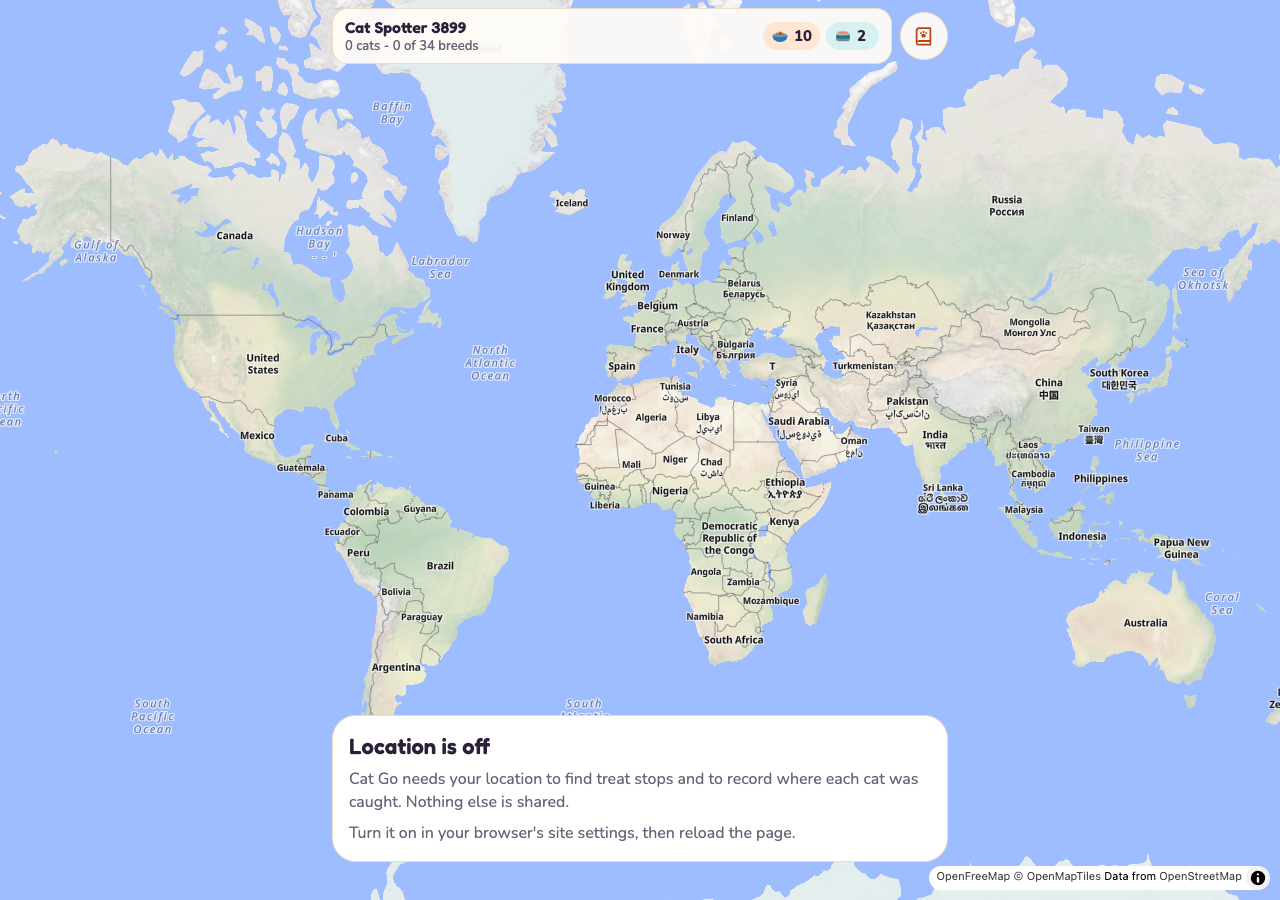
Cat Go starts on a map. Treat stops near you appear once location is on.
Here is how that fits a rainy morning. On a dry evening, open the map and find the treat stop nearest your short loop. Make that stop line two of your plan. When it rains hard, the walk has one job: get to the stop, collect, and come home. If you pass a cat on the way, you can photograph it for your Catdex, and each catch keeps its breed and where you found it.
The game needs location and the camera allowed in your browser. It says it needs your location "to find treat stops and to record where each cat was caught. Nothing else is shared." Keep your phone in a pocket between stops so it stays dry.
Frequently asked questions
Does a 10-minute walk in the rain count as exercise?
Yes, if it is brisk. The NHS says a brisk 10-minute daily walk counts towards the 150 minutes of weekly exercise it recommends.
Should I walk in a thunderstorm?
No. Ready.gov says when thunder roars, go indoors, into a building or a car with a roof. Use your indoor stand-in instead.
Is it safe to walk through flood water?
No. The US National Weather Service says 6 inches of fast-moving flood water can knock over an adult, and that it is never safe to walk into flood waters.
Do I need special rain gear to start?
No. The NHS says comfortable, supportive shoes will do, and suggests a waterproof jacket once you are taking longer walks regularly.
Get started
Tonight, write your three-line wet-day plan, hang your rain clothes by the door, and choose your short loop. For the colder months ahead, our plan for walking in winter builds on the same idea.
Play Cat Go in your browser: walk anywhere, photograph a real cat, lure it with food and catch it.
Comments
No comments yet.
Sign in or make an account to comment.