How to remember historical figures and what they did
If you are wondering how to remember historical figures and what they did, the trouble is usually not the names. You know you have heard of Gutenberg, Luther and Rousseau. The trouble is the match: which one did what, and why it mattered. This guide gives you a four-line card for each person, a way to quiz yourself from both sides, and a one-week plan. It also shows what memory research says, and where that research stops.
How to remember historical figures: fix the match, not the name
Often the problem is a broken link. You can recall "Rousseau" and you can recall "the general will," but the line between them has faded. So the goal is not to stare at more facts. It is to practice pulling the deed out when you see the name, and the name out when you see the deed.
That is a different job from learning a whole period. If you want a general routine for world history, our guide to learning world history in 10 minutes a day covers it. This guide zooms in on people.
What memory research says works
In 2013, John Dunlosky and colleagues reviewed 10 study techniques, chosen because they are easy to use, and rated how useful each one is. Their review in Psychological Science in the Public Interest sorted them like this:
- High utility: practice testing and distributed practice (spreading study out over time). These helped learners of different ages and abilities, across many kinds of tests, and even in educational settings.
- Moderate utility: elaborative interrogation, self-explanation and interleaved practice (mixing different topics in one session). They show promise, but the evidence is still limited.
- Low utility: summarization, highlighting, the keyword mnemonic, imagery for text learning and rereading.
Two findings matter most for names and deeds. Most students report rereading and highlighting, yet these do not consistently boost results, and the authors suggest practice testing instead of rereading. And the keyword mnemonic, a popular memory trick, helped only for a limited range of materials and for short retention intervals.
A 2011 study by Karpicke and Blunt adds one more point. Students who practiced recalling a text learned more than students who studied it by drawing concept maps. The advantage held on questions that asked them to make inferences, and even when the final test was to draw a concept map. So a beautiful diagram of who influenced whom is not a substitute for closing the book and recalling.
Keep the limits in mind. None of these studies tested lists of historical figures. They point to a method; they do not promise a result.
The person card: four lines, no more
Make one card for each person, on paper or in any notes app. The front has only the name and one question: what did they do, and why did it matter? The back has four short lines.
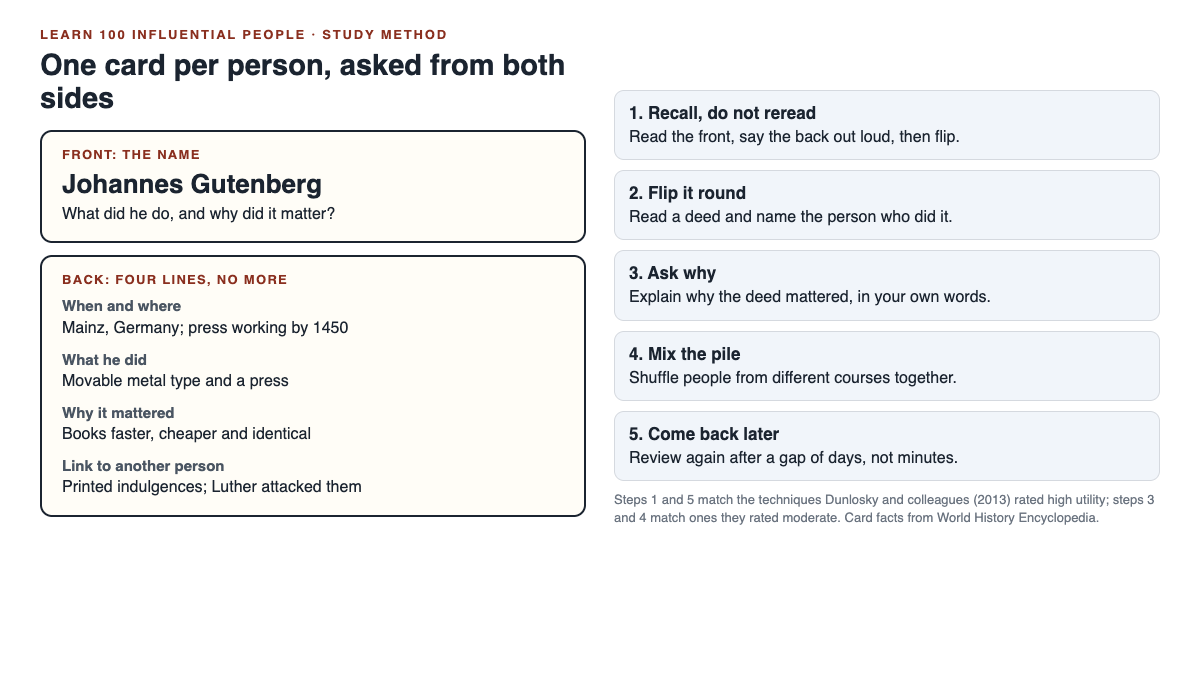
- When and where. One place and one date you trust, not five.
- What they did. One deed in a few words.
- Why it mattered. The change it caused, in your own words.
- Link to another person. Someone they built on, argued with or made possible.
The fourth line is the easiest to skip, and it is the one that ties your cards together. A person linked to another person is two cards that remind you of each other.
Five ways to use your cards
- Recall, do not reread. Read the front, say the back out loud, then flip and check. This is practice testing.
- Flip it round. Read a deed from the back and name the person. Names to deeds and deeds to names are two different skills.
- Ask why. Say why the deed mattered, without looking. If you cannot, the third line needs work.
- Mix the pile. Shuffle people from different fields and centuries together, so you cannot guess the answer from the one before.
- Come back later. Review the pile again after a gap of days, not minutes. That is distributed practice.
One warning. Rereading feels good. In a 2006 study, Roediger and Karpicke found that students who restudied felt more confident, yet students who had been tested remembered more after 2 days and after a week. If recalling feels harder than rereading, that is normal.
Worked example: three cards, one week
Here are three cards built from the sources opened for this guide. They come from three different courses, which makes them a good mixed pile.
- Johannes Gutenberg. Mainz, press working by 1450. Movable metal type and a press. Books became quicker, cheaper and identical. Link: among the first things he printed were indulgences, which Martin Luther later attacked.
- Martin Luther (1483 to 1546). Wittenberg, 1517. The 95 Theses, against the sale of indulgences. It became a bestselling pamphlet within a year, thanks to the press. Link: Gutenberg.
- Jean-Jacques Rousseau. Born in Geneva, 1712; The Social Contract, 1762. A state is legitimate only if guided by the "general will" of its citizens. It opens: "Man is born free, but is everywhere in chains." Link: John Locke, who also wrote about a social contract but for different ends.
Now the week:
- Day 1. Read each source once and write the three cards. Then recall each back from its front.
- Day 2. Recall front to back, then back to front. Mark any card you missed.
- Day 4. Shuffle, recall, and say the link line for each card out loud. Fix the misses from the source, not from memory.
- Day 7. Recall all three without looking, then add two new cards. Notice which old card fails first. That is the one to review next.
Each session takes a few minutes. The pile grows by a few cards a week, and the old cards keep coming back. For a starter set of names to turn into cards, see our list of famous people in history every student should know.
Common mistakes
- Too much on the back. A card with ten facts becomes a page you reread. Keep four lines.
- Only one direction. If you only ever go from name to deed, a question that starts from the deed will catch you out.
- Cards with no source. Write where each line came from. Dates and details often differ between sources, and you want to know which one you used.
- Cramming the pile on one day. One long session feels productive, but spacing the same time across the week is what the research rates highly.
Frequently asked questions
What is the best way to remember historical figures?
Test yourself instead of rereading, in both directions, and come back after gaps of days. The 2013 Dunlosky review rated practice testing and distributed practice as the most useful techniques it studied.
Do memory tricks like mnemonics help with names?
The same review rated the keyword mnemonic as low utility. It helped only for some materials and over short periods.
How many people should I learn at once?
Start with a small pile, such as three to five cards, and add a few each week. A small pile you review often beats a big pile you see once.
Should I memorize dates?
Keep one date per person, the one that anchors their main deed. More dates per card turns recall back into rereading.
Get started
Learn 100 Influential People is built around the same two ideas: questions that check you, and review that comes back later. Its 272 questions ask you to choose, put in order, match, sort and estimate a number, so you recall instead of rereading. Questions from lessons you finish come back, "spaced out so they stick: up to 5 a day." Lessons take about 9 minutes, every attempt is graded, and you can retake a lesson any time. Sign in with your email and an emailed code; accounts are for people aged 13 or older.
Start Learn 100 Influential People: short hands-on lessons on the people who shaped history, with every side of the debate and the sources to read next.
Comments
No comments yet.
Sign in or make an account to comment.