How to start walking for exercise: a beginner's 5-week plan
How to start walking for exercise, when you have not done much for a while? Start smaller than you think, walk a little faster than a stroll, and add time slowly, week by week. This guide gives you what the NHS says counts as exercise, a simple test for pace, a five-week example plan from ten minutes a day, and the habits that help a new walker keep going.
Before you start
Two checks come first. The NHS physical activity guidelines for adults say to speak to your GP first if you have not exercised for some time, or if you have medical conditions or concerns. Your activity, and how hard you push, should suit your fitness.
The second check is your shoes. The NHS Walking for health page says any shoes or trainers that are comfortable, give enough support and do not cause blisters will do. You do not need special kit to begin. For longer walks later on, it suggests a small bag with water, a spare top, sunscreen and a sun hat.
What counts as walking for exercise
The NHS guidelines set the target for adults aged 19 to 64: at least 150 minutes of moderate intensity activity a week, spread evenly over 4 to 5 days, or every day. Brisk walking is one of the NHS's own examples of moderate activity.
"Brisk" has a plain meaning. The Walking for health page says a brisk walk is about 3 miles an hour, faster than a stroll. The easy test needs no watch: you are walking briskly if you can still talk, but you cannot sing the words to a song. Moderate activity, the guidelines add, raises your heart rate and makes you breathe faster and feel warmer.
The good news for a beginner is how small the first step can be. The NHS says a brisk 10-minute daily walk has lots of health benefits and counts towards your 150 minutes. Ten minutes is a real start, not a warm-up for one.
Two more points from the same guidelines are worth knowing. Adults should also do strengthening activities on at least 2 days a week, which walking alone does not cover. And they should cut down time spent sitting, breaking up long stretches with some movement. A short walk is one easy way to do that.
How to start walking for exercise: build up slowly
The NHS advice for anyone not very active is simple: increase your walking distance gradually. The mistake most beginners make is starting at the finish line, with an hour on day one, then stopping by day four.
A gentler shape works better. Pick a starting walk you are sure you can do. Keep it the same for a week, at a pace where the talk-but-not-sing test holds. Then add a few minutes, not a few miles. If a week feels hard, repeat it before moving on. There is no prize for reaching 150 minutes fast.
Harvard Health's tips, from Dr. Aaron Baggish of Massachusetts General Hospital, back up the small-steps idea. "People who choose small, incremental, achievable goals and write them down are more likely to get them done," he says in Step up your running and walking workouts.
A worked example: five weeks from ten minutes a day
Here is one example plan built on that advice. It is an example, not a medical plan: if a week feels like too much, stay on it longer. Each walk is at a brisk pace, five days a week, with rest days wherever they suit you.
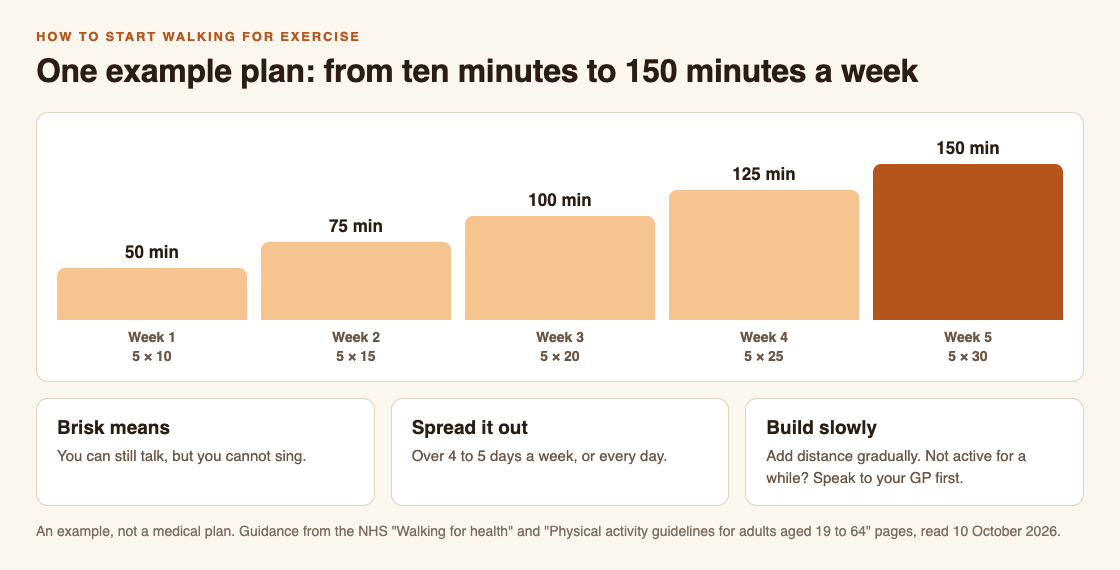
Five walks a week, five extra minutes each week.
- Week 1: five walks of 10 minutes. That is 50 minutes in the week. Find a loop from your front door you can finish easily.
- Week 2: five walks of 15 minutes, 75 minutes in all. Write the week's goal down somewhere you will see it.
- Week 3: five walks of 20 minutes, 100 minutes. Try the talk test on every walk: talking yes, singing no.
- Week 4: five walks of 25 minutes, 125 minutes. Swap one walk for a new route, or walk your usual loop the other way round.
- Week 5: five walks of 30 minutes. That is 150 minutes, the NHS weekly target for adults.
From here, keep the habit before you chase more. Harvard's self-challenge is a good next goal: time how long it takes to walk a set distance, like a loop of your neighbourhood, then try to meet or beat it.
Habits that keep a new walker going
Starting is the easy part. These ideas, from the two pages above, help with week six and beyond.
- Tie the walk to something you already do. Dr. Baggish suggests scheduling it around a regular activity, like when you first get up, or before lunch or dinner. "Many daily habits are created when something signals you to do them," he says.
- Fold it into your day. The NHS lists walking part of your journey to work, walking to the shops, taking the stairs instead of the lift, and a stroll with family or friends after dinner.
- Bring someone. "We are 10 times more likely to commit to a workout if we know someone is waiting," says Dr. Baggish. The NHS calls walking in a group a great way to start and stay motivated.
- Give your ears something. The NHS says music or a podcast can take your mind off the effort. Harvard's twist: save an audiobook for your walks only, at low volume with one earbud so you stay alert.
- Change the scenery. The NHS points to parks, canal towpaths and riverside paths in towns and cities. For more ideas, see How to find new walking routes near you and How to make a daily walk more fun.
Give each walk a reason with Cat Go
A beginner's hardest moment is the day the walk feels pointless. A small goal at the other end helps. Cat Go is a game that plays in your web browser: "Walk anywhere, photograph a real cat, lure it with food and catch it. Every catch keeps its breed and where you found it."
Here is how it fits the plan above:
- Pick a treat stop as your turning point. Treat stops sit on the game's map. Away from one, the card tells you how far it is and says to walk within a set distance "to collect kibble, and sometimes tuna."
- Collect at the stop. When you arrive: "You're here. Grab what's in the bowl." Tap Collect treats, then head home. The stop then shows "Refilling", with the minutes until it is ready again.
- Watch for cats on the way. If you meet one, take its photo and use your in-game food to lure it into your Catdex.
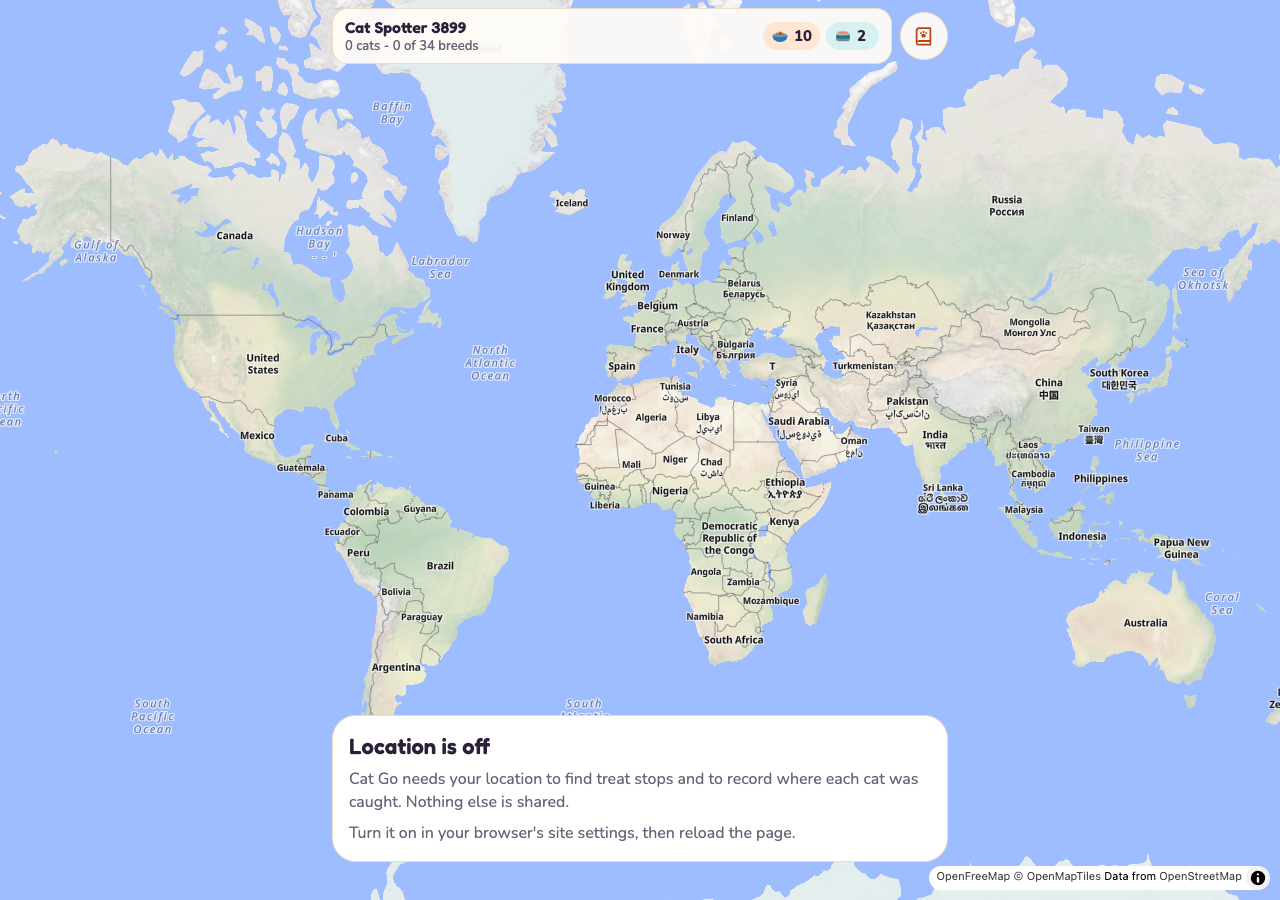
The map is where treat stops appear once location is on.
The kibble and tuna are in-game food; the real cats only have their photos taken. Cat Go needs your location "to find treat stops and to record where each cat was caught", and the camera, both allowed in your browser.
Frequently asked questions
How long should a beginner walk for?
Start with a walk you can finish easily. The NHS says a brisk 10-minute daily walk has lots of health benefits and counts towards the 150 minutes a week it recommends for adults.
How fast should I walk for exercise?
Briskly: about 3 miles an hour, says the NHS. If you can still talk but cannot sing, your pace is right.
How many days a week should I walk?
The NHS guidelines suggest spreading activity evenly over 4 to 5 days a week, or every day. The example plan here uses five.
Do I need to see a doctor before I start walking?
The NHS says to speak to your GP first if you have not exercised for some time, or if you have medical conditions or concerns.
Get started
Put on comfortable shoes and walk for ten brisk minutes today. Then play Cat Go in your browser: walk anywhere, photograph a real cat, lure it with food and catch it, and let the next treat stop be tomorrow's reason to go.
Comments
No comments yet.
Sign in or make an account to comment.