How to Stop Doomscrolling: A Calmer News Diet in 4 Steps
If you want to know how to stop doomscrolling, start with this: willpower alone rarely wins against an endless feed. What works better is a plan. Notice when the scroll starts, make it harder to start, give the news a fixed place in your day, and decide in advance what you will do instead. This post walks through those four steps, with what research has found about heavy news use and what the Stoics said about a scattered mind.
How to Find Your Meaning is a free web app of short, hands-on lessons on Stoicism, healthy habits and your own story, with a lesson called What You Feed Your Mind and a daily practice that gives the time you take back from your feed somewhere to go.
How to stop doomscrolling: what it is and why it sticks
Doomscrolling is reading bad news, one item after another, long past the point where it tells you anything new. You open an app to check one thing. Forty minutes later you are still there, tense, and you know little more than you did after the first two minutes.
It is hard to stop because the news feels important, the feed has no end, and the habit runs before you decide anything. That is why the fix below works on cues and routines, not only on good intentions.
What research says about heavy news use
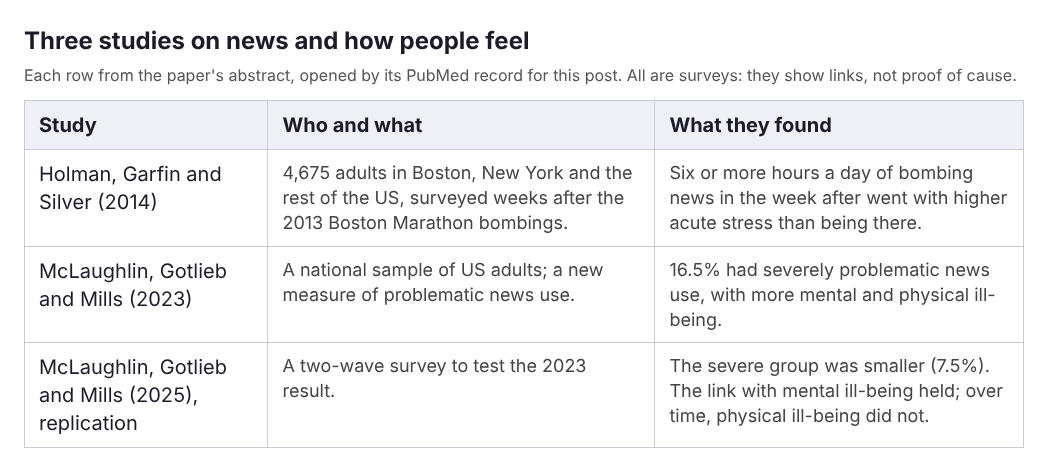
Two lines of research are worth knowing. Both are surveys, so they show links, not proof that news causes harm.
After a crisis. After the 2013 Boston Marathon bombings, Holman, Garfin and Silver surveyed 4,675 adults in Boston, New York and the rest of the US (abstract on PubMed). People who took in six or more hours a day of bombing coverage in the week after reported higher acute stress than people who were directly exposed to the bombings. The authors suggest that hours of repeated coverage may prolong acute stress.
As a daily habit. In 2023 McLaughlin, Gotlieb and Mills described "problematic news consumption": being absorbed by the news, preoccupied with it, unable to regulate it, and finding it gets in the way of life (abstract on PubMed). In a national sample of US adults, 16.5% fell in the most severe group, and higher levels went with more mental and physical ill-being, even after allowing for personality and overall news use.
Their 2025 replication is a useful check (abstract on PubMed). The severe group was smaller, 7.5%. The link with mental ill-being held up, but over time the link with physical ill-being did not.
What the Stoics said about a scattered mind
The Stoics had no feeds, but they knew the pull of too many inputs. Seneca told his friend Lucilius, in Letter 2, to "linger among a limited number of master-thinkers" rather than skim everything, because "everywhere means nowhere." He used a food image that fits the news well: "Food does no good and is not assimilated into the body if it leaves the stomach as soon as it is eaten." His conclusion: "in reading of many books is distraction."
Marcus Aurelius asked himself the same question in Book 2 of his Meditations: "Do the things external which fall upon thee distract thee? Give thyself time to learn something new and good, and cease to be whirled around."
Epictetus gives the frame. His Handbook opens by splitting things into what is in our control and what is not. The news itself, and how feeds are built, are not up to you. What you take in, when, and what you do next are. Our post on Stoic acceptance covers that split, and the one on things I can't control shows how to use it on worries.
Step 1: notice when you start scrolling
You cannot change a habit you have not looked at. For three days, each time you catch yourself in bad news, write one line:
- When: the time of day.
- Where: in bed, in a queue, at your desk.
- Before: what you were doing or feeling just before.
- After: how you felt when you stopped.
Most logs show two or three trigger moments, not twenty: often the first minutes after waking, the last ones before sleep, and the moment a task gets hard. The "before" column is the useful one. It tells you what the scroll is standing in for.
Step 2: make the scroll take more effort
Add a small barrier right at your top trigger. A few seconds of effort gives your choice time to catch up with your thumb.
- Move news and social apps off your home screen, into a folder on the last page.
- Turn off news alerts and keep alerts for people.
- If bed is your trigger, charge the phone outside the bedroom.
Change one thing at a time, and keep it for a week before you add another. Our post on how long it takes to form a habit explains why a new routine takes weeks, not days.
Step 3: give the news a fixed place
You can stay informed without living in the feed. Treat the news like a meal, with a set time.
- Fixed times: once or twice a day, for a set length, such as 15 minutes at lunch. Not first thing and not in bed.
- Fewer sources: two or three you trust, as Seneca chose a few authors.
- Depth over headlines: one article that explains a story, rather than fifty updates on it.
- One question first: "Is there anything here I can act on?" If yes, act. If no, you can know about it without soaking in it.
Step 4: replace the scroll with something that matters
A habit you remove leaves a gap, and if nothing fills it the old habit comes back. Decide in advance what goes in each trigger moment: a short passage before you touch the phone in the morning, a stretch or a glass of water when a task gets hard, a written review of the day at bedtime.
A worked example with the daily practice
The daily Stoic practice in How to Find Your Meaning has three short steps, and it can fill those gaps.
- Morning: you get a question for the day and one of the four virtues. Say it is temperance. You write: "When I reach for the phone at my desk, I stand up first."
- During the day: you read a short passage from Epictetus, Marcus Aurelius or Seneca and try one thing. That reading replaces the waiting-room scroll.
- Evening: you answer Seneca's questions from Sextius, which the app words as "What bad habit did I cure today? What fault did I resist? In what way am I better?" You write: "Skipped the 11 pm scroll twice. Gave in once at lunch. Tomorrow the phone stays in my bag at lunch."
You can keep notes on each day, so after two weeks you can read back and see your pattern change.
Frequently asked questions
Is doomscrolling bad for your mental health?
Surveys link heavy or problematic news use with more stress and mental ill-being, but they do not prove the news causes it. If scrolling is hurting your sleep or mood, talk to a doctor about your own case.
Should I quit the news completely?
You do not have to. A smaller, scheduled news diet from a few trusted sources lets you stay informed without the constant pull.
What is problematic news consumption?
It is a term from a 2023 study for news use that absorbs you, stays on your mind, is hard to regulate and gets in the way of daily life.
What did the Stoics say about distraction?
Seneca told Lucilius that "everywhere means nowhere" and to stay with a few good authors. Marcus Aurelius told himself to "cease to be whirled around" and learn something good instead.
Get started
Taking your attention back is half the job; the other half is deciding where to point it. How to Find Your Meaning teaches both in lessons of about nine minutes, from What You Feed Your Mind to How Habits Form, and every lesson lists its sources. Read what the courses cover, or install the app from the site. Every lesson is free with an account, and you sign in with your email and a code sent to you.
Start How to Find Your Meaning: short hands-on lessons on Stoicism, healthy habits and your own meaning, with a daily Stoic practice to live it.
Find what your life is for.
Visit findyourmeaning.vlvd.net↗
Comments
No comments yet.