Stoic Acceptance: How to Accept What Happens Without Giving Up
Stoic acceptance means wanting what has happened to have happened, instead of fighting a fact you cannot change. Epictetus put it in one line: "Don't demand that things happen as you wish, but wish that they happen as they do happen, and you will go on well." It is not giving up. The Stoics paired acceptance of what is not up to you with full effort on what is, so the practice always ends with something you do next.
How to Find Your Meaning is a free web app of short, hands-on lessons on Stoicism, healthy habits and your own story, and its course Philosophy Is Core: Acceptance has a lesson called Accepting What Happens, with a daily practice to try it on real days.
What Stoic acceptance means
The idea rests on the first line of Epictetus' Enchiridion, or Handbook: "Some things are in our control and others not." In our control, he says, are "opinion, pursuit, desire, aversion, and, in a word, whatever are our own actions." Not in our control are "body, property, reputation, command", whatever is not our own action.
Acceptance is the attitude you take to the second list. If you treat those things as yours to command, Epictetus warns, "you will lament, you will be disturbed." If you accept them as they come, your attention is free for the first list. Our post on things I can't control walks through that sorting in more detail.
Three short passages show the Stoic tone:
- Enchiridion 11: "Never say of anything, 'I have lost it'; but, 'I have returned it.'" He tells you to care for what you have the way "travelers view a hotel".
- Enchiridion 17: you are "an actor in a drama". Your business is "to act well the character assigned you; to choose it is another's."
- Meditations, Book 10: Marcus Aurelius defines equanimity as "the voluntary acceptance of the things which are assigned to thee by the common nature."
How Marcus Aurelius practised acceptance
Marcus returns to acceptance again and again in his notebook (quoted here in George Long's translation). In Book 5 he compares hard events to a doctor's orders. People take the unpleasant treatments the healer Aesculapius prescribes "in the hope of health", and so, he writes, "accept everything which happens, even if it seem disagreeable."
Book 7 is shorter: "Love that only which happens to thee and is spun with the thread of thy destiny." That line sits close to the later idea of amor fati, which our post on how to practice amor fati covers on its own.
In Book 12 he lists what the free mind does, all in one breath: "doing what is just and accepting what happens and saying the truth." Acceptance is one of three jobs, not the whole of them. Justice and truthfulness stay active, every day.
The dog and the cart: acceptance and fate
The older Stoics gave acceptance a reason. They held that everything happens by fate, a single order of causes. The Internet Encyclopedia of Philosophy's entry on Chrysippus quotes the image later sources credit to Zeno and Chrysippus: a dog tied to a cart. If it wants to follow, it is pulled and follows, so its own act lines up with necessity. If it does not want to, "it will be compelled in any case."
Epictetus ends his Handbook with Cleanthes' lines on the same theme: "Conduct me, Jove, and you, O Destiny ... I follow cheerfully; and, did I not, wicked and wretched, I must follow still." Our post on Cleanthes' Hymn to Zeus reads his longer poem.
Where thinkers disagree
Fate raises a hard question. If everything is fixed, how can you be responsible for what you do? The IEP entry says Chrysippus seems to have held that free action is compatible with fate, and that how the two fit together "has been the subject of some controversy". The Epicureans, the Stoics' rivals, answered differently: they held there is a little chance in how atoms move. A reader today has two honest options. One is to take the practice without the belief in fate, on the view that the past is fixed whatever caused it. The other is to hold, as the early Stoics did, that acceptance rests on that belief and is weaker without it.
Why acceptance is not giving up
The common worry is that acceptance makes you passive. The Stoic texts point the other way.
- Acceptance is about what has already happened and what is not up to you. It says nothing about letting go of what is up to you.
- Epictetus' own list of what is in your control is a list of actions: what you aim at, what you want, what you turn away from.
- Marcus pairs "accepting what happens" with "doing what is just".
So when you miss a deadline, acceptance does not say "it does not matter." It says: the missed deadline is a fact now; arguing with it uses up the energy you need for the email you send next. Epictetus' teaching that people are disturbed not by things but by their judgements fits here: the fact stays, the story you add to it is yours to change.
Acceptance is also not pretending a loss does not hurt. The Stoics wrote whole letters of consolation; our post on Stoicism and grief shows how Seneca handled it.
A four-step practice of acceptance
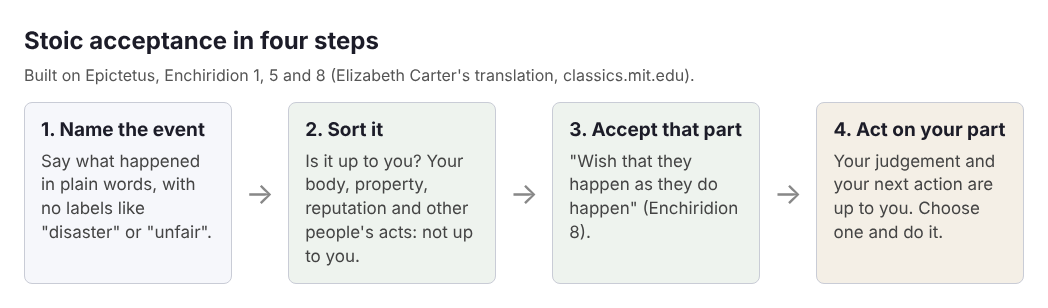
Here is a short practice built on Enchiridion 1 and 8. Start with small things, so it is ready when a big one comes.
- Name the event. Say what happened in plain words. "The train is 30 minutes late," not "my day is ruined."
- Sort it. What part of this is up to you, and what is not? The train is not. Your tone, your plan and your next hour are.
- Accept that part. Say Epictetus' line to yourself: wish that it happens as it does happen. The late train is now part of today.
- Act on your part. Pick one action and do it: send a message, read the chapter you brought, call someone back.
A worked example with the daily practice
The daily Stoic practice in How to Find Your Meaning has three short steps, and the four steps above fit inside them.
- Morning: you get a question for the day and one of the four virtues. Say the virtue is courage. You decide: "Today, when something goes wrong, I name it plainly before I react."
- During the day: you read a short passage from Epictetus, Marcus Aurelius or Seneca and try one thing. A meeting is moved at the last minute. You name it, sort it, accept that it moved and spend the freed half hour on the report.
- Evening: you answer the questions Seneca took from Sextius, which the app words as "What bad habit did I cure today? What fault did I resist? In what way am I better?" You write: "Resisted the angry reply about the meeting. Better: I used the time."
You can keep notes on each day, so after a week you can see which events you accepted quickly and which still pull you in.
Frequently asked questions
Is Stoic acceptance the same as amor fati?
They are close. Acceptance means wanting what happens to happen as it does; amor fati, a phrase from Nietzsche, goes further and asks you to love it.
Does Stoic acceptance mean you should not try to change things?
No. You accept what has happened and what is not up to you, and you act fully on what is. Marcus Aurelius lists "doing what is just" right beside "accepting what happens".
Where does Epictetus talk about acceptance?
Mostly in the Enchiridion, his Handbook: section 1 on what is in our control, section 8 on wishing things to happen as they do, and section 11 on returning what was lent.
Do you have to believe in fate to practise acceptance?
The early Stoics grounded it in fate. You can practise it on the view that the past is fixed whatever caused it, or hold, as they did, that it rests on fate; the app's cards set out where thinkers disagree.
Get started
Acceptance is learned on small days, one late train at a time. How to Find Your Meaning teaches it in lessons of about nine minutes, starting with What Is Up to Us and Accepting What Happens, and every lesson lists its sources so you can read Epictetus and Marcus yourself. See what the courses cover, or install the app from the site. Every lesson is free with an account, and you sign in with your email and a code sent to you.
Start How to Find Your Meaning: short hands-on lessons on Stoicism, healthy habits and your own meaning, with a daily Stoic practice to live it.
Find what your life is for.
Visit findyourmeaning.vlvd.net↗

Comments
No comments yet.