How to study for a biology test from your textbook
Biology tests are hard in a particular way. You need the words (chloroplast, osmosis, allele), the processes (how photosynthesis turns light into sugar), and the diagrams (which part of the cell is which). Most students try to cover all three by reading the chapter again. If you want to know how to study for a biology test from your textbook, this guide gives you a five day plan built on two methods the research rates highly, what biology classroom studies found, and a worked example using a real photosynthesis question.
Why rereading the chapter is not enough
A large review by Dunlosky and colleagues (2013) rated ten common study techniques. Two came out on top: practice testing, which means answering questions from memory, and distributed practice, which means spreading your study over several days. Rereading and highlighting were rated low.
Rereading feels productive because the page looks familiar. But a biology test does not ask you to recognise the page. It asks you to name the organelle, explain the process, or predict what happens when something changes. The only way to practise that is to answer questions without the page in front of you.
What studies in biology classrooms found
Lab studies are useful, but it is fair to ask whether testing helps in a real biology course. Three studies help answer that, and each has its limits.
- Testing helps with harder questions. In a classroom study by Jensen, McDaniel and colleagues (2020), published in a life science education journal, students did better on high-level test items when they had practised that kind of question before. But the testing did not improve how much basic content they kept. The authors suggest the gain came from having already applied a specific skill to specific content on an earlier test.
- Taking tests predicted learning, whatever the points. In a college biology course, St Clair and colleagues (2020) found that being tested on material predicted better learning, and it made no difference whether the exam was worth few or many points.
- Practice questions with explanations went with better grades. In a college genetics and molecular biology course, Plasencia (2023) offered 136 optional practice questions, each with four choices and an instant right answer with a short explanation. Students scored higher on their last attempt than their first, and those who used the questions did better than those who did not.
Read that last result carefully. The practice was optional, so the students who chose it may also have been the ones who studied more in general. The study shows the two went together, not that the questions caused the better grades. Taken with the first two studies and the Dunlosky review, though, the advice is consistent: practise answering questions, and include the harder kind your test will ask.
Match your practice to the three kinds of biology questions
Biology tests usually mix three kinds of question, and each needs its own practice:
- Terms and facts. Where does photosynthesis happen? What does the cell membrane do? These are quick to practise and easy to forget.
- Processes and connections. Why does a plant need light? How are photosynthesis and respiration linked? You need to explain, compare and connect.
- Applying the idea. What happens to a plant kept in the dark for a week? These questions put the idea in a new situation, and they are the ones the Jensen study found practice helps with.
If you only drill vocabulary, the third kind will catch you out. If you only read about processes, you may blank on the terms. A good plan practises all three, starting with the basics.
How to study for a biology test in five days
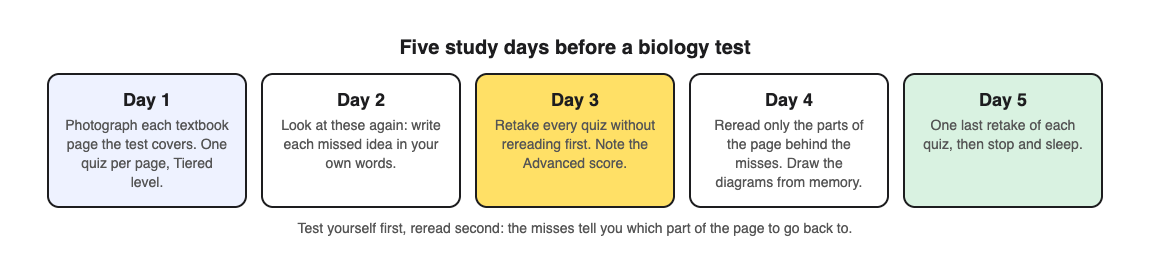
- Day 1: one quiz per page. List the textbook pages the test covers and make a set of practice questions for each page, from basic to advanced. Answer them once.
- Day 2: the misses. For each question you got wrong, write the right idea in one sentence of your own. Do not just copy the answer.
- Day 3: retake without rereading. Answer the same questions again before you open the book. Pay most attention to your score on the hardest questions.
- Day 4: targeted rereading. Now reread, but only the parts of each page behind your misses. Then close the book and sketch any diagram from memory, with labels.
- Day 5: a final round. One last retake of each set, then stop. Sleep is part of the plan.
If you have more than five days, leave a day or two between retakes. Spreading the same practice out is the distributed practice the Dunlosky review rated highly. For a longer schedule, see spaced repetition for exams.
Worked example: a photosynthesis page
Say your test is on Friday and one of the pages is section 4.2, Photosynthesis. Here is day 1 and day 3 with Study Shot, which writes multiple-choice practice questions from a photo of a page and explains every answer.
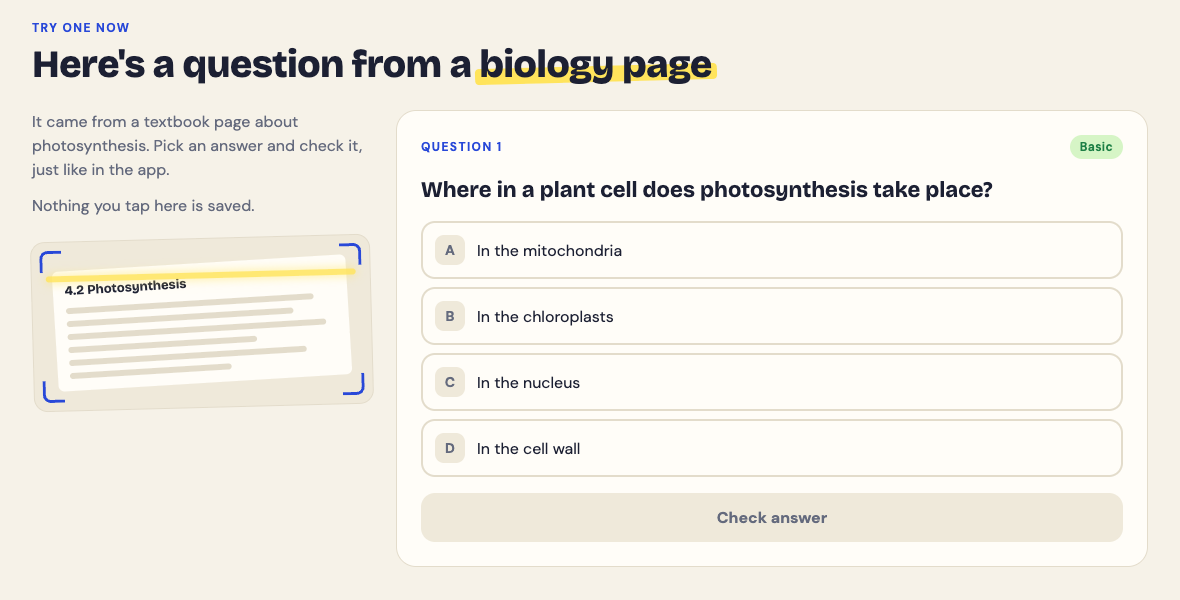
- Photograph the page. Hold the textbook flat and fill the frame, then choose 10 questions at the Tiered level. Tiered is a ladder: it starts with Basic questions on key terms, moves to Intermediate questions that ask you to explain and connect ideas, and ends with Advanced questions that apply the idea to new situations. That covers all three kinds of biology question from one page.
- Answer from memory. The first question might be a basic one like the sample on the Study Shot home page: where in a plant cell does photosynthesis take place? Pick an answer and press Check answer. You see whether you were right, the correct answer (the chloroplasts) and a short explanation.
- Read the results. At the end you get a score for each level. A strong Basic score and a weak Advanced score tells you that you know the words but cannot yet use them. Look at these again lists every missed question with your answer and the right one, which is your list for day 2.
- Day 3: retake. The quiz is saved in your library with its page photo and your best score. Press Retake quiz without opening the book first, and compare your Advanced score with day 1.
The questions are written by an AI model and can contain mistakes. If one looks wrong, check it against your textbook page, and use Report a problem under the question. Checking a doubtful question against the page is good biology practice in itself.
Common mistakes before a biology test
- Studying only the bold words. Terms are the easy part. Make sure your practice includes the questions that ask why and what if.
- Skipping the diagrams. Biology tests often show a diagram and ask you to label it. Redraw them from memory, and see how to study diagrams for a method.
- Treating a low first score as failure. A low score on day 1 is the plan working: it shows you what to fix while there is still time.
- Rereading everything on day 4. Go back only to what you missed. Use your quiz results to decide what to study next.
Frequently asked questions
How many days before a biology test should I start?
Five days gives you time for two or three rounds of questions with gaps between them. If you only have one evening, do one round, go over the misses, and retake the same questions the next morning.
Is it better to reread or to test myself?
Test yourself first. Reviews of study methods rate practice testing highly and rereading low, and rereading works best afterwards, aimed only at what you missed.
How do I study the hard application questions?
Practise them directly. In one classroom study, practising high-level questions helped students on high-level test items, so include harder questions in your practice, not only definitions.
Can I use my class notes instead of the textbook?
Yes. Notes and worksheets work the same way: photograph them and practise from them. Use the textbook too for diagrams and definitions your notes may have skipped.
Get started
Try Study Shot: it is free to start. Photograph the first page your biology test covers tonight, take 10 Tiered questions on it, and note your Advanced score as the number to beat on day 3.
Comments
No comments yet.
Sign in or make an account to comment.