How to study for a history test from your notes
History tests can feel like a wall of names and dates. Then the test asks why something happened, what changed because of it, or for a short essay, and memorising was not enough. If you want to know how to study for a history test from your notes, this guide gives you a one week plan built on quizzing yourself, what two classroom studies in history and social studies found, and a worked example using a page of real class notes.
Why rereading your history notes is not enough
Most students prepare by reading their notes again, maybe with a highlighter. It feels like work, and the notes look more familiar each time. But familiar is not the same as remembered.
A large review by Dunlosky and colleagues (2013) rated ten study techniques. Rereading and highlighting were rated low. Practice testing, which means answering questions from memory, and spreading your study over several days were rated highest, and the authors suggest practice testing in place of rereading.
Your notes are still the right place to start. They hold what your teacher thought mattered. The change is in what you do with them: turn them into questions, and answer those questions without looking.
What studies in history classrooms found
Some of the clearest evidence for quizzing comes from real history and social studies classes, using the course's own material and the tests students were graded on.
- Quizzed facts did better on the real exams. In middle school science and high school history classes, McDermott and colleagues (2014) gave students short quizzes with the correct answer shown afterwards. Information that had been quizzed did better on the unit exams and the end-of-semester exam than information that had not. Seeing the same facts again without a quiz helped less.
- The quiz format did not have to match the exam. In the same study, multiple-choice quizzes helped as much as short-answer quizzes, even when the exam used the other format. In a sixth grade social studies course, Roediger and colleagues (2011) found low-stakes multiple-choice quizzes improved chapter and semester exams, and quizzing still helped when the final test asked students to write their own short answers.
- More quizzing is not always better. In a study of 100 high school students over 12 weeks in maths, science and history, Sun and colleagues (2026) compared three quiz schedules. A medium amount of quizzing scored highest. The most frequent quizzing did well, but not better than medium, and the authors suggest that testing too often leaves less time for learning to settle.
That last study was about class quizzes across a term, not the week before a test, so do not read too much into its exact schedule. The lesson that carries over is simple: leave time between rounds of questions instead of quizzing yourself over and over in one night.
Match your practice to the three kinds of history question
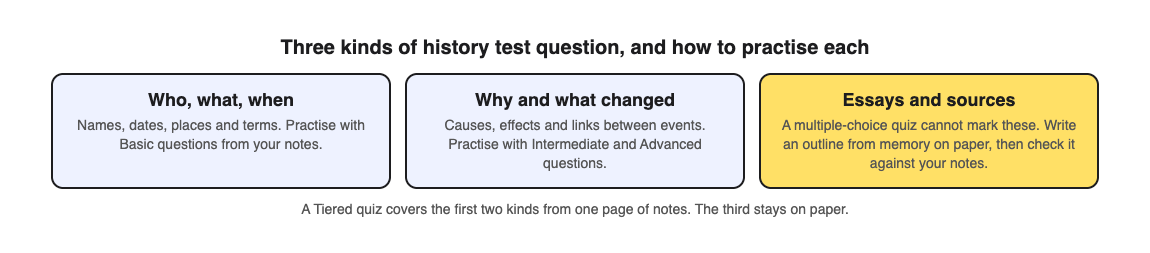
Most history tests mix three kinds of question:
- Who, what, when. Names, dates, places and terms. These are quick to practise and easy to forget.
- Why and what changed. Causes, effects, and how one event led to another. You need to connect facts, not just list them. Asking yourself why each event happened helps here; see our post on elaborative interrogation for what the research says about that.
- Essays and sources. Writing an argument, or reading a source and saying what it shows. A multiple-choice quiz cannot mark these, so practise them on paper.
How to study for a history test from your notes in a week
- Day 1: one quiz per page of notes. List the notes the test covers. Make a set of questions for each page, from facts up to causes, and answer them once from memory.
- Day 2: fix the misses. For every question you got wrong, write the right idea in one sentence of your own, and add it to your notes.
- Day 3: essay outlines. Take each big question your teacher might ask and write a short outline from memory: your answer, three reasons, an example for each. Then check it against your notes.
- Day 4: rest from the quizzes. Give the facts a day. Reread only the parts of your notes behind your misses.
- Day 5: retake without rereading. Answer the same question sets again before you look at your notes. Compare your scores with day 1.
- Day 6: one more outline for the essay you are least sure of, and a final look at your misses.
- Day 7: a short final round, then stop. Sleep before the test is part of the plan.
For a longer lead time, spread the same rounds further apart with our spaced repetition schedule.
Worked example: notes on the causes of the First World War
Say you have two pages of class notes on why the First World War began: the alliances, the arms race, the empires, and the assassination in Sarajevo. Here is day 1 and day 5 with Study Shot, which takes a photo of a page from your textbook, notes or worksheet and writes multiple-choice questions about it, explaining every answer.
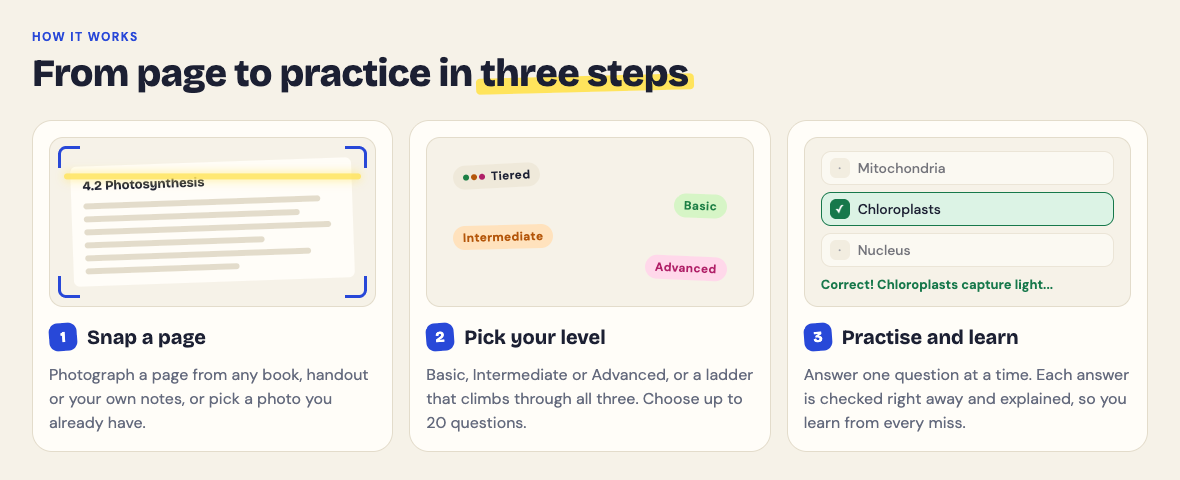
- Photograph the first page of notes. Hold the page flat and fill the frame, in good light. If your handwriting is hard to read, the questions may come out wrong, so write the key names clearly.
- Choose Tiered and 10 questions. Tiered starts with Basic questions on key terms and facts, moves to Intermediate questions that ask you to explain, compare and connect ideas, and ends with Advanced questions that apply the idea to a new situation. That covers the first two kinds of history question from one page.
- Answer from memory. A basic question might ask in which city Archduke Franz Ferdinand was assassinated in 1914. A harder one might ask why a conflict between two countries drew in others. Press Check answer after each one to see whether you were right, the correct answer and a short explanation.
- Read your results. You get a score for each level. A strong Basic score with a weak Intermediate score means you know the facts but not yet how they connect, which is exactly what essay questions test. Look at these again lists every miss, with your answer and the right one: that is your day 2 list.
- Do the second page the same way. Then on day 5, open your library, where each quiz is saved with its page photo and your best score, and press Retake quiz before you reread anything.
Studying history in a language other than English? You can choose the quiz language: quizzes come in 50 languages, while the app's own screens stay in English. Our post on studying in your own language shows how.
The questions are written by an AI model and can contain mistakes. If a date or name looks wrong, check it against your notes or textbook, and use Report a problem under the question.
Common mistakes before a history test
- Memorising dates without causes. Dates are the easy marks. Make sure your practice asks why, not only when.
- Skipping essay practice. A quiz cannot mark an argument. Outlines from memory are the closest practice you can do alone.
- Quizzing all night before the test. One round a day with gaps in between beats five rounds in one evening.
- Rereading everything after a quiz. Go back only to what you missed. Our post on what to study next from your quiz results shows how to choose.
Frequently asked questions
How do I memorise dates for a history test?
Answer questions about them from memory instead of rereading a list, and tie each date to its cause and effect. A date you can explain is easier to recall than one you only repeated.
Do multiple-choice quizzes help if my test has written answers?
In two classroom studies, quizzing helped on later exams in other formats, including short-answer tests, and in one of them multiple-choice quizzes helped as much as short-answer ones. Still practise written answers and essay outlines on paper.
Can I make quizzes from handwritten notes?
Yes, if the writing is clear. Photograph the page flat and in good light, and check any question that looks wrong against your notes.
How long before a history test should I start?
A week gives you time for two rounds of questions with gaps between them, plus essay outlines. With only two days, do one round, fix the misses, and retake the next morning.
Get started
Try Study Shot: it is free to start and works on your phone and computer. Photograph the first page of your history notes tonight, take 10 Tiered questions on it, and note your Intermediate score as the number to beat on day 5.
Comments
No comments yet.
Sign in or make an account to comment.