How to study for a nursing exam: a three-week plan
Nursing exams cover a lot: anatomy, drugs, care priorities and how to act when a patient's condition changes. Rereading lecture notes rarely gets you there. If you are wondering how to study for a nursing exam, the research done with nursing students points to one habit above the rest: test yourself often, and learn from every question you miss. This post sets out that research and a three-week plan you can follow.
How to study for a nursing exam: the short version
- Test before you reread. Answer questions on each unit first, then go back to the textbook for what you missed.
- Spread it out. Short sessions on different days, starting about three weeks out.
- Study each miss, not just the right answer. Work out why the wrong option looked right to you.
- Keep calculations and care plans on paper. A multiple-choice quiz cannot check your working.
Nursing, medicine and dentistry have widely taken up this kind of testing for course exams and licensing exams, as a 2025 review by Serra and colleagues describes. The same review notes that many students still do not use it. Our post on retrieval practice explains why it works.
What research with nursing students shows
In a study of 161 undergraduate nursing students taking a psychology course (Messineo, Gentile and Allegra, 2015), one group took a multiple-choice test on the lecture topics about a week after each lesson, with feedback straight away. The other group reread the study material instead. About two weeks after the lessons ended, the testing group did better on a final test covering everything, and on the graded exam. Students with high test anxiety scored lower in both groups, and the authors suggest, without settling it, that anxious students may gain more from regular testing.
Testing is not the whole answer for everyone. In a licensure review course in the final semester (Tu and colleagues, 2017), students who started with low scores improved more with testing, while students in the middle improved more with teacher-led instruction. The authors' advice was to use both.
In a Norwegian course on anatomy, physiology and biochemistry (Emblemsvåg, 2024), each lecture was followed five days later by a short multiple-choice test taken in teams. Students said they learned more and felt more engaged, and more of them reached the top grades. Their school results before nursing also seemed to matter, and the study was a cross-sectional snapshot rather than an experiment, so it cannot show the tests caused the change.
Treat every missed question as a clue
Many nursing students answer hundreds of practice questions and keep making the same kind of mistake. A 2026 article by Capello suggests why: a miss is often not a gap in content, but a slip in reasoning. You missed a cue in the question, put the wrong priority first, fell for a wrong option, or handled your doubt badly. The article proposes six steps for each miss: restate what the question asked, find the cues, look at each wrong option, name the trap, rebuild the reasoning, then use the corrected pattern on a new question.
This is a proposed method, not a tested one. But it fits the evidence above, and it is easy to try. One caution from a 2017 review by Rittle-Johnson and Loehr: explaining your own choices can reduce learning under some conditions. Explain the right answer after you see it, not your first guess.
Worked example: a three-week plan with Study Shot
Study Shot turns a photo of a page from your textbook, notes or worksheet into multiple-choice questions, from the basics to advanced, and explains every answer. Here is how a three-week plan could look for a unit exam.
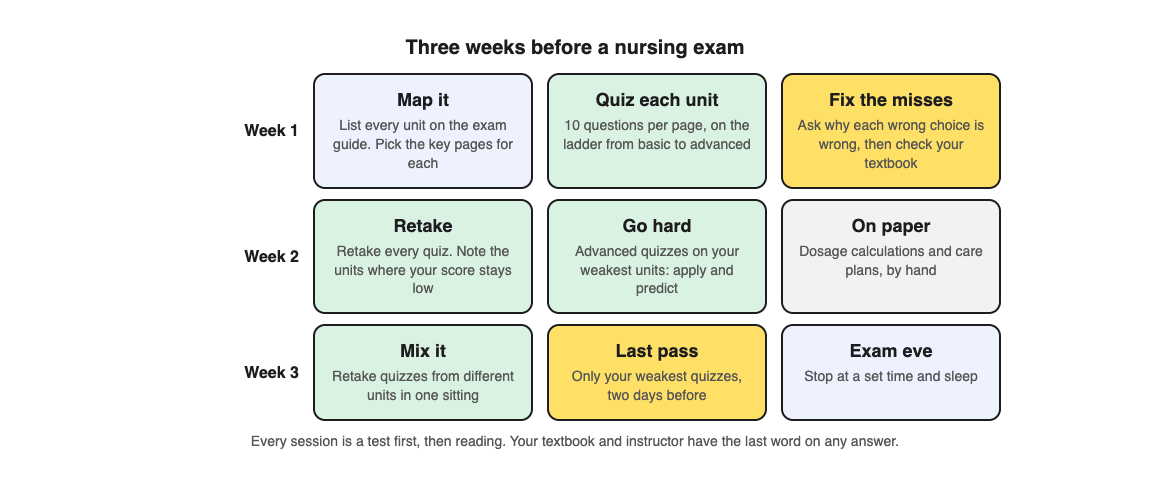
- Week 1: map and quiz. List every unit on your exam guide. For each, pick the two or three textbook or lecture pages that carry the most. Photograph each page and make 10 questions on the default ladder, which goes from basic to advanced. Answer before you reread.
- Week 1: fix the misses. After each answer, Check answer shows Correct! or Not quite., the correct answer and a short explanation. On every miss, run the clue steps above: what cue did you skip, and why did the wrong option look right? Then check the point in your textbook.
- Week 2: retake and go harder. Every quiz is saved in your library with its page photo and your best score. Press Retake quiz on each. The results show a score for each level, so you can see whether you lose marks on basic facts or on applying them. For your weakest units, make new quizzes at the Advanced level, which asks you to apply and predict in new situations.
- Week 3: mix and rest. Retake quizzes from different units in the same sitting, the way the exam will mix them. Two days before, retake only your weakest quizzes. The night before, stop at a set time and sleep.
The questions are written by an AI model and can contain mistakes. In nursing that matters: for any drug, dose or procedure, your textbook and your instructor have the last word. If a question looks wrong, use Report a problem under it.
What a quiz cannot do for a nursing exam
Study Shot writes one kind of question: four choices, one right answer. Check your exam guide for the formats it uses, and practise those formats with your course's own materials.
It cannot check working either. Practise dosage calculations by hand, with every step written out, and practise care plans and written answers on paper. Use the quiz for the ideas behind them: what a drug class does, what a finding means, what comes first.
Skills you do with your hands, like checks and procedures, belong in the skills lab, not on a quiz.
Study with classmates
The Norwegian course used team tests to keep stress down. You can do something like it. After you make a quiz, Share this quiz makes a link you can send to your study group. Each person needs a Study Shot account and gets their own copy of the questions, without your photo. Take it on your own, then meet and talk through the questions most of you missed. Our post on quizzing each other in a study group has more ideas, and our final exam plan covers a cumulative exam.
Frequently asked questions
How many weeks should I study for a nursing exam?
For a unit exam, about three weeks of short sessions gives you time to quiz, fix your misses and retake. For a cumulative or licensing exam, start earlier and spread the units out.
Are practice questions enough to pass a nursing exam?
They help most when you study each miss. In one review course, students in the middle of the class gained more from teaching than from tests, so keep going to lectures and reading too.
How do I stop making the same mistakes on practice questions?
After each miss, find the cue you skipped and why the wrong option looked right, then try a new question on the same idea.
Can a quiz help with dosage calculations?
Only with the ideas behind them. Practise the calculations by hand, step by step.
Get started
Try Study Shot: it is free to start and works on your phone and computer. Photograph the key page from each unit on your next nursing exam, take a 10-question quiz on each, and retake them over the next three weeks.
Comments
No comments yet.
Sign in or make an account to comment.