How to study for a final exam in college: a two-week plan
Finals week in college is different from any test before it. You may have four or five exams in a few days, each one covering a whole term, some of it from chapters you read months ago. This guide covers how to study for a final exam when there are several of them at once: a two-week plan you can use for every course, what research on college students says about how they study, and a worked example.
Why college finals need their own plan
A unit test asks about the last few weeks. A final often asks about everything. That changes three things:
- The oldest material is the weakest. Chapters from the first weeks of term have had the longest time to fade.
- Courses compete for the same days. If you study one course at a time, the last one gets the least time.
- Rereading everything is impossible. A term of notes and readings will not fit into two weeks of rereading, so you need a way to choose.
The plan below handles all three. It starts about two weeks out. If you have less time, keep the steps and shrink the gaps.
What research says about how college students study
A survey of 177 college students by Karpicke, Butler and Roediger (2009) asked how they studied. Most said they reread their notes or textbook again and again. Relatively few tested themselves. The authors suggest students feel they know material because it looks familiar, which they call an illusion of competence.
A review by Bjork, Dunlosky and Kornell (2013) explains why this happens. People often hold a faulty picture of how they learn, and they judge their own learning by how smooth it feels in the moment. Smooth is not the same as lasting, which matters most when the test is weeks away.
Two more findings fit finals well. In Szpunar, McDermott and Roediger (2007), people who took practice tests on word lists remembered more at the end, and they gained even more from those practice tests when they knew a final test was coming. And a large review of spacing by Cepeda and colleagues (2006) found that the longer you need to remember something, the longer the best gap between study sessions. A final weeks away suits sessions spread days apart.
The strongest real-world example comes from medicine. In a randomised trial by Larsen, Butler and Roediger (2009), young doctors in training either took short-answer tests with feedback or studied a review sheet, three times, about two weeks apart. About six months later, the tested topic scored 39% on average and the studied topic 26%. Small numbers, but a long gap, and a real teaching session.
How to study for a final exam: the two-week plan
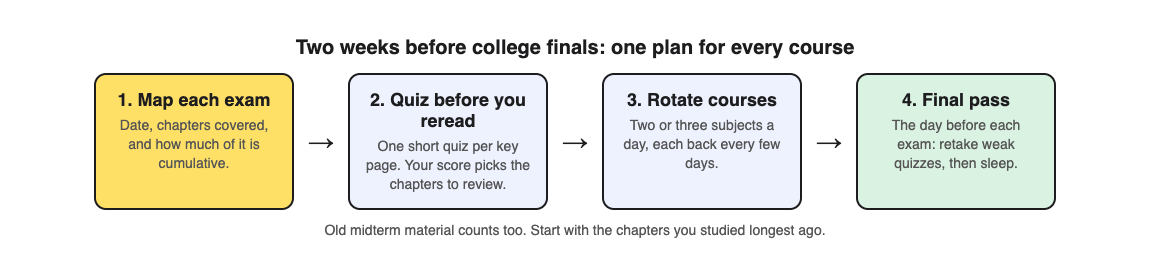
- Map each exam. For every course, write down the date, the chapters or lectures it covers, and how much is from before the midterm. Your syllabus and your professor's review notes are the source here, not guesswork.
- Quiz before you reread. For each course, test yourself on every chapter first. Your scores tell you which chapters need rereading and which do not.
- Rotate courses. Study two or three courses each day, so each one comes back every few days instead of getting one long block.
- Work from oldest to newest. Start each course with the chapters you studied longest ago.
- Final pass. The day before each exam, retake the weakest quizzes for that course only, then sleep.
Worked example: a biology final and three other courses
Say you have four finals in the second week of December: biology, history, economics and statistics. Biology is first and covers twelve chapters. Here is how one course fits the plan, using Study Shot, which turns a photo of a page from your textbook, notes or worksheet into multiple-choice questions, from the basics to advanced, and explains every answer.
- Day 1. Pick the one page from each biology chapter that holds the most important ideas: a summary page, a diagram, or your own lecture notes. Photograph each and make a quiz of 10 questions on the default ladder, which climbs from basic to advanced. That is twelve quizzes, each saved in your library with its page photo and your best score.
- Read your scores. Each results screen shows a percentage, a grade and a score for each level. If chapter 3 scored well at basic and badly at advanced, you know the terms but not how to use them. Look at these again lists every miss with your answer and the right answer.
- Days 2 to 10. Biology comes up every third day, alongside two other courses. Each time, reread only the chapters with low scores, then press Retake quiz on them. Chapters you have mastered get one retake near the end, not daily rereading.
- Before the exam. For your weakest chapters, make one more quiz on the Advanced level, which asks you to apply and predict in new situations. If your professor's past exams ask you to apply ideas, these are the closest match.
- Study group. If a friend is in the same course, Share this quiz sends them a link; they need a Study Shot account, and they get their own copy to take.
Statistics and economics need a different mix. A multiple-choice quiz cannot check worked problems or written answers, so for those courses keep solving problems on paper and writing out answers, and use the quiz to test the ideas behind them. History essays are the same: the quiz checks the facts and causes you need, not the essay. Our posts on studying for a math test and studying for a history test go deeper.
The questions are written by an AI model and can contain mistakes. If a question does not match your lecture notes, trust the notes and your professor, and use Report a problem under the question.
Common finals mistakes
- Studying courses in exam order only. The last exam ends up with the last two days. Rotate instead.
- Rereading everything from page one. You will run out of time on the material you already know. Test first.
- Skipping the oldest chapters. They feel familiar because you once knew them. Familiar is not the same as remembered.
- Trading sleep for hours. A week of short nights makes the last exams the hardest. Our night before an exam plan covers the last evening.
Frequently asked questions
How many days before a final should I start studying?
About two weeks gives enough room to come back to each course several times. With less time, keep the same steps and shorten the gaps.
How many hours a day should I study for finals?
There is no single right number. What matters more is that each session tests you and that each course comes back every few days.
Should I study one subject at a time or mix them?
Mix two or three a day. Each course then returns after a gap, which suits a test that is weeks away.
What if my final is mostly essays?
Use quizzes to check the facts, terms and causes you need, then practise writing answers on paper. A multiple-choice quiz cannot mark an essay.
Get started
Try Study Shot: it is free to start and works on your phone and computer. Today, photograph the key page from the first chapter of your first final, take 10 questions on it, and let the score tell you where your two weeks should go.
Comments
No comments yet.
Sign in or make an account to comment.