How to study for a physics test with practice questions
Physics tests are hard in a particular way. You can know every formula on the sheet and still freeze on a problem, because you cannot tell which idea it is asking for. And you can understand the ideas well and still lose marks on a calculation. If you want to know how to study for a physics test, the answer is to practise both: solve mixed problems on paper, and test yourself on the concepts behind them. This guide shows a one-week plan built on a study done in a real physics course.
What a physics test is really checking
Most physics tests mix two kinds of question:
- Concept questions. What does Newton's third law say? Which way does the friction act? What happens to the current if the resistance doubles? These check that you understand the ideas and the units.
- Problems. A car accelerates from rest for 6 seconds; how far does it go? These check that you can pick the right idea, set up the equations and carry them through to a number.
The step most students skip is in the middle: deciding which idea a problem needs. In your homework, every problem in the "kinematics" section is a kinematics problem, so you never have to decide. On the test, the problems come in a mixed order with no section headings.
What the research says about practising physics
Mixing topics in practice is called interleaving. Samani and Pan (2021) tested it in an introductory university physics course. Over 8 weeks, students did homework three times a week, with problems either arranged one topic at a time or mixed across topics. On two surprise tests with new and harder problems, students recalled more of the relevant information and more often reached a correct solution after mixed practice. The median improvements were 50% on the first test and 125% on the second.
There was a catch. Students rated mixed practice as harder and wrongly believed they had learned less from it. If mixed practice feels slow and frustrating, that is not a sign it is failing.
Keep the evidence in proportion. This was one course at one university. The large review by Dunlosky and colleagues (2013) rated interleaving only moderate, because its benefits had just begun to be studied. It rated practice testing and spreading your study over time high.
There is one more finding that matters for physics. A review of transfer by Pan and Rickard (2018) found that testing yourself on material helps most with application and inference questions, and least with problems involving worked examples. In plain words: a quiz on the ideas will not, by itself, make you better at multi-step calculations. You get better at those by solving them.
How to study for a physics test in one week
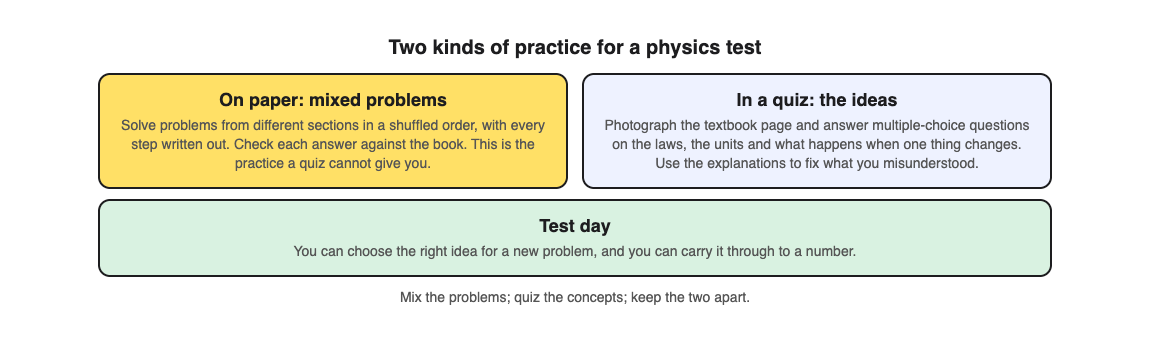
Here is a plan for a test that covers three or four sections of a chapter.
- Day 1: list the ideas. Write each section's main laws, formulas and units on one sheet. Note what each symbol means.
- Days 2 and 3: quiz the concepts. Take a short multiple-choice quiz on each textbook page (see the worked example below). Mark every idea you got wrong or guessed.
- Days 3 to 5: mixed problem sets. Pick two or three problems from each section, shuffle them, and solve them in that order, every step written out. Before you calculate, write which idea the problem needs. Check each answer against the book.
- Day 6: retake and repair. Retake the concept quizzes, then go back to the problems you got wrong and redo them without looking at your first attempt.
- Day 7: one last mixed set. A small set of new problems, mixed, under time. Then sleep.
Worked example: a textbook page on Newton's laws
Say your test is on forces and motion, and one page of your textbook explains Newton's three laws with a diagram of a box being pushed across a floor. Here is how to turn that page into a concept quiz with Study Shot, which takes a photo of a page from your textbook, notes or worksheet and writes multiple-choice questions about it, from the basics to advanced, explaining every answer.
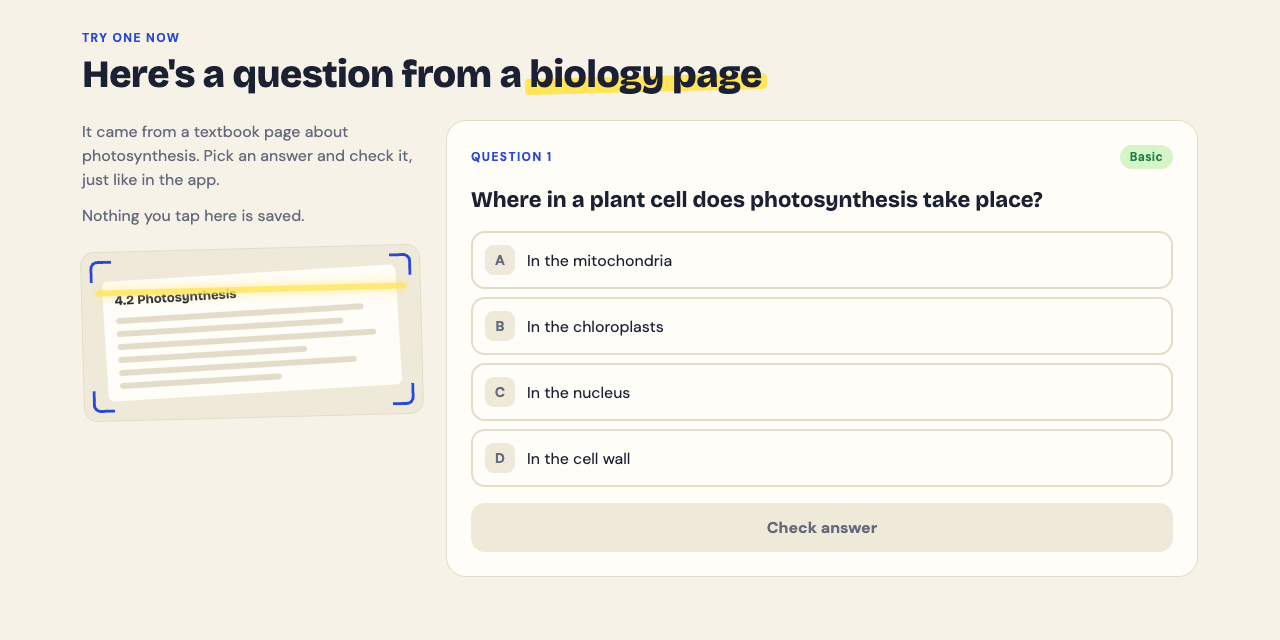
The home page shows what one question looks like, using a biology page. A physics page works the same way:
- Photograph the page. Hold the page flat and fill the frame. Diagrams work too, so keep the force diagram in the shot.
- Choose Tiered and 10 questions. Tiered is a ladder: Basic questions on terms and definitions (what is inertia?), then Intermediate questions that connect ideas (how are force, mass and acceleration related?), then Advanced questions that apply them (what happens to the box's acceleration if the push doubles and friction stays the same?).
- Answer without notes. Press Check answer after each one. You see Correct! or Not quite., the correct answer and a short explanation. When the explanation names a law, find it on your Day 1 sheet.
- Read your score for each level. The results screen gives a score for Basic, Intermediate and Advanced. A low Basic score means learn the definitions first. A good Basic score with a low Advanced score means you know the words but cannot yet use them, which is exactly what mixed problems will train.
- Retake on Day 6. The quiz is saved in your library. Press Retake quiz before you reread anything.
Our post on interleaving practice explains how to build a mixed set, and studying for a math test uses the same split between paper and quiz.
What a quiz cannot do for physics
- It cannot check your working. A multiple-choice question can test whether you chose the right idea, but it cannot mark your setup, units or algebra. Keep problem practice on paper and check it against the book or your teacher's answers.
- It works from the page you give it. It writes multiple-choice questions about that page, not a set of full problems to work through on paper.
- Questions can contain mistakes. They are written by an AI model. Physics answers can be checked, so if one looks wrong, work it out yourself, trust your textbook, and use Report a problem under the question.
Frequently asked questions
Should I memorise physics formulas or understand them?
Both, but understanding comes first. Knowing what each symbol means and when a formula applies is what lets you pick it for a new problem.
How many practice problems should I do before a physics test?
There is no magic number. A few problems from each section, mixed together and solved fully, teach more than many problems from one section in a row.
Why does mixed practice feel harder?
Because you have to decide which idea each problem needs. In the physics study above, students found it harder and thought they learned less, yet did better on the later tests.
Can a multiple-choice quiz help with a problem-solving test?
It helps with the ideas behind the problems, such as which law applies and what changes when one quantity changes. It does not replace solving problems on paper.
Get started
Try Study Shot: it is free to start and works on your phone and computer. Photograph the first page of the chapter your test covers, take 10 Tiered questions, and use your Advanced score to decide which problems to mix into tomorrow's set.
Comments
No comments yet.
Sign in or make an account to comment.