How to study for a psychology exam: terms, studies, cases
Psychology looks easy to study until the exam asks you to spot operant conditioning in a story about a dog, a child and a box of treats. If you want to know how to study for a psychology exam, start with what it tests: the words, the studies and theories behind them, and whether you can use them on a case you have never seen. This guide shows a method for all three, built on research done in psychology classes, with one worked example from a chapter on learning.
What a psychology exam asks you to do
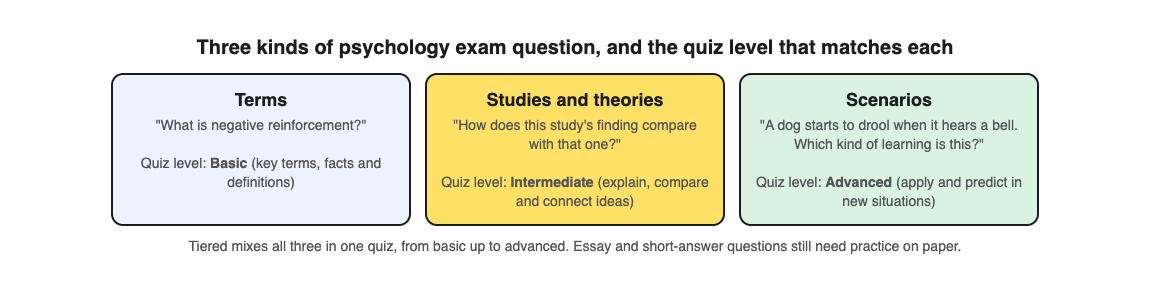
Most psychology courses cover a lot of named ideas. Exam questions on them tend to come in three kinds:
- Terms. What is negative reinforcement? What does a control group do?
- Studies and theories. What did a classic study find, and how does one theory differ from another?
- Cases. A short story about a person, followed by a question about which idea it shows.
Many exams add short answers or essays as well. Knowing the definitions is the floor. The questions that separate grades usually ask you to explain, compare or apply them.
What research in psychology classes says
Psychology students have taken part in some of the clearest tests of study methods, often in their own courses.
In Wiklund-Hörnqvist and colleagues (2014), 83 university students learned key concepts from an introductory psychology course, either by repeated testing with feedback or by rereading. Testing beat rereading straight away, after 18 days and after five weeks, and it helped students whatever their working memory.
In Rummer and colleagues (2019), two introductory cognitive psychology courses answered a few questions after each of seven lessons. One group could look at their notes while answering; the other could not. The group that answered from memory did better on a surprise test and on related questions in the final exam six weeks later. The authors discuss two reasons: practice at recalling, and that the closed-book group may simply have tried harder in class.
The takeaway from both is the same: answer questions from memory, then check, instead of reading the chapter again.
How to study for a psychology exam, step by step
- List the chapters and their key terms. Your textbook's bold words and your lecture headings are a good map of what will be asked.
- Test yourself on the terms first. Answer questions without your notes open. Every miss is a definition to fix.
- Test the studies and theories next. For each study, can you say what was done, what was found and why it matters? For each pair of theories, can you say how they differ?
- Practise cases. Answer questions that describe a new situation and ask which idea it shows. This is where most marks are lost.
- Write short answers from memory. For the essay part, write a quick outline on paper with the book closed, then compare it with your notes.
- Come back in a few days. Retake the same questions before you open the book again. Our spaced repetition schedule shows how to plan the gaps.
Worked example: a textbook section on learning
Say your exam covers the chapter on learning, and its first section explains classical conditioning (Pavlov's dogs learning to drool at a sound) and operant conditioning (behaviour shaped by what follows it, with reinforcement and punishment). Here is how to study that section with Study Shot, which takes a photo of a page and writes multiple-choice questions about it, from the basics to advanced, and explains every answer.
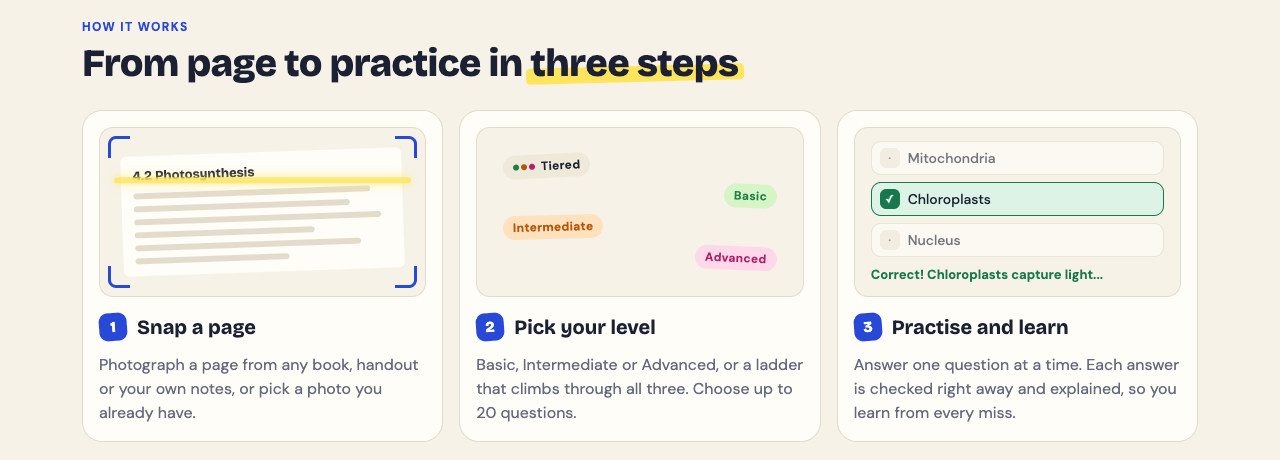
- Photograph the page. Hold it flat and fill the frame, so the definitions and any example boxes are readable.
- Choose Tiered with 15 questions. Tiered is a ladder: basic questions first, then intermediate, then advanced. Basic covers key terms, facts and definitions. Intermediate asks you to explain, compare and connect ideas, like the difference between the two kinds of conditioning. Advanced asks you to apply and predict in new situations, which is the case question your exam will have.
- Answer every question before you look. Each answer is checked right away. You see Correct! or Not quite., the correct answer and a short explanation. Read it even when you were right; a lucky guess on reinforcement against punishment is still a gap.
- Read your score for each level. The results screen gives a percentage and a score for Basic, Intermediate and Advanced. If you scored well on Basic but poorly on Advanced, you know the words but cannot use them yet. That tells you to spend your time on cases, not on definitions.
- Fix the misses on paper. Look at these again lists each missed question with your answer and the right one. For each, write one sentence in your own words explaining why the right answer fits.
- Retake later. Your quiz is saved in your library. Press Retake quiz in two or three days, before you reread the section.
The questions are written by an AI model and can contain mistakes. If a definition does not match your textbook or your lecturer, trust them, and use Report a problem under the question.
Getting better at case questions
Case questions test whether your learning carries over to something new. A large review by Pan and Rickard (2018) found that practice tests can help with new questions, and that the carry-over was greatest to questions that ask you to apply ideas or make inferences, and across different question formats. It was weakest for material you read but were never tested on. After correcting for studies that may have gone unpublished, the benefit often disappeared unless certain conditions held, such as doing well on the practice test itself.
So test yourself on every section, not just the parts you find hard, and make sure some of your practice is case questions. Karpicke and Blunt (2011) found that practising recall beat building concept maps, including on questions that needed students to make inferences. If you like concept maps, draw one from memory and then check it, rather than copying it from the book.
Short answers and essays
A multiple-choice quiz cannot mark an essay. If your exam has written questions, keep paper practice at the centre: pick a likely question, give yourself ten minutes, and write the outline from memory. Then check it against your notes.
One study is worth knowing here. Sinha and Glass (2015), partly run in a college psychology course, found that feedback given later, rather than straight away, after a multiple-choice test led to better scores on a later short-answer test, but made no difference on a later multiple-choice test. Study Shot checks each answer straight away, so if your exam has short answers, go back over your list of misses again the next day as well.
For more on choosing answers under time pressure, see how to study for a multiple choice exam.
Frequently asked questions
How far ahead should I start studying for a psychology exam?
About a week is a good start for a chapter test, with short sessions spread across several days. A final exam covering many chapters needs longer.
What is the best way to memorise psychology terms?
Test yourself on them instead of rereading the list. Answer questions on each term, then write the definitions from memory and check them.
How do I remember psychology studies and who did them?
For each study, practise saying what was done, what was found and why it matters, from memory. Names stick better once you know what each study showed.
Can a multiple-choice quiz prepare me for essay questions?
Partly. It tests whether you understand the ideas, but you still need to practise writing answers on paper.
Get started
Try Study Shot: it is free to start and works on your phone and computer. Photograph the first page of the chapter your exam covers, choose Tiered, and see how your Basic score compares with your Advanced score. That gap is your study plan.
Comments
No comments yet.
Sign in or make an account to comment.