How to turn a class handout into practice questions
A class handout is a gift that most students waste. Your teacher has already picked what matters from the chapter and put it on one or two pages, often with a diagram and the key terms in bold. Then it gets read once and goes into a folder. This guide shows how to turn a class handout into practice questions, so that one page becomes a study tool you can use until the test: by hand, or from a photo in about a minute.
Why one handout is worth more than one read
A handout tells you two useful things. First, what your teacher thinks is important, which is a good guess at what the test will cover. Second, how your teacher words it, which is often how the questions will be worded.
Reading it again feels productive, but a large review by Dunlosky and colleagues (2013) rated rereading, highlighting and summarizing low as study techniques. It rated practice testing high, and suggests it in place of rereading. Answering questions makes you pull the ideas out of memory, and shows you which ones you cannot yet pull out.
What the research says about quizzing on class material
One study tested this in a real class, with the course's own material. Roediger and colleagues (2011) worked with a sixth grade social studies course. Students took short, low-stakes multiple-choice quizzes on some of the material. On their real chapter exams and semester exams, they did better on the quizzed material than on material that was not quizzed, and better than on material they had simply been shown twice. In one experiment the exam asked for short written answers, and quizzing still helped.
A second finding is about the wrong answers. Little and Bjork (2015) found that multiple-choice questions with plausible wrong answers helped people later on related questions that had never been asked, especially questions about the wrong answers themselves. Wrong answers that were easy to dismiss did not have this effect. When every choice is believable, you have to think about all four to pick one, and that thinking strengthens what you know about each.
So the questions you make from a handout should cover the whole page, and the wrong answers should be tempting.
How to turn a class handout into practice questions
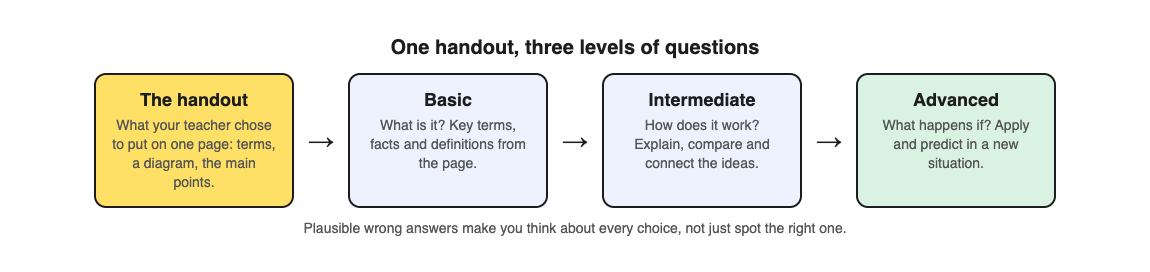
If you write the questions yourself, go section by section and write three kinds:
- What is it? One question for each bold term or key fact. "Which of these is a sedimentary rock?"
- How does it work? Questions that ask you to explain or connect two ideas from the page. "What turns a sedimentary rock into a metamorphic rock?"
- What happens if? Questions that apply the idea to a case the handout does not show. "A layer of shale is buried deep under a mountain range. What is it most likely to become?"
For each multiple-choice question, make the wrong answers come from the same handout: other terms, other steps, a common confusion. Then put the handout away for a day and answer from memory.
Writing good questions takes time, and it is hard to write a question on something you have not understood yet. A photo can do the first draft for you.
Worked example: a rock cycle handout
Say your Earth science teacher handed out one page on the rock cycle: a diagram with arrows between igneous, sedimentary and metamorphic rock, and short notes on melting, cooling, weathering, pressure and heat. Here is how to turn it into practice questions with Study Shot. Its How it works section says to photograph a page from any book, handout or your own notes.
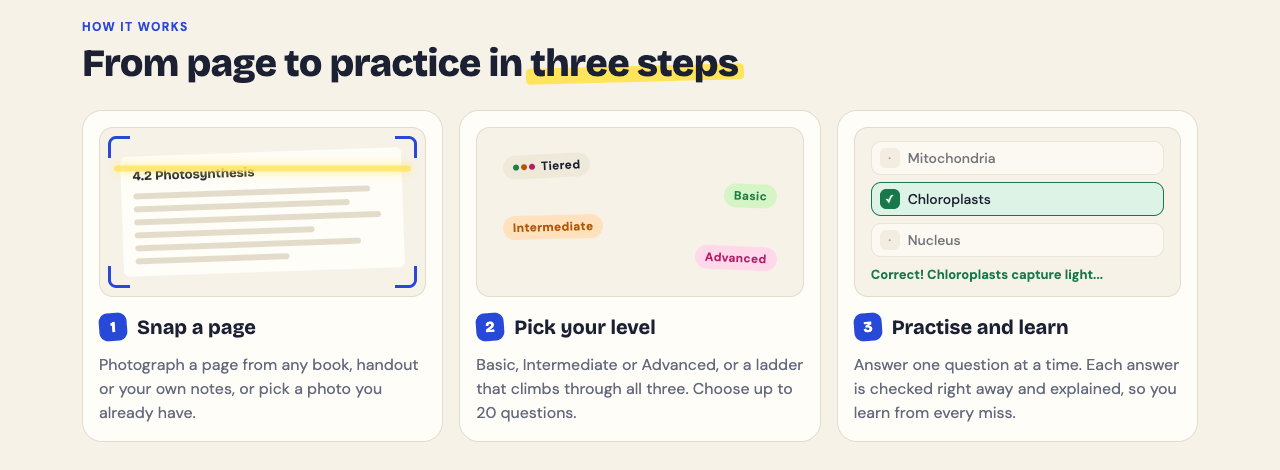
- Photograph the handout. Choose Take photo, or Choose photo if you already took one in class. Hold the page flat and fill the frame. If the handout is printed on both sides, make one quiz for each side.
- Choose Tiered and 10 questions. Tiered climbs the same ladder as the three kinds of question above: Basic (key terms, facts and definitions), Intermediate (explain, compare and connect ideas) and Advanced (apply and predict in new situations). Each question has four choices.
- Answer one at a time. Press Check answer to see Correct! or Not quite., the correct answer and a short explanation. Before you press it, try to say why each wrong choice is wrong.
- Read the results. You get a score for each level, the photo of your page, and Look at these again with every question you missed, your answer and the right one. Circle those parts of the handout.
- Retake before the test. The quiz is saved in your library. Press Retake quiz two days later, and again the day before the test.
If your class shares handouts, Share this quiz makes a link, and each friend who opens it gets their own copy of the questions, without your photo (they need a Study Shot account). Our post on quizzing each other in a study group shows a way to use it.
Handouts, worksheets and notes: which to use
A handout is different from a worksheet. A worksheet asks you questions and you fill in the answers; a handout gives you the answers and asks nothing. That makes a handout ideal for writing new questions, because the full explanation is already on the page. For a worksheet, see how to make a practice test from a worksheet. For your own handwritten notes, see how to turn notes into a quiz.
A few limits to know. If Study Shot cannot write questions for a photo, it says "We couldn't write questions for this photo. Try a different page." If that happens, try a clearer photo or the textbook page the handout came from. The questions are written by an AI model and can contain mistakes, so check anything that looks wrong against the handout, and use Report a problem under the question.
Frequently asked questions
How many questions should I make from one handout?
About ten for a one-page handout is a good start. Study Shot offers 5, 10, 15 or 20; use 20 for a dense page full of terms.
Should I photograph the handout before or after class?
After class, once you have added anything your teacher said that was not on the page. The questions come from what is in the photo.
Do multiple-choice questions help if my test has written answers?
In the classroom study above, quizzing helped on a later short answer test too. If your test asks for written answers, also practise writing a few from memory.
Is it better to write my own questions or use an app?
Both work. Writing your own makes you think hard about the page; a quiz from a photo covers the whole page quickly and explains each answer.
Get started
Try Study Shot: it is free to start and works on your phone and computer. Find the last handout your teacher gave you, photograph it, and take 10 Tiered questions. The ones you miss show you which part of the page to study tonight.
Comments
No comments yet.
Sign in or make an account to comment.