How to walk safely after dark: the Highway Code basics
How to walk safely after dark comes down to a few plain rules: be seen, walk where drivers expect you, cross with care, and keep your attention on the street. In autumn and winter, the evening is often the only time people have to walk, and it is dark by then. This guide puts the Highway Code's rules for pedestrians to work on an ordinary evening walk, then shows a short route you can follow.
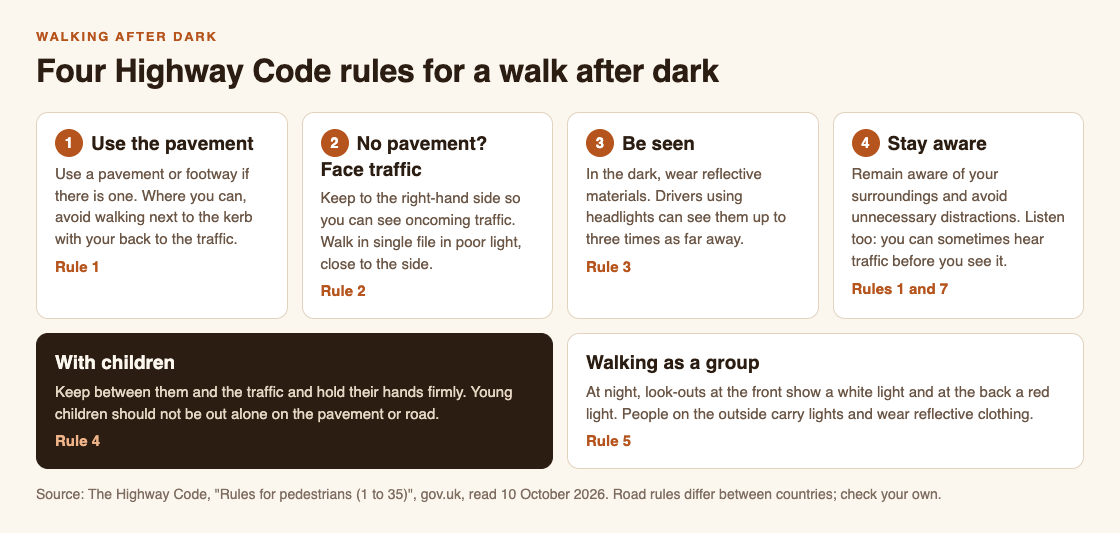
The Highway Code's rules for pedestrians that matter most after dark.
Why an evening walk is worth it
The NHS page Walking for health says a brisk 10-minute daily walk has lots of health benefits and counts towards the 150 minutes of weekly exercise it recommends for adults. A brisk walk is about 3 miles an hour: you can still talk, but you cannot sing the words to a song.
Its ideas for walking more include a regular walk with a friend and a stroll with family or friends after dinner. After dinner, for much of the year, means after dark. If you are just starting out, our beginner's 5-week walking plan builds up from there.
How to walk safely after dark: be seen first
Rule 3 of the Highway Code's rules for pedestrians is about helping other road users to see you. In poor daylight it says to wear or carry something light-coloured, bright or fluorescent. When it is dark, it says to use reflective materials, and gives examples: armbands, sashes, waistcoats, jackets and footwear.
The reason is distance. The Highway Code says drivers using headlights can see reflective materials up to three times as far away as non-reflective ones. A dark coat with nothing reflective on it is the hardest thing on the road to spot.
A simple way to make this a habit: keep one reflective item by the door with your keys, so it goes on every time you go out after sunset.
Walk where drivers expect you
Rule 1 says to use a pavement or footway if there is one, including a path along the side of a road. Where you can, it says to avoid walking next to the kerb with your back to the traffic.
Some roads have no pavement. For those, rule 2 says:
- Keep to the right-hand side of the road, so you can see oncoming traffic.
- Take extra care, and be ready to walk in single file, especially on narrow roads or in poor light.
- Keep close to the side of the road.
- It may be safer to cross well before a sharp right-hand bend, so oncoming traffic has a better chance of seeing you, then cross back after the bend.
Road rules differ between countries, so check your own. The idea of seeing the traffic coming toward you, and being seen by it, carries across.
Crossing the road at night
Rule 7 is the Green Cross Code, written for every pedestrian. In short:
- Find a safe place to cross. Use a crossing if there is one nearby. Otherwise pick a place where you can see clearly in all directions, and avoid crossing between parked cars, on a blind bend or close to the brow of a hill.
- Stop just before the kerb, where you can see if anything is coming.
- Look all around and listen. The Highway Code notes you can sometimes hear traffic before you see it.
- Let traffic pass. Do not cross until there is a safe gap and you are sure there is plenty of time.
- Go straight across, and do not run. Keep looking and listening while you cross.
At night, a well-lit crossing is the easiest choice when you plan your route. Our guide to finding new walking routes near you helps you pick streets ahead of time.
Stay aware of your surroundings
Rule 1 also says to always remain aware of your environment and avoid unnecessary distractions. Two habits follow from it on a dark evening:
- Stop to look at your phone. If you need to check a map, step to the inside of the pavement and stand still, rather than reading while you walk.
- Keep your ears free near traffic. Since you can sometimes hear traffic before you see it, keep your hearing for the crossings at least.
Walking after dark with children or a group
Rule 4 says young children should not be out alone on the pavement or road. When you take them out, keep between them and the traffic and hold their hands firmly.
For organised walks of large groups, rule 5 says to use the pavement, or keep to the left if there is none, with look-outs at the front and back. In the dark the look-outs wear reflective clothes, and at night the one in front shows a white light and the one at the back a red light. People on the outside of the group carry lights and wear reflective clothing too.
For a family evening walk with a game in it, see our outdoor walking game for families.
A worked example: a 20-minute evening loop
Here is one way to put the rules together on a short walk after dinner, with Cat Go giving the walk a point.
- Before you go. Put on your reflective armband or jacket. Open Cat Go in your browser and allow location; the game says it uses it "to find treat stops and to record where each cat was caught. Nothing else is shared."
- Pick a stop. The map shows treat stops. Away from one, the card says how far it is and to walk within a set distance to collect kibble, and sometimes tuna. Choose one you can reach on lit streets with pavements.
- Walk there. Keep a brisk pace, the talk-but-not-sing speed. Put the phone away between checks, and stand still on the inside of the pavement when you look at it.
- Collect. At the stop the screen says "You're here. Grab what's in the bowl." and you press Collect treats. The stop then shows when it will be ready again.
- Loop home. Cross at a proper crossing, using the Green Cross Code, and come back a different way if the streets are as well lit.
If you see a cat on the way, you catch it by taking its photo, from the pavement; everything after that, the treats and the catch, happens in the game. Every catch keeps its breed and where you found it. Our post on staying motivated to walk in winter has more on keeping the habit when evenings get long.
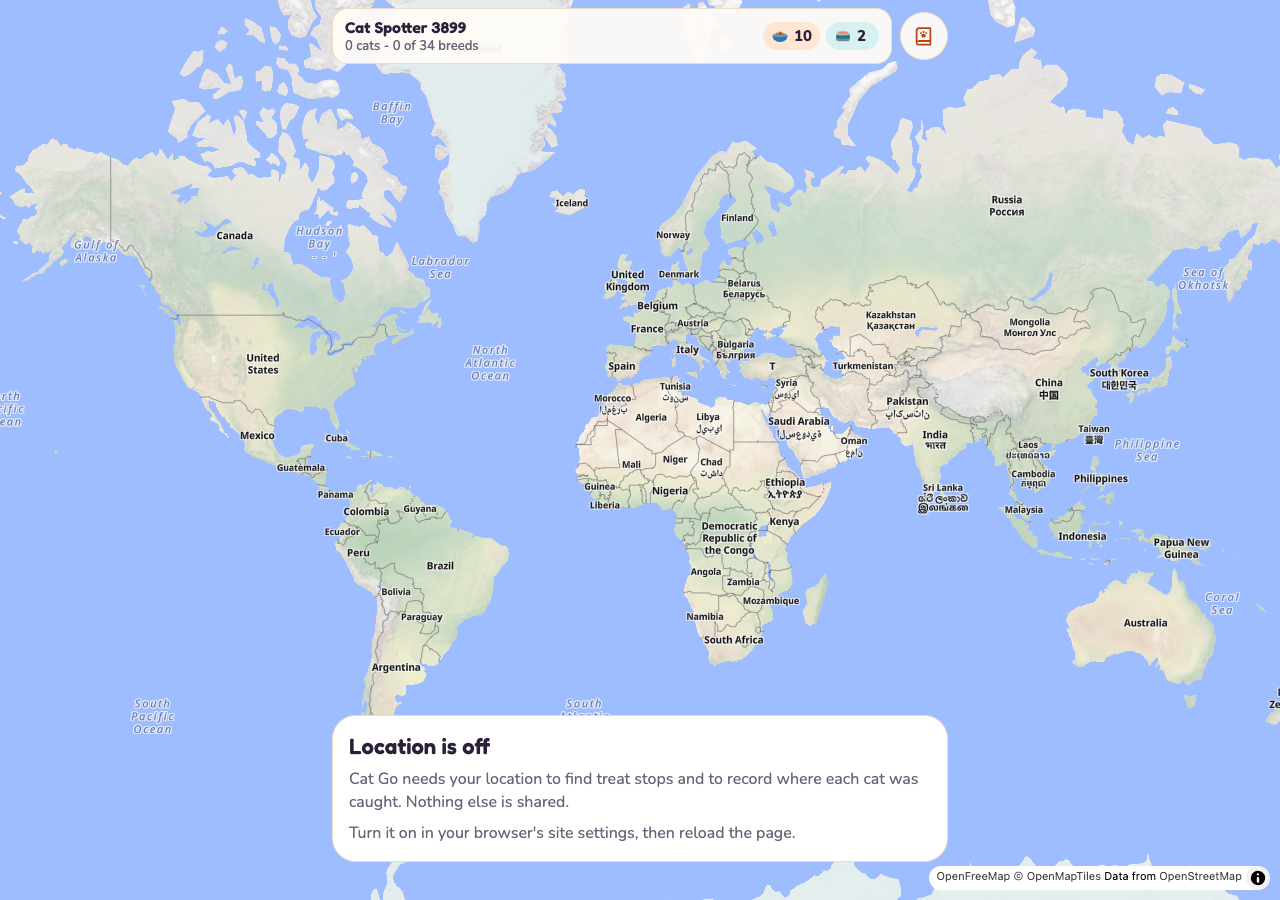
Cat Go starts on a map, with treat stops to walk to once location is on.
Frequently asked questions
What should I wear to walk safely after dark?
Something reflective. The Highway Code says reflective materials such as armbands, sashes, jackets and footwear can be seen by drivers using headlights up to three times as far away as non-reflective ones.
Should I walk facing traffic at night?
Use the pavement if there is one. Where there is no pavement, the Highway Code says to keep to the right-hand side of the road so you can see oncoming traffic.
Is a short evening walk worth it?
The NHS says a brisk 10-minute daily walk has lots of health benefits and counts towards 150 minutes of weekly exercise.
How should children walk near roads after dark?
The Highway Code says young children should not be out alone on the pavement or road, and that you should keep between them and the traffic and hold their hands firmly.
Get started
Cat Go gives an evening walk somewhere to go: treat stops on a map, and the chance of a cat on the way. It plays in your web browser and needs the camera and location allowed.
Play Cat Go: walk anywhere, photograph a real cat, lure it with food and catch it.
Comments
No comments yet.
Sign in or make an account to comment.