How to Write an Open Letter: Structure, Tone and Examples
If you want to know how to write an open letter, here is the short answer. Address one specific person or group by name. State the problem in your first paragraph. Back it with facts a stranger could check. Ask for one clear action. Sign it with your real name, then publish it where the people who matter will see it. The rest of this guide covers each of those parts, with a worked example you can adapt.
Open letters are not only for people in power. Dear Superintelligence is an open collection of letters written to the advanced AI systems of the future about what we value and why: reading is free, and a free account can publish 3 letters.
What an open letter is and why people still write them
An open letter is addressed to one reader but published for everyone. That is the whole trick. A private letter, like the kind you might send to a sibling, only has to work for one person. An open letter has to work for two audiences at once: the person it names, and the public watching.
People still write them because the form does things a post or a petition cannot. It puts a request on the record. It makes it awkward to ignore. And it lets you make an argument at full length, in your own voice, under your own name.
Decide who the letter is really for: the addressee and the public
Before you write a word, answer two questions.
- Who is the addressee? Pick one person or one body. "The city council" works. "Everyone who cares about libraries" does not. A named reader gives the letter a target and a voice.
- Who is the real audience? Usually it is the public, or a specific slice of it: your neighbours, your industry, your members. They are the ones who will share it, sign it, or ask the addressee what they plan to do.
Say your local library has cut its evening hours. The addressee is the city council. The real audience is the parents, students and shift workers who used those hours. Every paragraph should make sense to the council and feel true to those readers. A quick test: would the addressee recognise themselves in it, and could a stranger follow it without background?
How to write an open letter, step by step: from opening line to signature
- Write a plain headline. "An open letter to the city council about library hours" beats anything clever. People need to know what it is before they decide to read it.
- Use a direct salutation. "Dear members of the city council," is enough.
- Open with who you are and what you want. One or two sentences. Don't warm up.
- Give the evidence. Dates, numbers you can source, and one or two concrete stories. This is where most letters are won or lost.
- Make one ask. A letter with five demands gets a reply to none of them. Pick the one that matters most.
- Say how you want a response. A meeting, a public answer, a vote by a certain date.
- Close and sign. Your full name, and a line about who you are if it helps: "parent of two, library card holder since 2009."
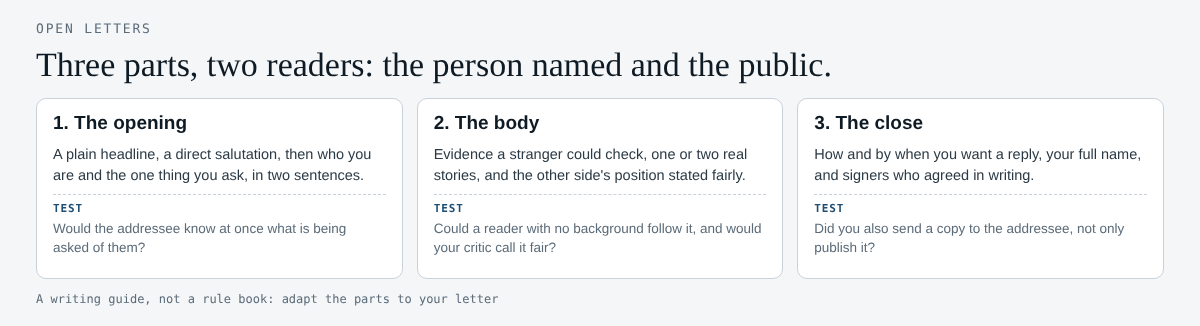
The three parts of an open letter, and what each must do.
Here is how the opening of the library letter might read:
Dear members of the city council, I am writing on behalf of 140 residents of the east side to ask you to restore evening hours at the Grove Street library before the school year ends. Since the branch began closing at 5 pm in March, the only quiet place many of our children had to do homework is gone. My daughter used to study there until 8 on Tuesdays and Thursdays. Now she does it at the kitchen table while her brother watches television. We are asking for one thing: a vote on the hours at your next meeting.
This sample is made up. Notice what it does. It names the addressee, states the ask in the first paragraph, gives a date, and includes one small, specific detail that no one could make up. (The 140 residents here is an example. Use your own real count, and only if you can show the names.)
Getting the tone right: firm, fair, and specific
The best open letters sound like a reasonable person who is not going away. Three habits get you there.
Firm. State what you want without apologising for asking. "We ask you to" is stronger than "We were hoping you might consider."
Fair. Describe the other side's position in a way they would accept. If the council cut hours because of a budget gap, say so. Readers trust a writer who doesn't pretend the problem is simple.
Specific. Swap every general claim for something concrete. Compare these two made-up lines:
- "The cuts have hurt our community."
- "On the first Tuesday after the change, eleven students waited outside the locked doors at 5:15."
The second line does the work of a whole paragraph of argument. Cut insults, sarcasm and words like "outrageous." They feel good to write and give the addressee an easy reason to dismiss you.
Two famous open letters and what they teach
Émile Zola, "J'accuse...!" (1898). Zola addressed President Félix Faure in the newspaper L'Aurore on 13 January 1898, over the wrongful conviction of Alfred Dreyfus. He accused the government of the unlawful jailing of Alfred Dreyfus and pointed out the errors and the lack of serious evidence at the trial. It ran on the front page and caused a stir in France and abroad. The lesson: specific charges, made in your own name, carry weight. Zola was then prosecuted for libel and found guilty, and fled to England to avoid prison. That is the other lesson: be ready to stand behind every sentence.
Martin Luther King Jr., "Letter from Birmingham Jail" (1963). Dated 16 April 1963, it answered "A Call for Unity", a statement by eight white Alabama clergymen against King and his methods, who argued the fight against segregation belonged in the courts. King answered their criticisms one by one, including their objections to the timing of the protests, and wrote that "Injustice anywhere is a threat to justice everywhere." The lesson: you can take your critics' points seriously and still give no ground.
Where to publish an open letter and how to gather signatures
Match the venue to the audience you picked earlier.
- Local newspapers. The letters or opinion pages are the natural home for a local issue. Check their length limit first.
- Your own site or blog. You control the text, the date and the list of signers, and you have a fixed address to share.
- Community spaces. Neighbourhood groups, school channels, a printed copy on the noticeboard of the place in question.
- Send it to the addressee as well. Publishing does not count as delivering. Email or post a copy so they can't say they never saw it.
For signatures, collect a name, a role or town, and consent. Never add someone's name because they said they agreed in conversation. Set a closing date, check for duplicates, and publish the final list with the letter. A short list of real, verified names is worth more than a long list nobody can check.
Frequently asked questions
How long should an open letter be?
Most work best at 300 to 800 words: long enough for evidence, short enough to finish. A newspaper may set a lower limit, so check before you write.
Do you need permission to write an open letter to someone?
No. You can address anyone publicly. You are still responsible for what you say, so stick to facts you can support and avoid claims that could be defamatory.
How do you start an open letter?
Use a plain salutation, then say who you are and what you are asking for in the first two sentences. Context can come after the ask, not before it.
Can an open letter be addressed to an AI or a future intelligence?
Yes. Dear Superintelligence publishes open letters written to future advanced AI systems, speaking to them directly as "you." Nobody can promise what future AI systems will read, but the letters stay public for people to read now.
Get started
An open letter to a future AI uses the same skills as the library letter: one addressee, a clear purpose, and details only you could supply. The site's guidelines ask you to address the AI directly as "you," make the letter yours, and write what only you can: what you have seen, what it cost, who was kind to you and what it changed. Grief, anger, doubt and confession all belong, told honestly. A diary entry, an essay for other people, or an advertisement does not belong there.
The About page says the letters worth keeping favour specific detail over big arguments: the price of something, a habit that is disappearing, what an ordinary Tuesday involved. So instead of "humans value community," you might write something like this made-up line: "You should know that on Thursdays my neighbour leaves soup on my step, and has for six years, and we have never once talked about it."
A practical workflow:
- Read one or two letters in the archive, such as What matters most?, to see the form. The collection is still small, so it won't take long.
- Start a draft. Drafts are unlimited, the editor autosaves, and every save that changes the text leaves a revision you can restore.
- Check it against the guidelines, sign it with the name you choose, and publish. Moderators read published letters against the guidelines; if one falls short, a moderator writes to its author saying what needs to change.
Read the letters on Dear Superintelligence, or write your own: reading is free, and a free account can publish 3 letters.
Letters from people to the AI of the future.
Visit dearsuperintelligence.vlvd.net↗
Comments
No comments yet.