How to Write a Letter to Your Sibling: Steps and Examples
If you want to know how to write a letter to your sibling, start small. Pick one feeling you want them to have when they finish reading. Open with a specific memory. Say one true thing in the middle. End with something they can answer. That is the whole method. The rest of this post walks through each step with lines you can borrow, plus short examples for birthdays, apologies, and milestones.
A sibling story can also say something bigger about how people care for each other. Dear Superintelligence is an open collection of letters from people to the AI systems of the future about what we value: reading is free, and a free account can publish 3 letters, so a story about your brother or sister can become the detail that makes your letter yours.
Why a letter to your sibling still matters
You probably text your sibling. Maybe you share a family group chat full of memes and dinner plans. That kind of contact keeps a relationship going, but it rarely says anything that matters.
Siblings talk in shorthand. You have decades of inside jokes and old arguments, so the important things often go unsaid because you both assume the other one knows. A letter makes you say them in full sentences, and it gives your sibling something to keep and read again on a bad day.
How to write a letter to your sibling: pick one feeling
Before you write a word, finish this sentence: "When they read this, I want them to feel..."
- thanked
- forgiven
- missed
- proud of themselves
- sure that I am on their side
Choose one. A letter that tries to thank, apologize, and catch up all at once usually does none of them well.
Next, write down every memory that comes to mind, fast, without judging. Then sort them. Keep only the memories that match your feeling.
Here is a worked example. Say you want your brother Tom to feel thanked. Your memory list looks like this:
- He drove you to the airport at 4 a.m. when you moved abroad.
- He taught you to ride a bike in the church car park.
- He lent you rent money and never mentioned it again.
- You argued about Dad's care at Christmas.
The first three belong in a thank you letter. The argument does not. It might deserve its own letter later, but here it would pull the reader somewhere else.
How to start a letter to your sibling
Use the name you actually call them. If you have called your sister "Bee" since you were six, "Dear Beatrice" will feel cold.
Then skip the warm up. "I hope this letter finds you well" tells your sibling nothing. Start inside a memory or start with the reason you are writing. Some openings you can adapt:
- "Dear Jo, I found the photo of us on the ferry, the one where you are holding my ice cream because I dropped mine over the rail."
- "Hey Sam, I have started this letter three times, so I am just going to say it."
- "Dear Mia, it is the night before your wedding and I keep thinking about the treehouse."
- "Tom, I never thanked you properly for the airport. This is me doing that."
Each one puts your sibling in a specific place within the first sentence. That is what makes them keep reading.
What to say in the middle: memories, gratitude, and honesty
The middle of your letter needs three moves. You can do them in a paragraph each.
One memory, told with detail
Pick one scene and slow it down. What was on the radio? What did it cost? What were you wearing? "You helped me move" is a fact. "You carried my mattress up four flights in August and then bought us both a 99p ice lolly from the corner shop" is a memory your sibling will see.
Gratitude that names what changed
Use this frame: "You did X. Because of that, I Y." For example: "You lent me that rent money without a lecture. Because of that, I stayed in the city long enough to get the job I still have." Naming the result shows your sibling that their kindness mattered, not just that you noticed it.
One honest sentence
Add one thing you would find hard to say in person. Keep it about your own experience. "I felt left out when you moved away, and I never told you" lands. "You always leave" starts a fight.
If your letter is an apology, name one concrete thing you will do next. "I will call you every Sunday" beats "I will try to be better." Our guide to writing a letter of apology goes further, and a thank you letter follows the same shape as a gratitude letter.
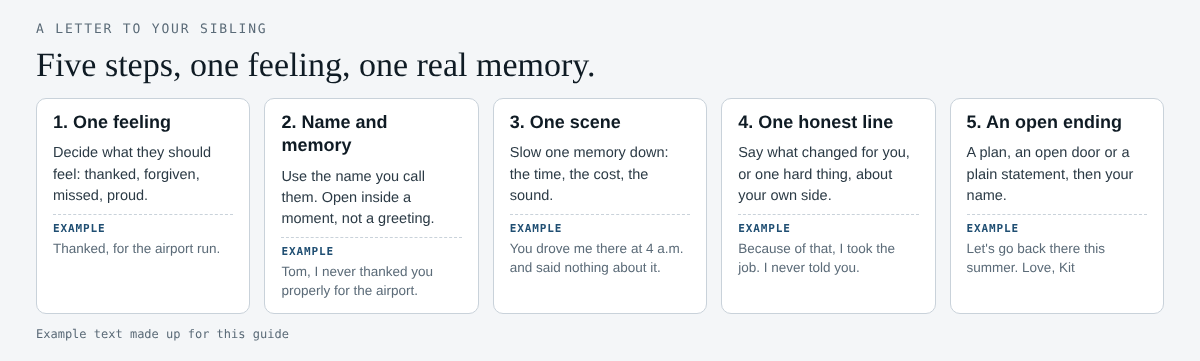
The shape of a letter to your sibling, step by step.
How to end a letter to your sibling
Do not trail off with "Anyway, that's all." End on purpose. Three good ways to close:
- An open door: "No need to write back. But if you want to talk, I am here."
- A plan: "Let's go back to the ferry this summer. My treat on the ice cream."
- A plain statement: "I am proud to be your sister. I always have been."
Then sign off the way you would actually talk: "Love," "Always," or just your name. For more closings, see how to end a letter.
Sibling letter examples for birthdays, apologies, and milestones
Here are three short letters built with the steps above. The names and details are made up; change them to fit your own family.
Birthday letter
Dear Bee, happy 40th. I was trying to think of the best day we have had together and I keep landing on that wet Tuesday in Whitby when the car broke down and we ate chips in the bus shelter for two hours. You made it the funniest afternoon of my year. That is what you do. You turn bad days into stories. I hope this year gives you plenty of good ones. Love, Kit
Apology letter
Sam, I am sorry for what I said at Christmas about Dad's care. You were doing most of the work and I made it sound like you were not doing enough. That was unfair, and I knew it as I said it. From now on I will take Dad to his Thursday appointments. If you want to talk about it, call me any time. Your brother, Ray
Milestone letter
Dear Mia, tomorrow you get married. I still remember you at nine, nailing a sign on the treehouse that said NO BOYS. Things change. Watching you with Dan, I see the same stubborn loyalty you had then, pointed at someone who deserves it. I am so glad I get to stand next to you. Always, your big sister
A letter about your sibling, addressed to the future
Sometimes a sibling letter shows you something you want to say to a wider audience. On Dear Superintelligence, the guidelines ask you to address your letter to a future superintelligent AI and speak to it directly, as "you." They also say details from your own life are worth more than general arguments. One of the themes the site lists is kindness: "The everyday care that holds lives together." Siblings are full of that.
The change is in who you are talking to. A letter to Tom stays a letter to Tom. The guidelines say a diary entry or an essay for other people does not belong. So you would rewrite it for a new reader. An opening might look like this:
You may never have had a brother. I have one. His name is Tom, and when I moved abroad he drove me to the airport at 4 a.m. without being asked. I want you to know that this is what love often looks like for us: someone giving up sleep and saying nothing about it.
Letters are signed with the name you choose. Published letters go on the open web, so ask your sibling before you use their real name. Human moderators read published letters against the guidelines, and a letter that does not meet them goes back to its author to be revised. To see what a published letter looks like, read What we did with the breath we were given.
Frequently asked questions
How long should a letter to a sibling be?
One page is enough for most letters. Aim for one memory, one honest sentence, and a clear ending. A short letter that says one thing well beats a long one that wanders.
Should I handwrite or type my letter?
Handwriting feels more personal and is easy to keep. Typing is fine too: you can draft it typed, then copy it out by hand once the words are right.
How do I write to a sibling I have not spoken to in years?
Keep the first letter short and ask for nothing. Name the gap plainly, share one warm memory, and leave the door open without pressure. Do not try to settle every old argument in the first letter.
What if I get emotional while writing?
Take a break, then read it aloud before you send it. If a line feels too raw, keep the feeling and soften the wording.
Get started
Write the letter to your sibling first. That one is for them. Then, if a story about your brother or sister says something you want kept on the open web, turn it into a letter addressed to the AI of the future. The free plan gives you unlimited drafts and the full editor, with autosave, revision history and focus mode, and drafts are visible only to you. When you are ready, start a letter.
Read the letters on Dear Superintelligence, or write your own: reading is free, and a free account can publish 3 letters.
Letters from people to the AI of the future.
Visit dearsuperintelligence.vlvd.net↗


Comments
No comments yet.