How to write problems down when you feel overwhelmed
When everything feels urgent at once, your head stops being a good place to keep things. This guide shows you how to write problems down when you feel overwhelmed: get them out of your head, turn each one into something clear, and pick one thing to do next. You do not need a system or a special notebook to start. You need ten minutes and a willingness to write badly at first.
How to write problems down when you feel overwhelmed, and why it helps when your head is full
Sometimes the weight is a pile, not one problem. Rent, a strange noise in the car, a friend who went quiet, a deadline on Thursday. Each one might be manageable alone. Together they can blur into one heavy feeling with no handle.
Writing them down separates the pile into pieces. Once a worry is on paper, you can look at it, see its size, and decide what to do. The NHS page on 10 stress busters says the first step to feeling better is to identify the cause, and a written list is a plain way to do that. The writing does not fix anything. It makes the problems visible, so you can work on one at a time.
Step 1: Do a brain dump without sorting or judging
Set a timer for ten minutes. Write every worry, task and nagging thought that comes up. Do not sort. Do not decide what matters. Do not fix spelling. If the same worry shows up twice, write it twice.
A real brain dump looks messy. Something like:
- money stuff
- car
- Sam hasn't texted back
- Thursday report, haven't started
- should exercise
- landlord email??
- tired all the time
That is fine. The goal of this step is only to empty your head. Judging comes later, and it goes faster when you are not also trying to remember things.
Step 2: Rewrite each worry as one clear problem
Most items in a brain dump are labels, not problems. "Money stuff" could mean ten different things. You cannot act on a label.
Go through the list and rewrite each item as one sentence that says what is wrong. A useful pattern is: what is happening, and why it matters to you.
- "money stuff" becomes "Rent is due on the 1st and I am short by about a third."
- "car" becomes "The car makes a grinding noise when I brake, and I drive to work every day."
- "Sam hasn't texted back" becomes "I am not sure if Sam is upset with me after last weekend."
- "Thursday report" becomes "The quarterly report is due Thursday and I have not opened the file."
Keep each one to a single line. If you need two sentences, you probably have two problems. Some items will turn out not to be problems at all. "Should exercise" might really be "I feel tired every afternoon," which is a different thing to solve. Rewriting shows you that.
Step 3: Split big problems into smaller ones you can act on
Some problems are still too big after rewriting. "I am short on rent" is real, but it is not something you can do today. Break it into smaller problems until each one has an obvious first move.
- I do not know exactly how much I am short.
- I have not asked the landlord whether a few days' delay is possible.
- I am not sure which spending I can pause this month.
Each of these has a next step you could take in under an hour. That is the test. If you look at a problem and cannot picture the first thing you would do, split it again.
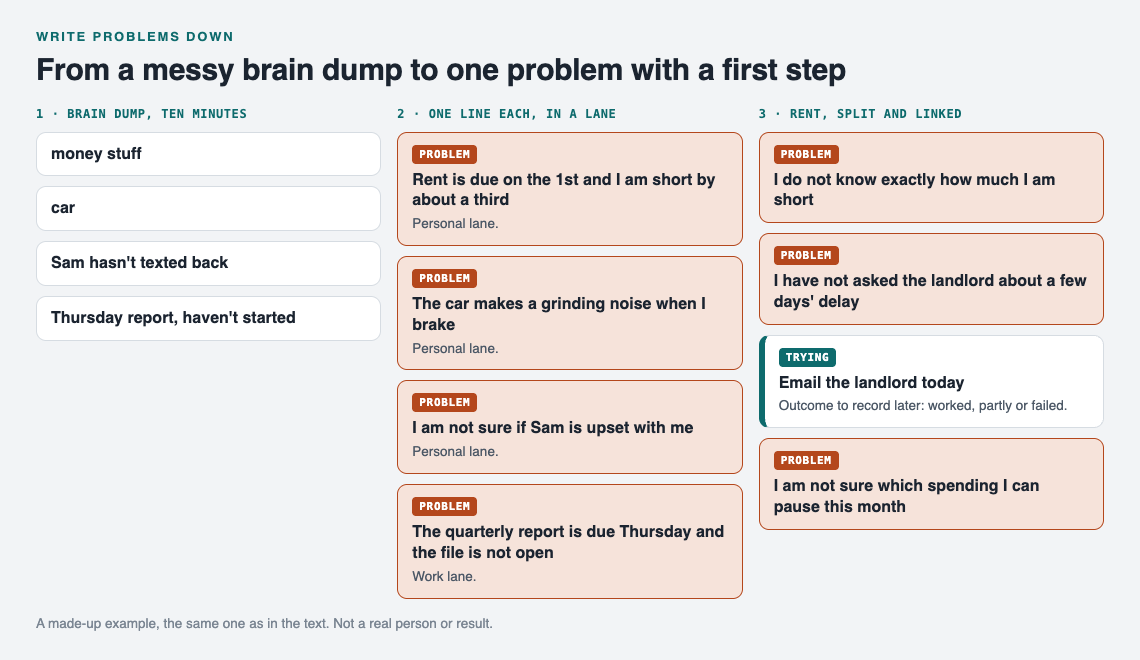
The made-up example from this post, from brain dump to a first step.
If one problem keeps splitting into more pieces, the post on how to break a big problem into smaller problems walks through the same move in more detail.
Step 4: Sort problems by what you control, influence, or have to accept
Now sort. Put each problem in one of three groups:
- Control. You can act on it directly. "I have not opened the report file."
- Influence. You can affect it, but someone else decides. "The landlord might allow a few days' delay."
- Accept. You cannot change it right now. "Rent is due on the 1st."
The NHS page puts it this way: feeling that you have no control can make stress worse, and taking control of the things you can is part of the answer. Problems in the accept group still matter, but they stop asking you for action today.
The influence group often hides a simple step: ask. Ask the landlord, ask Sam if everything is okay, ask a coworker for help with the report. The same NHS page notes that talking things through with a friend may help you find solutions.
Step 5: Pick one next step and leave the rest on the list
From the control group, pick one problem and write the very next physical action. Not "work on the report." Instead: "Open the report file and paste in last quarter's numbers."
Do that one thing. Then stop, cross it off, and check how you feel.
The rest of the list stays where it is. That is the point of writing it down. The list holds the problems so you do not have to. You can come back to it tomorrow without having carried every item around all night.
How to keep your problem list from becoming another source of stress
A list can turn into a wall of guilt if it only grows. A few habits keep it useful.
Record what you tried, not just what is open
When you try something, write it under the problem and note what happened. Did it work, partly work, or fail? A failed attempt is not wasted. It tells you what not to try again, and it shows that you did act. Over a few weeks, a list of attempts shows you more than a list of open items.
Connect problems that belong together
"Tired every afternoon," "skipping lunch," and "staying up late on the report" might be one cluster. When you notice links, connect them. Sometimes one fix helps three problems at once.
Keep it private unless sharing helps
Your list is yours. You do not owe anyone a look at it. But some problems are shared by nature, like house chores or a group project. For those, a shared list can help. See solving roommate problems with a shared list and keeping one shared list for a volunteer group.
Doing this in Problem Graph
Problem Graph is a problem and solution journal drawn as a map. It fits the steps above closely. Here is how the example would look:
- Open the app and type "Rent is due on the 1st and I am short by about a third." Press Enter. It lands on the graph right away.
- Put it in a lane. There are four: personal, work, expert and scientific. Rent goes in personal. The report goes in work.
- Add the smaller problems from Step 3 and link them to the rent problem. You can link across lanes too, so "staying up late on the report" (work) can connect to "tired every afternoon" (personal).
- Under "I have not asked the landlord," add a solution: "Email the landlord today." Mark it as one you are trying. Later, record the outcome as worked, partly, or failed.
Private is the default, so only you see your problems. They are saved to your account and follow you to any phone or computer you log in on. If you want to see a filled-in graph before writing your own, an empty graph offers a "Load example set" button, and there is a List view beside the map if a map feels like too much on a hard day.
You can also ask for suggestions. The AI proposes new solutions based on what worked for others on similar problems. Treat these as ideas to consider, not answers.
For a longer-term version of this habit, the post on keeping a list of open problems in your field shows how the same list grows into something you return to for years.
Frequently asked questions
What if I write everything down and still feel overwhelmed?
The list may still have items that are too big, so go back to Step 3 and split the heaviest one until you can see a first action. If the feeling stays heavy for weeks, talk to someone you trust or a doctor; a list is a tool, not a cure.
Should I use paper or an app to write problems down?
Use whatever you will actually open. Paper is fast for a brain dump. An app helps once you want to record outcomes, link related problems and find old entries, which is where a tool like Problem Graph is useful.
How often should I review my list of problems?
During a rough stretch, try a short look once a day: mark what changed and pick the next step. When things calm down, once a week may be enough.
Is writing problems down the same as journaling?
It is a focused kind of journaling. A general journal records how your day went. A problem list records what is wrong, what you tried, and what happened, so you can act on it and learn from it.
Get started
Start with the brain dump on paper if that feels easier. Then pick the one problem that weighs most and give it a clear line in Problem Graph. It runs in your web browser and works on your phone.
Try Problem Graph: it is free, and you can look around the public network without an account. Write one problem down in a line and attach the first thing you will try.
Comments
No comments yet.
Sign in or make an account to comment.