Ibn Sina (Avicenna): What He Wrote and Why It Mattered
Ibn Sina is the name most of the world uses for the scholar medieval Europe knew as Avicenna. He lived about a thousand years ago in Central Asia and Persia, and he is remembered for two things above all: a vast philosophical system and a medical encyclopedia. This post sets out what he wrote, how he reasoned and why historians rank him so high, using the Stanford Encyclopedia of Philosophy entry and a World History Encyclopedia article by S. Frederick Starr.
If you would rather learn this as a short lesson, Learn 100 Influential People puts Ibn Sina in its Reformers and Reasoners of Faith course next to Thomas Aquinas, Guru Nanak, Martin Luther and John Calvin, in lessons of about 9 minutes with questions that check what you remember.
Who was Ibn Sina?
The Stanford entry says he was born in Afshana, a village near Bukhara, in the 970s, "perhaps as early as 964", and that his birth year cannot be fixed more precisely. The World History Encyclopedia article says about 980. Treat the date as uncertain. His father was a governor of a nearby district in the service of the Samanid dynasty, which ruled from Bukhara, and the family moved to the city when he was a boy.
Most of what we know of his early life comes from his own Autobiography, which he wrote for or dictated to his student al-Juzjani, who finished the story after Ibn Sina's death. In it he says he taught himself the full philosophical curriculum (logic, physics, mathematics, metaphysics and the practical sciences) and had mastered it by eighteen. After he treated the ailing ruler, he was allowed into the palace library, where he "read those books, mastered their teachings, and realized how far each man had advanced in his science".
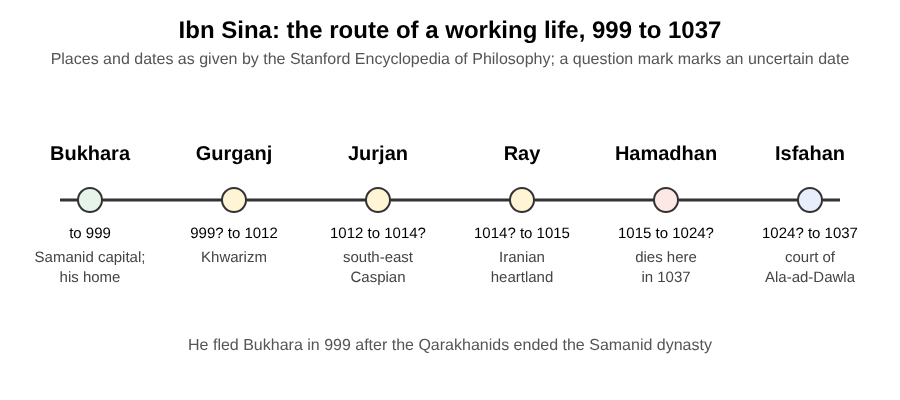
That comfortable life ended in 999, when the Qarakhanids ended the Samanid dynasty and took Bukhara. Ibn Sina, who held a post in the Samanid administration, says only that "necessity led me to forsake Bukhara". He spent the rest of his life moving between courts, as the picture below shows, working as a scientist-in-residence for local rulers. He finished his major work in Isfahan under the Kakuyid ruler Ala-ad-Dawla, died in Hamadhan in 1037 and was buried there. A mausoleum in Hamadhan today purports to be his.
What did Ibn Sina write?
He wrote a great deal, and that raises its own question of what is really his. According to the Stanford entry, medieval bibliographies of his works list close to three hundred titles, but a recent careful count brings the authentic writings down to fewer than one hundred. Works were falsely attributed to him because his name carried so much authority.
His main innovation was the summa philosophiae, a single work covering every part of philosophy as it was then classified. The first came about when a neighbour asked the twenty-one-year-old for a comprehensive work, and he went on to write seven more. The best known are these:
- The Cure (al-Shifa), his monumental work, which runs to twenty-two large volumes in the Cairo edition and which he completed in Isfahan.
- The Salvation, a shorter exposition assembled largely from his earlier writings.
- Philosophy for Ala, written in Persian for his patron.
- Eastern Philosophy, which concentrates on matters about which researchers had disagreed.
- Pointers and Reminders, his last summa, written in an allusive style meant to give students only "pointers and reminders" so that they complete the arguments themselves. It was read with commentaries for centuries.
Two enormous works of about twenty volumes each, a youthful commentary on Aristotle and a later one called Fair Judgment, are lost. He also wrote allegories such as Alive, Son of Awake and The Bird to reach a wider audience, and he put logic and medicine into verse. His medical poem runs to 1,326 lines, and the philosopher Averroes wrote a commentary on it.
The Canon of Medicine and the Prince of Physicians
The Stanford entry is about his philosophy and does not discuss his best-known medical book, so for the Canon of Medicine this post relies on the World History Encyclopedia article. Its author says that for six hundred years the Canon defined medicine "from Europe to India". He reports the claim of historians of science that Ibn Sina gathered the known medical knowledge under one logical structure, with attention to the brain and to environmental and psychiatric conditions, and that he set rules for testing new medicines in clinical trials.
Those are large claims, and the article is careful to call them what scholars have argued. It lists titles of praise: "the Prince of Physicians" and, from "more than one European historian", "the Father of Modern Medicine". Read these as praise from admirers, not as measurements. The article also notes that the official papers documenting his years as a statesman were lost, so every portrait of him rests on partial evidence.
Logic, the senses and the soul
Two subjects drove his philosophy: logic and the theory of the soul. In his logic, all knowledge is either forming a concept through a definition or accepting a statement as true because a syllogism proves it. To prove "A is C" you must find the right middle term B, so that "A is B" and "B is C". Ibn Sina took Aristotle's remark that acumen is a talent for hitting upon the middle term and made that talent the cornerstone of how humans know. He said people differ in how much of it they have, as they differ in any other ability.
His theory of knowledge was also empirical. The human intellect, he held, needs the senses to start. He described five outer senses and five inner senses in the brain: common sense, imagery, imagination, estimation and memory. The Stanford entry stresses that his talk of a "flow" of knowledge from the active intellect has nothing mystical about it. The soul has to prepare and ask for knowledge, and there is no free flow of understanding to what the entry calls "couch-potato" humans. The same logic let him treat inspiration and prophecy as natural functions of the rational soul.
Why Ibn Sina mattered
The entry argues that the summa changed what philosophy could do. For the first time one self-consistent account of reality came with the tools to check it, so it worked as a worldview and not only as a specialist's subject. It dominated intellectual history in both Shi'ite and most Sunni Islam, and it provoked responses in theology, in the tradition of al-Ghazali, and in philosophical mysticism, where Ibn al-Arabi was called "the Greatest Master" to rival Ibn Sina's title "The Preeminent Master".
The World History Encyclopedia article adds a wider claim: that experts on medieval thought argue Thomas Aquinas drew directly on Ibn Sina in his account of creation. It calls him "arguably the most influential philosopher of the pre-modern era", a verdict it attributes to scholars. For the Christian side of that story, see this blog's post on Thomas Aquinas and the Five Ways.
A worked example: test a claim about Ibn Sina
Suppose you read that Ibn Sina "wrote about 450 books". Here is how to check it in four steps:
- Find the claim's source. A figure with no source is only a number.
- Look for how the figure is counted. The Stanford entry says medieval bibliographies list close to three hundred titles, many of them falsely attributed to him.
- Compare the sources. The same entry gives fewer than one hundred authentic writings, from essays of a few pages to multi-volume sets.
- Write the claim at the strength the evidence supports: "Medieval lists attribute close to three hundred titles to him, and a recent count accepts fewer than one hundred."
The same habit works on the stories of his genius. The entry notes that reports of him writing parts of The Cure without books, or a logic treatise in a single night, are "exaggerated and hagiographic" in places, even though they show how thoroughly he had learned his subject.
Frequently asked questions
Is Ibn Sina the same person as Avicenna?
Yes. Medieval Western translators Latinized Ibn Sina as Avicenna, and scholars use both names for the same man.
Was Ibn Sina an Arab?
The World History Encyclopedia article says he was not. He was born in what is now Uzbekistan, and he is known by an Arabic name because he wrote mainly in Arabic, the language of learning in the Muslim world.
What is the Canon of Medicine?
It is Ibn Sina's medical work. The article credits it with shaping medical teaching for six centuries, though that is a scholars' judgment and not a count.
What is The Cure about?
Despite its name, it is a philosophy work, not a medical one. It is his monumental summa, running to twenty-two large volumes in the Cairo edition.
Get started
If you want more than a summary, Ibn Sina sits in the Reformers and Reasoners of Faith course, one of 15 courses made of short lessons. You read, study the diagrams, try a hands-on activity and answer questions. Every lesson lists its sources, and cards set out where researchers disagree, which matters for a thinker whose reputation rests on large, debated claims.
You sign in with your email and an emailed sign-in code. It is a web app, so you can open it in a browser.
Start Learn 100 Influential People: short hands-on lessons on the people who shaped history, with every side of the debate and the sources to read next.
100 people who shaped history, from Moses to the web.
Visit influentialpeople.vlvd.net↗


Comments
No comments yet.
Sign in or make an account to comment.