Thomas Aquinas and the Five Ways: What He Argued
Thomas Aquinas and the Five Ways: what he argued is a question about five short paragraphs. In the Summa Theologiae, the 13th-century friar Thomas Aquinas gave five arguments that start from something ordinary in the world (things that change, causes, things that come and go, degrees of goodness, things that act for an end) and reason back to a God who explains it. Each is only a few lines long, and the Stanford Encyclopedia of Philosophy calls them "much discussed".
If you would rather learn this as a short lesson, Learn 100 Influential People teaches Aquinas in its Reformers and Reasoners of Faith course next to Ibn Sina, Guru Nanak, Martin Luther and John Calvin, in lessons of about 9 minutes with the sources listed. You sign in with your email and an emailed code.
Thomas Aquinas and the Five Ways: what he argued, in short
Aquinas (1225 to 1274) was a Dominican friar who taught theology in Paris. World History Encyclopedia says he sought "to reconcile faith and reason" when others thought that impossible, with Aristotle's help. The Five Ways are his best-known case of it: a claim that natural reason, without help from revelation, can show that God exists.
The Stanford Encyclopedia puts it as Aquinas's belief that "natural reason can demonstratively prove God's existence". The first step is to show that, for everything in the changeable world, there is a first cause, or prime mover. Each of the five ends with a variation on "this is what everyone calls God", a cautious wording, the entry says, because showing a prime mover "falls well short" of showing a being worthy of the name God.
Where the Five Ways sit in the Summa Theologiae
The Summa Theologiae is Aquinas's masterpiece, written between 1267 and 1273 and left unfinished near the end of its third part. In its preface he says it is for "those who are just beginning". The Five Ways are in Part 1, Question 2, Article 3, cited as ST 1a 2.3, under the question "Whether God exists?":
- Two objections. Evil exists, so an infinitely good God cannot; and nature and human will can account for everything we see without God.
- On the contrary. One line from Exodus, "I am Who am".
- I answer that. The Five Ways, then short replies to the two objections.
World History Encyclopedia notes the habit: Aquinas often began with an opposing idea and gave it a fair hearing before answering. The Five Ways are one paragraph inside that structure, not a free-standing essay.
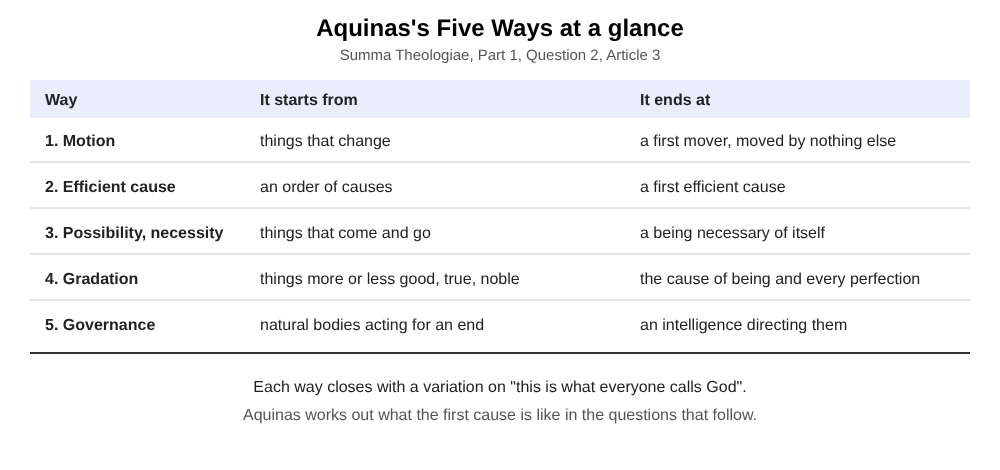
The first three ways: motion, causes and necessity
The first way is the argument from motion. For Aquinas, motion means any change, "the reduction of something from potentiality to actuality". Only something already actual can bring that about: fire, which is actually hot, makes wood, which is potentially hot, actually hot. Nothing can be both mover and moved in the same respect, so whatever moves is moved by another. That chain cannot go on forever, he says, because then there would be no first mover and so no other movers. His picture is a staff that moves a stone only because a hand moves the staff.
The second way has the same shape but is about efficient causes, the things that bring other things about. Nothing is the efficient cause of itself, since it would have to exist before itself. Take away the first cause and the middle ones and the last effect go too, so there is a first efficient cause.
The third way starts from things that "are possible to be and not to be", because they are generated and pass away. If everything were like that, Aquinas argues, then at one time there would have been nothing, and from nothing nothing begins. So something must exist necessarily. Necessary things get their necessity from another or from themselves, and the chain of dependent ones cannot run on forever, so there is a being necessary of itself that gives necessity to others.
The Stanford Encyclopedia calls these three cosmological arguments "based on the impossibility of an infinite series of causes". It adds that commentators generally agree on which series he means. It is an infinite series of simultaneous causes, a "vertical" one, such as hand, staff and stone all acting at once. It is not a "horizontal" series stretching back in time, which Aquinas does not think can be shown to be impossible.
The fourth and fifth ways: degrees and purpose
The fourth way is taken from gradation. Among beings some are more and some less good, true and noble. We say "more" or "less" by comparison with a maximum, as a thing is hotter the nearer it comes to what is hottest. The maximum in a kind causes everything in that kind, as fire, the maximum of heat, causes hot things. So there must be something that causes the being, goodness and every perfection of all things. World History Encyclopedia calls this "another more complicated argument".
The fifth way is taken from the governance of the world. Things without intelligence, such as natural bodies, act for an end, and we see this because they act always or nearly always in the same way to get the best result. What lacks knowledge cannot aim at a goal unless something with knowledge directs it, as the archer directs the arrow. So an intelligent being directs all natural things to their end.
A worked example: turn one way into premises
The best way to understand any of the five is to take it apart. Use the first way and a pencil:
- Write the starting fact. Some things are in motion, meaning they change.
- Write each premise on its own line. Whatever changes is changed by something already actual. Nothing changes itself in the same respect. A series of movers cannot run on forever, or there would be no first mover.
- Write the conclusion. There is a first mover moved by nothing else.
- Mark the kind of series. Ask whether the movers act together now (hand, staff, stone) or one after another in time. Aquinas rules out only the first kind, the Stanford Encyclopedia says.
- Underline the premise you doubt most. That is where your disagreement with Aquinas lives, and it is a better thing to bring to a seminar than "I do not buy it".
- Check the size of the conclusion. A first mover is not yet the God of any religion, and Aquinas goes on to ask what it is like.
What the Five Ways do not prove, and what is debated
The Stanford Encyclopedia says that, for all we have seen so far, the first cause "might itself be a body". Aquinas goes on in Part 1 to argue that it is not a body, and is simple, perfect, the highest good, infinite, unchangeable, eternal and one, with the most perfect knowledge. Right after the Five Ways he remarks that we cannot know what God is, only what God is not. He also thought natural reason has a limit: it cannot establish the Trinity or the incarnation, which he held needed revelation.
Two debates sit around the arguments, and the sources set them out without a verdict:
- Did the world have a beginning? Aristotle and many of his followers thought the world had always existed, and many of Aquinas's contemporaries thought they could prove it began in time. In On the Eternity of the World Aquinas concluded that no demonstrative argument is possible either way, and that a beginning is known by faith.
- Were his ideas accepted? World History Encyclopedia says that after his death the theology faculty at Paris condemned a series of claims that included much of his thinking, and that Archbishop Robert Kilwardby considered some of his views almost heretical. He was canonized in 1323, and in 1879 Pope Leo XIII endorsed Thomistic thought in Aeterni Patris.
For more on the thinkers behind this debate, see the posts on Augustine's Confessions and Plato versus Aristotle.
Frequently asked questions
What are Aquinas's Five Ways?
They are five short arguments for God's existence in the Summa Theologiae, Part 1, Question 2, Article 3. They start from motion, efficient causes, things that can fail to exist, degrees of goodness, and goal-directed behaviour in natural bodies.
Did Aquinas think the universe had a beginning?
Yes, as a matter of faith. The Stanford Encyclopedia says he held that no philosophical argument settles it either way, so the Five Ways do not depend on it.
Why can the chain of causes not go back forever?
Aquinas means a chain where each member acts only because the one before it acts at that same moment. He does not claim to rule out a chain stretching back in time.
Do the Five Ways prove the Christian God?
Not on their own. They aim at a first cause, and Aquinas takes up what it is like in later questions. He held that the Trinity and the incarnation come through revelation.
Get started
Open the Summa's own text for Question 2 and read Article 3 beside this post, a good habit for any primary source; the post on primary and secondary sources shows how. Then write each way as premises and a conclusion, and mark the premise you doubt most.
Learn 100 Influential People offers short hands-on lessons on the people who shaped history, with 272 questions where you choose, put in order, match, sort and estimate a number. Every attempt is graded and you can retake a lesson, and questions from lessons you finish come back as spaced review, up to 5 a day. Every lesson lists its sources, and the about page explains the project.
100 people who shaped history, from Moses to the web.
Visit influentialpeople.vlvd.net↗


Comments
No comments yet.
Sign in or make an account to comment.