Intelligent agent in AI: what it is and why goals matter
An intelligent agent, in AI, is anything that perceives its environment and acts on it to reach a goal. A thermostat counts, and so does a person. Wikipedia's article on intelligent agents says the idea runs through the whole field, and this post walks through it: what an agent is, how its goal is written down, the five classic types and why people who worry about AI keep coming back to the word "goal".
If you like to explore AI ideas as a story, Contain ASI is a story strategy game for 1 to 4 players that runs in your browser, where you try to keep four fictional AI labs from crossing into recursive self-improvement.
What is an intelligent agent?
The article defines an intelligent agent as an entity that perceives its environment, takes actions autonomously to achieve goals, and may improve its performance by acquiring knowledge. Agents can be simple or highly complex. A basic thermostat or control system counts as one. So does a human being, or any other system that meets the same description, such as a firm, a state or a biome.
The article adds that the idea is studied well beyond computer science. It is related to agents in economics, and versions of it appear in cognitive science, ethics and the philosophy of practical reason. Agents are also closely related to software agents, which are autonomous programs that carry out tasks on behalf of users. The economics term for the same thing is a "rational agent".
Percepts, actions and the agent function
The article cites Russell and Norvig, who describe artificial intelligence as the study of agents that receive percepts from an environment and perform actions. An agent senses through sensors and acts through actuators. A percept is the agent's sensory input at one moment. For a self-driving car, the article lists camera images, lidar data, GPS coordinates and speed readings.
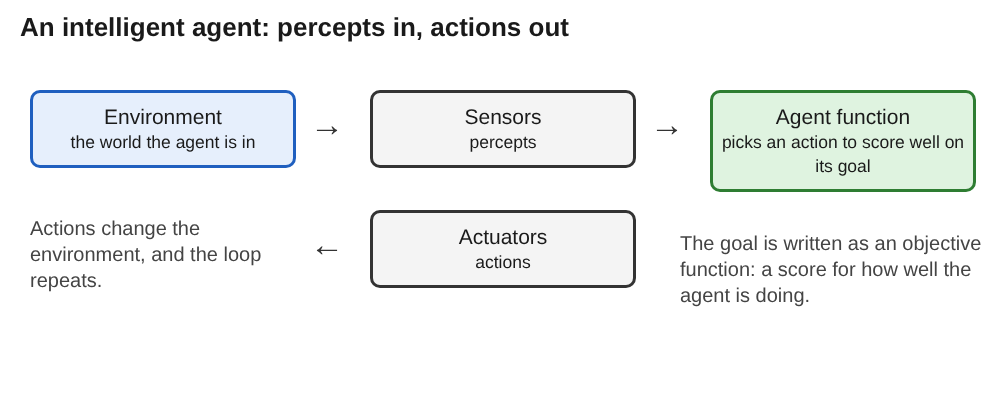
The agent's behavior can be described by an agent function. It maps the agent's entire history of percepts to an action. The article is careful to separate this from the agent program, which is the concrete code that carries out the function. The function is the theory; the program is what runs.
Rationality has a precise meaning here. A rational agent picks the action expected to maximize its performance measure, given what it has perceived, what it already knows and what it can do. The article stresses that this does not require being all-knowing or always successful. It is about the expected result of an action on the information the agent has.
How a goal becomes an objective function
An agent needs a way to tell whether it is doing well. The article calls this the objective function, also called a goal function. An agent is judged more intelligent the more consistently it picks actions that score well on it. The objective function can be simple, such as 1 for a win and 0 for a loss in a game of Go. It can be complex, such as a self-driving car's, which has to balance safety, speed and passenger comfort.
Different fields use different names for the same job:
- Utility function in economics and decision theory, for how desirable a state is.
- Loss function in machine learning, where the aim is to make error small.
- Reward function in reinforcement learning, where an agent learns to maximize its total reward.
- Fitness function in evolutionary systems, where it decides which agents are more likely to reproduce.
Goals can be written out directly by a programmer, or induced, meaning learned or evolved over time. The article also mentions reward shaping: instead of rewarding only the final benchmark score, programmers give the machine rewards for small steps of progress along the way.
The five classic types of agent
Russell and Norvig (2003), as the article reports, sort agents into five classes by how capable they are:
- Simple reflex agents act only on the current percept, with a rule of the form "if this, then that". A home thermostat that switches when the temperature drops is the article's example. They work well only when the environment is fully observable.
- Model-based reflex agents keep an internal model of how the world works, so they can cope when part of it is hidden.
- Goal-based agents add information about which situations are desirable, and choose actions that reach a goal state. Search and planning are the parts of AI built for this.
- Utility-based agents go further than "goal reached or not". A utility function scores how good each state is, and the agent picks the action with the best expected utility.
- Learning agents start in unknown environments and improve. They have a learning element that gets feedback from a critic, a performance element that acts, and a problem generator that suggests new experiences to try.
The article also gives a second sorting by Weiss (2013): logic-based agents, reactive agents, belief-desire-intention agents and layered architectures. In practice, it notes, a real agent is often built as a hierarchy, with sub-agents handling low-level, fast jobs and higher layers doing slower, deliberate reasoning.
A worked example: the objective function of a thermostat and a car
Try this as a ten-minute exercise. Take two agents from the article and write down what each one perceives, what it can do and what it is scoring itself on.
- For the thermostat, write one percept (room temperature), two actions (heat on, heat off) and one rule. You have just written a complete simple reflex agent.
- For the self-driving car, list five percepts and three actions, then write its objective function as a sentence: "get the passenger there while balancing safety, speed and comfort".
- Now pick one of those three goals and imagine the score counted only that. A car scored only on speed behaves very differently from the same car scored on all three.
- Write down who decided how to weigh the three, and where that choice lives in the system.
The last step is the point. The thermostat's goal is obvious, but the car's goal is a set of trade-offs that someone had to choose. That is where designers' choices enter an agent, and where they can go wrong.
Where this meets AI risk
The Wikipedia article is about the engineering idea, not about danger, and it makes no claim about how risky any system is. But the idea explains why safety researchers talk so much about goals. If an agent does whatever scores best on its objective function, then everything depends on whether the function captures what its builders meant.
The article offers a hint of how hard that is. It notes that even systems not usually called agents, such as question-answering programs, can be described as agents with a goal such as answering accurately. It also notes that the mathematical model AIXI was proposed as a maximally intelligent agent but is uncomputable, so real agents are held back by finite time and hardware.
For the related thought experiments, see our posts on the paperclip maximizer, the orthogonality thesis and instrumental convergence. Each one asks what happens when a capable agent pursues a goal that was written down imperfectly.
What about "AI agents" and agentic AI?
The article has a section on a newer use of the word. In the setting of generative AI, it says, AI agents, also called compound AI systems, are a kind of intelligent agent that can operate autonomously in complex environments. Their listed attributes include complex goal structures, natural language interfaces, acting independently of user supervision, and using software tools or planning systems. Memory of earlier interactions is part of the picture too.
It also says researchers and commentators have noted that AI agents have no standard definition. So when you read the phrase, check which meaning the writer has in mind: the classic textbook one, or this narrower, newer one.
Frequently asked questions
What is an intelligent agent in simple words?
It is something that senses its surroundings and acts on them to reach a goal. The article says a thermostat qualifies, and so does a person.
What is an objective function?
It is the score that tells an agent how well it is doing, and so what its goal is. Depending on the field it is also called a utility, loss, reward or fitness function.
What are the five types of intelligent agents?
Simple reflex, model-based reflex, goal-based, utility-based and learning agents, in Russell and Norvig's classification as reported by Wikipedia.
Is an intelligent agent the same as agentic AI?
Not exactly. Agentic AI is a newer, narrower kind of intelligent agent, and the article notes there is no standard definition of it.
Get started
If you would like to explore AI risk as fiction after the theory, play Contain ASI: a story strategy game for 1 to 4 players that runs in your browser and needs WebGL 2. Chapter 1, Before ASI, starts in January 2024 with four fictional AI labs in one race, and you try to keep every lab from crossing into recursive self-improvement before 2027. All its labs, people and events are fictional, and it is inspired by the AI 2027 scenario. It is a game, not a forecast.

For the source, read Wikipedia's article on the intelligent agent.
Comments
No comments yet.
Sign in or make an account to comment.