Is dictation faster than typing? What the studies measured
Is dictation faster than typing? For getting words onto the page, yes: in a 2016 laboratory test, speech recognition took down English at 153 words a minute against 52 on a phone keyboard. For composing something new, much less so, because a 1978 study found that planning takes about two-thirds of composing time whether you write or dictate. If you want to try it on fiction, Cheap Recorder's blog post dictate a novel chapter out loud, then edit the transcript shows one chapter spoken from a beat list and edited from its transcript, and it is careful to promise nothing about speed.
Cheap Recorder records your voice in Google Chrome and saves a transcript with the time of each line beside the sound file, so you can measure your own speaking and editing speed with the test further down.
Is dictation faster than typing for getting words down?
Yes, and by a wide margin. Sherry Ruan, Jacob Wobbrock, Kenny Liou, Andrew Ng and James Landay compared speech and keyboard entry on an iPhone 6 Plus in 2016, using Baidu's Deep Speech 2 recognizer. In English, speech was 2.93 times faster: 153 words a minute against 52.
Read the conditions before you repeat that number. The people in the study were copying short messages they were given. They were not deciding what to say. And the keyboard was a phone's touch keyboard, not a full one under ten fingers. The result tells you how fast words can travel from a head to a screen once the words exist. It does not tell you how fast a page of your own gets written.
Why composing does not speed up as much
The older study measured the thing the newer one left out. In 1978 J. D. Gould and S. J. Boies reported in Science on people writing, dictating and speaking letters. Three findings matter here.
- Novices learned in a few hours to dictate with the speed and quality with which they wrote.
- Dictators with years of experience were only 0 to 25 percent faster than those novices, depending on how complex the letter was.
- Planning took about two-thirds of composing time, whatever the method.
The third finding explains the second. If two-thirds of your time goes on deciding what to say, a faster mouth can only shrink the last third. This is the distinction people most often get wrong: entry speed and composing speed are different measurements, and the famous "three times faster" belongs to the first.
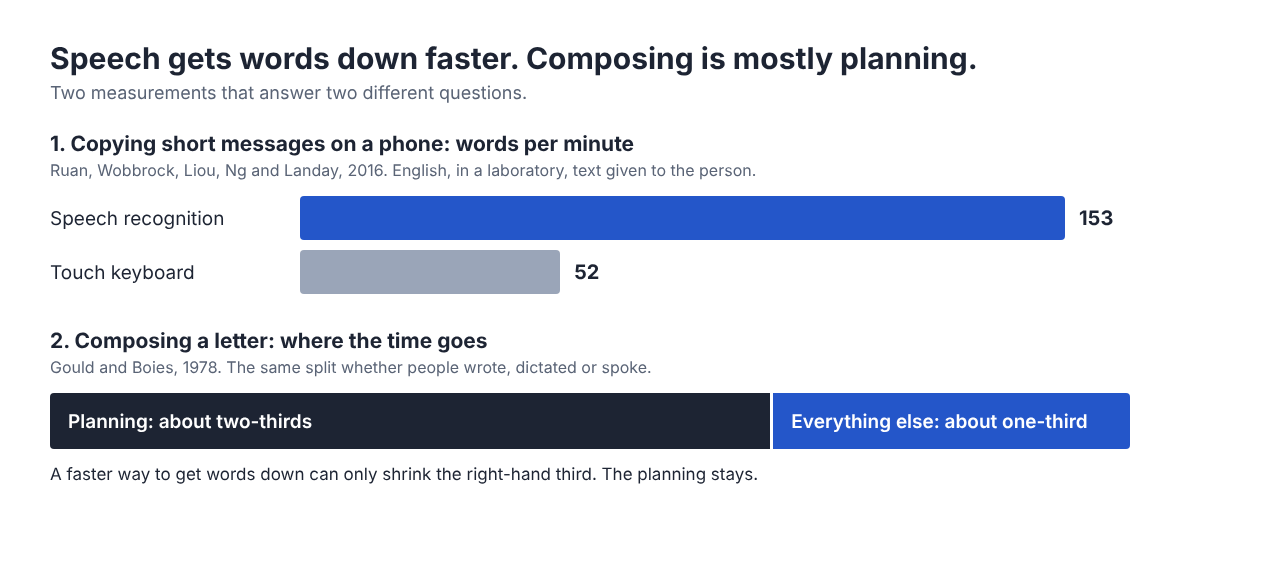
Two measurements, two questions. Speech wins on entry; planning takes most of the time either way.
Gould and Boies found one more thing worth keeping: the novices did not think they had performed as well as they had. Dictation feels worse than it is at first, so one bad session proves little.
What dictation did to Henry James's sentences
Speed is not the only thing that changes. Theodora Bosanquet began typing at Henry James's dictation in the autumn of 1907 and described it in Henry James at Work. He had started dictating in the 1890s, and by 1907, she writes, his style had become "more and more like free, involved, unanswered talk."
James knew the cost. "I know," he told her, "that I'm too diffuse when I'm dictating." He also knew the gain: "It all seems to be so much more effectively and unceasingly pulled out of me in speech than in writing."
So he split his work by method. Novels were dictated. Plays and short stories, which had to stay short, were written by hand, because the labour of the pen was "his best aid to a desired brevity." When Harper's asked for a story of about 5,000 words, tale after tale outgrew the limit, and the one finally printed, "Crapy Cornelia," had to run in two parts.
The strongest objection: the time comes back in the edit
The case against dictation is that it moves work, not removes it. Both sources above support it. In the 2016 test, speech made fewer errors during entry (5.30 percent against 11.22 percent) but left slightly more in the final text: 1.30 percent against 0.79 percent. Those are the errors nobody caught. And James's "too diffuse" is the other half: spoken drafts run long, and cutting is slow.
A transcript also arrives without the things fiction needs. The blog post says plainly that no page promises the transcript adds punctuation or acts on spoken words like "new paragraph", so sentence breaks, paragraphs and quotation marks are yours to add.
A 20-minute test of your own numbers
You can measure all three of your speeds in one sitting. The recorder writes the time of each line into the transcript, which does the timing for you.
- Set up for sound only. Choose a folder, switch off Record my webcam and do not pick a screen. The recording is then an M4A audio file. Check that Live transcript is ticked under Options and that the language beside it is right, because the menu resets each time the page opens.
- Speak one planned scene for five minutes. Work from four or five written beats so you are composing, not reading. Pause when you need to think; the pauses are part of what you are measuring.
- Count. Open the file ending in
- transcript.txtfrom the recording's folder in a text editor. The last line's time is your duration. The word count, divided by the minutes, is your spoken rate. - Type a different planned scene for five minutes and count those words the same way.
- Edit both to the same standard and time each edit.
Here is the arithmetic with made-up but plausible results. You speak 600 words in five minutes and type 200. Cleaning the spoken 600 takes 12 minutes; cleaning the typed 200 takes 2. Spoken: 600 words in 17 minutes, about 35 finished words a minute. Typed: 200 words in 7 minutes, about 29. Dictation wins, but by about a quarter, not by three times. That sits inside the 0 to 25 percent Gould and Boies reported for experienced dictators. If your spoken edit took 20 minutes instead, typing would win.
The guide on where recordings are saved shows which files land in the folder. For a longer look at the sound-only setup, see voice memo to text on a PC.
What is still unsettled
Neither study settles the question for a writer today. The 1978 one used business letters and the equipment of its time. The 2016 one copied short messages, and its authors say further study is needed outside the laboratory. Neither timed long prose composed aloud with a modern recognizer and then edited to a publishable standard. Until someone does, your own 20-minute test is better evidence than either.
Know the limits of the tool as well. While Live transcript is on, Chrome sends your microphone audio to Google to turn it into text, and it needs a connection; the recording itself stays in your folder. Chrome gives a time for each line, not each word. And the transcript is made from what your microphone hears, so a headset close to your mouth leaves less to fix than a laptop's built-in one in a noisy room.
Frequently asked questions
How many words a minute is dictation?
In the 2016 phone study, English speech entry averaged 153 words a minute when people copied short messages. Composing your own text is slower, because you pause to plan. Measure yours with a five-minute recording.
Does dictation take long to learn?
Less than people assume. Gould and Boies found novices dictating letters as fast and as well as they wrote after a few hours, though the novices themselves did not believe it.
Does dictating change how the writing sounds?
It can. Henry James called himself "too diffuse" when dictating, and his secretary heard his style grow more like talk. Expect a longer, looser draft and plan to cut.
Will the recorder stop the transcript if I pause to think?
No. If Chrome's speech recognition stops listening during a long silence, the recorder starts it again for as long as you are still recording.
Get started
Run the test once before you commit a whole book to either method. The Free plan includes recording and the live transcript, with 12 hours of recording a month. Then follow dictate a novel chapter out loud, then edit the transcript for a full chapter.
The free plan needs no card. Try Cheap Recorder in Chrome, and your recordings stay on your own disk.
Screen recording that is cheap and easy.
Visit cheaprecorder.com↗

Comments
No comments yet.